 Yijia Overseas
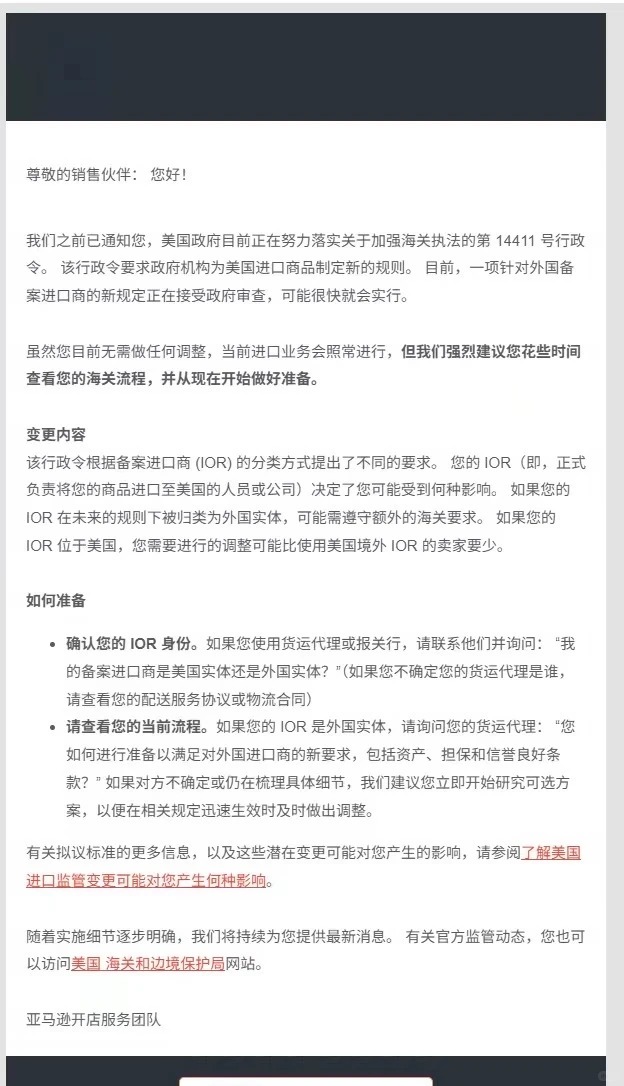
The U.S. government is developing new import rules under EO 14411. In the future, compliance requirements will differ depending on whether your Importer of Record (IOR) is a “U.S. entity” or a “foreign entity.”
Amazon reminds sellers to check their IOR status for U.S. imports in advance. New rules for foreign IORs are under government review and may add customs compliance requirements. Amazon recommends confirming your IOR status with your freight forwarder or customs broker now and preparing early.
1. What is an IOR?
IOR stands for Importer of Record, also called the importer. It is the individual or business that assumes importer responsibility in U.S. customs import declarations, ensuring goods are imported lawfully and bearing declaration, tax, and compliance obligations.
Key IOR responsibilities include making accurate import declarations; paying duties, taxes, and fees; ensuring goods meet U.S. customs and regulatory requirements; and arranging the required customs bond.
Note that the IOR is not necessarily the actual shipper or final consignee. A freight forwarder or broker may handle clearance, but acting as a broker does not automatically make it the IOR. For Amazon FBA sellers, Amazon and its fulfillment centers will not act as the IOR for FBA goods, so sellers must arrange a qualified importer and complete clearance in advance.
2. What is the difference between a U.S. IOR and a foreign IOR?
The key issue is not simply whether you have a U.S. company, but how U.S. Customs will classify the IOR and set compliance requirements accordingly.
U.S. IOR: an importer meeting U.S. importer qualification criteria. If your own U.S. company acts as IOR, verify that it actually assumes importer responsibility, its registration information is accurate, and it meets relevant requirements. A U.S. company registration, EIN, or bank account does not automatically qualify it under future rules.
Foreign IOR: a qualified foreign party, also called a non-resident IOR, that does not fall within the U.S. IOR category. Traditional arrangements usually involve CBP Form 5106 registration, a customs bond, importer identity and contact information, a valid POA when using a broker, and other required import documents.
Possible changes under EO 14411:
First, asset and bond requirements: the IOR may need to maintain specified U.S. tangible assets, a customs bond, or a combination; minimum bond coverage may change.
Second, importer information disclosure: authorities may require estimated import volume, company founding year, ownership and beneficial ownership, affiliated entities, and domestic assets.
Third, foreign IOR declaration methods: the order seeks to restrict foreign IORs’ use of informal entry procedures, which may change operations and costs.
Fourth, importer identity verification: CBP has strengthened review of IOR registration. Business address, contact information, importer number, and authorization relationships must be true, accurate, and match the actual importer.
3. When filling in the Amazon IOR, should you choose U.S. or foreign?
Core principle: fill in according to the party that actually assumes import responsibility and its true identity. Do not casually choose a U.S. IOR just to avoid potential new rules.
Scenario 1: You have a U.S. company and plan to act as your own IOR. Verify that the company actually appears as the importer in customs records and will meet the future U.S. IOR definition. Do not choose U.S. IOR based only on a registration certificate or EIN; a U.S. company wholly owned by Chinese shareholders especially needs to verify beneficial ownership and other conditions.
Scenario 2: A freight forwarder or customs broker arranges the import. Ask who the actual IOR is. If a third party acts as IOR, confirm its legal name, importer number, bond arrangement, and responsibility division. Do not rely only on “tax-inclusive” or “double clearance” wording.
Scenario 3: A Chinese company or individual is used as the IOR. Verify its foreign IOR status truthfully and ask the freight forwarder about asset, bond, and declaration arrangements under future rules. You do not need to change immediately, but confirm whether the current plan can be adjusted.
4. What if there is no IOR, or the freight forwarder cannot provide one?
If you have no IOR, or the freight forwarder only offers tax-inclusive clearance without clearly identifying the importer, follow these steps.
Step 1: Confirm in whose name the goods are imported. Ask the freight forwarder for the applicable CBP Form 7501, the IOR’s full legal name and importer number, clearance and duty payment records, and the bond provider, type, and coverage. If a third party acts as IOR, confirm that it actually assumes responsibility, not just that the quote says “tax-inclusive.”
Step 2: If there is no IOR, establish import arrangements through proper channels.
Option A: Let your own enterprise act as IOR. Based on your business structure, evaluate whether a U.S. company or a qualified foreign enterprise can act as IOR, and complete importer registration, customs number, and bond procedures.
Option B: Entrust a professional service provider. Contact a qualified customs broker or freight forwarder and confirm whether it provides broker services only, or whether it or another identified third party actually acts as IOR. Clarify entity identity, fees, bond, and responsibility division before signing. Appointing a broker does not mean you can ignore importer responsibility; Amazon will not act as importer.
Step 3: Evaluate bond and future adjustment costs in advance. If future rules raise bond amounts, change bond types, or add foreign IOR qualification conditions, reassess your clearance plan. Verify that the existing bond matches the actual IOR entity and coverage will meet future requirements; confirm whether changing the IOR requires resubmitting documents and whether it affects clearance, transit time, and FBA inbound plans. Do not wait until goods are shipped and clearance is blocked before finding a new IOR.
Final note:
Sellers should confirm the real IOR identity, importer number, and clearance records. Do not rely only on a freight forwarder’s verbal promise. Do not wait until clearance, bond, or platform review problems appear before adjusting. Check the import entity, company structure, and declaration information in advance to better respond to U.S. customs changes.
The above is shared by Yiju Overseas. Feel free to comment and discuss.