
 Yijia Overseas
1. Amazon New Sellers Plummet by 44% in 2025
In 2025, the number of new sellers on Amazon dropped to its lowest level in a decade.
According to a report by Marketplace Pulse, in the past year, only 165,000 new sellers were added globally, a 44% decrease from 2024, marking the lowest level since statistics began in 2015.
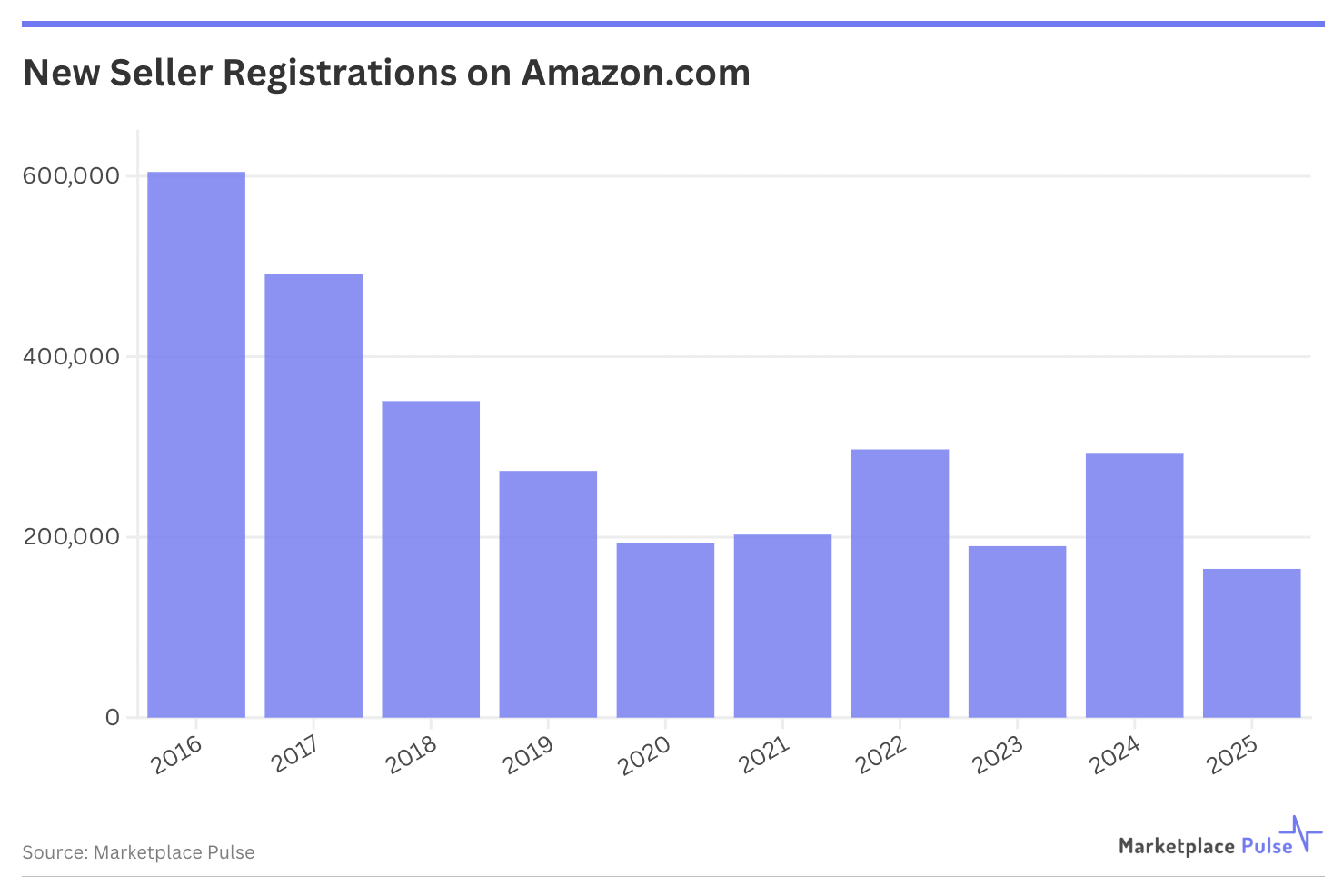
Why is this happening? Because all the factors squeezing profit margins are occurring simultaneously.
First, tariffs are compressing profit margins
Costs are rising, but prices are hard to increase accordingly, especially for local small and medium-sized sellers, who have almost no buffer space.
Second, AI has raised the competition threshold
Product selection, advertising, and operations are all data-driven, resulting in: the tools themselves are fair, but the advantages increasingly favor those with mature supply chains.
Third, advertising has shifted from a "plus" to a "survival necessity"
Without advertising, there's basically no traffic; but with advertising, profits are continuously eroded.
Fourth, platform fees continue to rise
Now, 60% of Amazon's revenue comes from service fees, with only 40% from its own retail sales.
The platform's logic is clear: sellers must continuously pay for efficiency, exposure, and compliance.
Interestingly, although the number of sellers has decreased, the money hasn't.
In 2025, Amazon's third-party GMV continued to grow: the U.S. market reached $305 billion, and the global market $575 billion. More strikingly, the average traffic of active sellers increased by 31%.
Sellers with annual sales exceeding $1 million increased from 60,000 in 2021 to over 100,000 now.
What does this indicate? The cake is still getting bigger, but there are fewer people sharing it, and they are more professional.
Looking at the structural changes in new sellers:
Chinese sellers still dominate, accounting for 59.9% of new registered sellers, but this is a 2.4 percentage point decrease from 2024, the first decline in four years, possibly due to stricter domestic tax declaration requirements. Even so, the supply chain and operational advantages of Chinese sellers have not been shaken.
In contrast, U.S. sellers now account for only 16.3% of new registrations, not only lower than in 2024 but also continuing a long-term decline since 2016 when it was 70.8%.
II. Compliance is Accelerating "Shuffling" in 2025
Many sellers recently shared a common feeling: the platform's requirements for data, taxes, and entities have become stricter.
Amazon has already completed its first quarterly report for July to September 2025, which includes sellers' identity information, transaction volume, income, as well as commission and service fee data.
During this period, many sellers received the platform's reissued tax-related data report for July to September. Essentially, this is a reminder to check the data promptly, take differences seriously, and make compliance adjustments in advance.
As a result, more and more cross-border sellers are rethinking their account structures. Using overseas companies to directly operate local accounts, in addition to using Hong Kong companies, is becoming a new trend.
The advantages of local accounts over cross-border accounts are becoming more pronounced:
1. Higher platform trust level: Local sellers have higher approval rates and more stable exposure
2. Broader sales permissions: Can operate more high-profit or special categories, such as jewelry, pesticides, seeds, etc.
3. More reliable brand image: Local companies, local bank accounts, local invoices, consumers and platforms have significantly higher trust.
4. More flexible tax structure: Some countries (such as Cyprus) have a corporate income tax of about 12.5%, which is a reasonable layout to reduce costs on the premise of legality and compliance, laying the foundation for long-term branding.
Finally:
Amazon is no longer a place where "anyone can casually try a side hustle." It is transitioning from an entry-level platform for small and medium sellers to a business ecosystem that relies more on capital, teams, and systematic operations.
Advance planning for local stores and operating legally and compliantly will enable steady progress in the new round of industry reshuffling.
That's all for the content risk brought to you by Yiju Overseas. Feel free to leave a comment and discuss!