 Yijia Overseas
The Hong Kong "Tax (Amendment) Automatic Exchange of Information Ordinance Bill 2026" (referred to as "CRS 2.0") was officially gazetted on March 27, submitted for its first reading to the Legislative Council on April 1, and will come into effect on January 1, 2027. There will be subsequent requirements in 2028 and 2029. Sellers with overseas assets and Hong Kong identities really need to take it seriously!
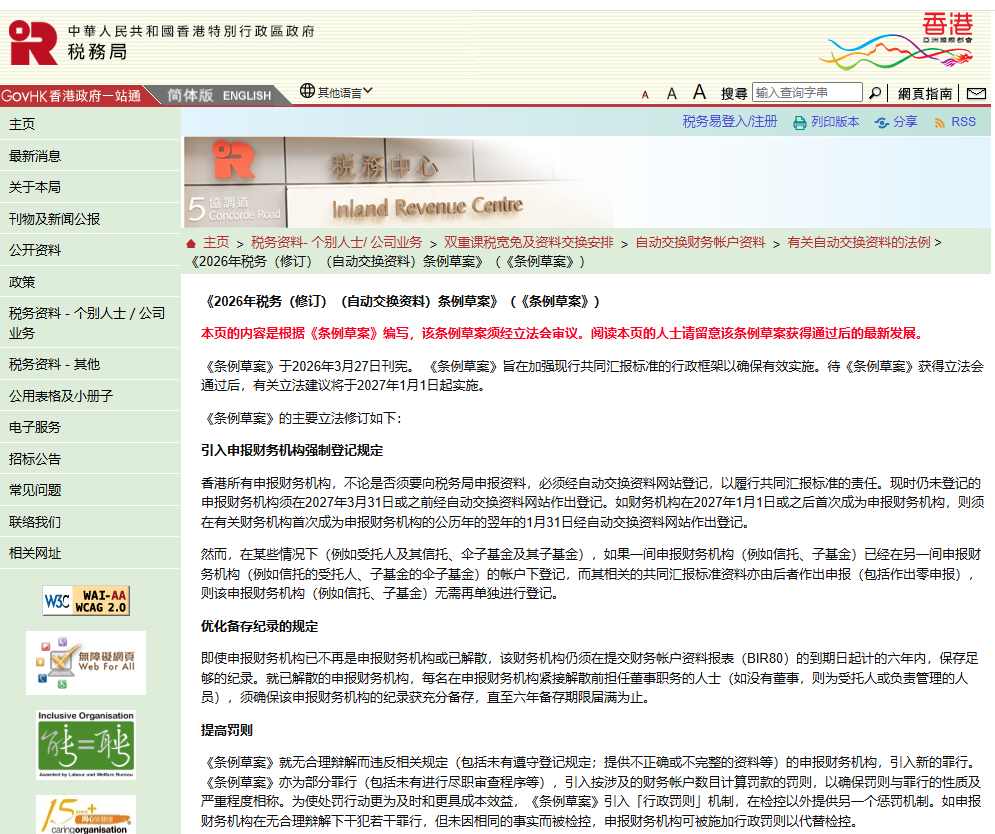
Core Changes in Hong Kong CRS 2.0
It has been upgraded from "being able to see the account" to "seeing through the structure + clarifying the source of assets", mainly with four changes:
1. Comprehensive expansion of asset scope
In the past, CRS only covered bank deposits, stocks/funds, and insurance. Now, new additions include encrypted assets (BTC, ETH, NFT, etc.), stablecoins/digital currencies, central bank digital currencies (CBDC), and encrypted derivatives. The tax avoidance blind spot of digital assets has been completely plugged.
2. Tax resident declaration: Cannot choose one to report
In the past, many people operated dual identities, such as mainland + Hong Kong, and only chose one to declare. Now, all tax resident places must be declared, and information will be sent synchronously to all countries/regions. Information is no longer "selectively disclosed" but "fully shared".
3. Penetrating supervision
Financial institutions need to report the actual controller (UBO), account type (individual/joint), account opening time, and investment structure relationship. In the past, it was about "accounts", now it's about "people + structure + capital path", and offshore structures (BVI/Cayman/multi-layer companies) are identified through penetration.
4. Compliance requirements upgraded
All financial institutions must register with the CRS system, keep data for 6 years, introduce administrative penalties + higher fines, which means not only deeper inspections but also heavier penalties.
II. Policy Implementation Timeline
2026.03.27: The ordinance was gazetted;
2026.04.01: First reading in the Legislative Council;
2027.01.01: The ordinance officially comes into effect;
2028: Crypto asset declaration (CARF) goes online;
2029: Implement comprehensive information exchange requirements of CRS 2.0.
III. The Real Impact on Cross-border Sellers
1. "Completely transparent" capital chain
Cross-border sellers commonly use Hong Kong companies to collect payments, overseas accounts (Payoneer/ WorldFirst, etc.), and then flow back to the domestic or allocation. After CRS 2.0, account information will be sent back to the tax resident place, and the capital flow can be linked. The risk is that inconsistent income and tax reporting are identified.
2. Hong Kong company ≠ tax avoidance tool
Many sellers use Hong Kong companies to reduce tax burdens or do profit sedimentation, but under the new regulations, the actual controller must be disclosed, and offshore structures will be penetrated, resulting in personal tax liabilities being locked in.
3. All multi-platform collections are included in supervision
It involves payment tools such as Amazon, Shopify, independent websites, Stripe, and PayPal, digital wallets/virtual assets. All may enter the scope of information exchange, and the play of diversifying accounts to avoid risks is invalid.
4. High-profit sellers have the greatest risk
For those whose profits have not been returned to the country for a long time, whose profits have not been fully declared, and who use multi-layer company structures, under CRS 2.0, the probability of passive compliance has greatly increased.
Finally:
Hong Kong CRS 2.0 starts from the legislation in 2026, officially takes effect in 2027, and fully exchanges information in 2028 and 2029. Global tax transparency is an established trend. What we should do now is not to wait and see, but to arrange compliance in advance.
That's all for the content sharing brought to you by Yiju Overseas. Feel free to leave a message and discuss in the comments section at any time!