 Cross-border information
As we enter 2026, Amazon's global compliance requirements have reached new heights.
1
Amazon strictly investigates customized Vine reviews
Recently, a large number of Amazon sellers reported that their product Vine reviews were wiped out overnight.
"My customized Vine reviews from last month were all removed on Saturday."
"Even though I didn't customize Vine reviews, they were still deleted."
And some sellers revealed that Amazon will impose centralized penalties on customized Vine reviews in May.
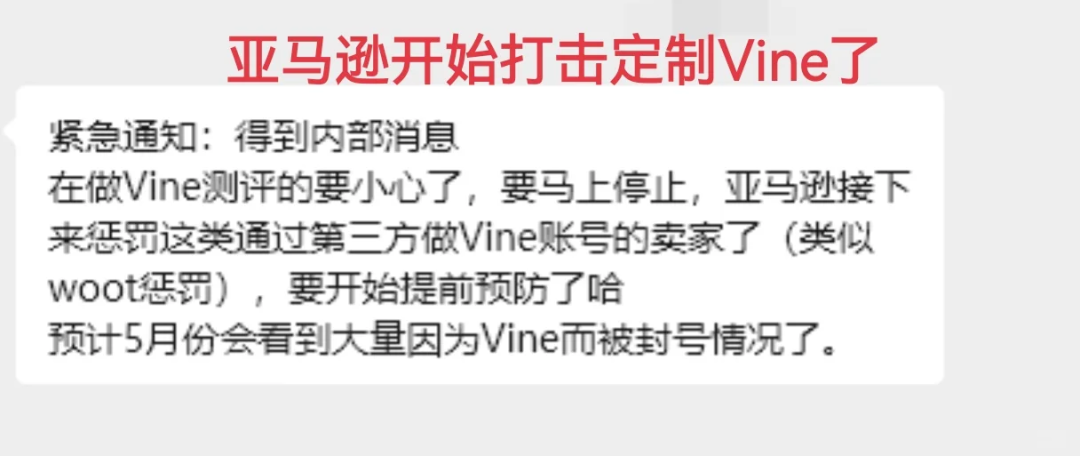
Image source: Seller disclosure
What are customized Vine reviews? Although the Vine program itself is an official Amazon project, customization artificially intervenes in the objectivity and authenticity of reviews. Service providers control buyers with Vine qualifications, arrange for these specific buyers to receive products, and finally leave positive reviews. Essentially, it is a form of brushing orders under the guise of official policy.
However, news of Amazon's crackdown on the customized Vine program comes only from disclosures by relevant parties, and the actual situation is unknown. Regardless of the truth, sellers should not gamble with the health of their accounts, and some sellers' customized Vines have already been cleared, so sellers should not entertain this idea.
In fact, the news of the cleanup is not unfounded. Recently, Amazon has cracked down on Woot's violation of brushing orders, with more than 800 brands being cleared and a large number of seller accounts being banned directly. This cleanup of customized Vine reviews also completely copies Woot's strict crackdown logic. Amazon's AI will precisely lock in customized Vine reviews, which generally exhibit phenomena such as concentrated reviews by the same batch of Vine accounts, highly homogenized review content, and abnormal tester account behavior. Once identified as a violation of customized Vine, the platform will ban the store on the grounds of operation, with brand joint liability, frozen funds, and no way to appeal, consistent with the punishment intensity of Woot's crackdown.
So sellers who have not yet been investigated should immediately self-inspect their stores to eliminate compliance risks:
Check all ASIN's Vine reviews, investigate abnormal accounts and homogenized reviews, and cut off all associations with third-party service providers;
Sort out variant structures, immediately split non-compliant merged parent ASINs to avoid joint punishment due to variant violations;
Verify the number of Vine reviews to ensure compliance with new regulations.
Amazon has always been the strictest in controlling violations. From the recent Woot brushing incident to this special crackdown on customized Vines, it is all about completely eradicating the gray play of manipulating reviews.
2
Amazon spot checks categories requiring TIC review
2026 can be said to be Amazon's compliance year. Amazon gave sellers a warning with the example of more than 800 accounts, and Amazon's compliance measures go far beyond that. It is reported that Amazon will strengthen the random spot check mechanism for product categories that have passed TIC review. Now, even if your product ASIN has passed TIC verification, the platform may still conduct random spot checks. So even if the product has passed the test, it is not all smooth sailing, but has entered a continuous supervision stage.
TIC direct verification system has been fully implemented on Amazon since September 2025, requiring specific category products to complete compliance verification through third-party organizations recognized by the platform, and the results are directly uploaded to the Amazon system by the organization, and sellers cannot modify or replace the report by themselves. The targets of this spot check will be purchased directly from the warehouse or sales channels by Amazon, rather than sent by the seller:
Warehouse purchase: Extract inventory goods directly from the FBA warehouse as test samples
Sales channel purchase: Place orders through the platform's normal purchase process to obtain products actually sold by the seller
Anonymity: The entire purchase process is not disclosed to the seller to ensure the authenticity and representativeness of the sample
These samples will be sent to a recognized TIC organization for testing, focusing on the consistency between the product and the original verification report, and whether it meets the latest safety regulations. If the structure does not match, the product will be downgraded for rectification and retested; in severe cases, the account will be banned and funds frozen.
Sellers with TIC-certified products in their stores must pay attention to establishing a sound compliance system to ensure that every link from product design, production to sales meets safety standards. Now doing Amazon, compliance is not only for review, but also the bottom line of product safety. Sellers need to ensure compliance at the supply chain end to ensure that all parts of the product are traceable.
Source: Min Ge Cross-border Journal