
 Xiyou Logistics
When we examine the global furniture industry map in 2026, an unavoidable fact emerges: the United States, with a market size of $120.93 billion, occupies nearly 46% of the global share. This is not just a numerical advantage, but also a manifestation of structural power.
This article will reveal the operating mechanisms behind this huge market by dissecting the "Furniture Going Global Analysis Report" by Xiyu Going Overseas.

Market Structure: Scale Paradox and Structural Opportunities
The global furniture market presents a distinct "one superpower, multiple strong" structure. The size of the US market is 1.6 times that of the European market and 36 times that of Southeast Asia. This concentration is particularly prominent in the highly fragmented furniture industry, which means that entering the US market is essentially entering the core arena of the global furniture industry.
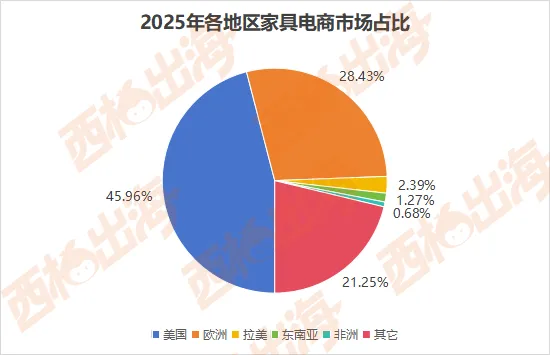
However, the data reveals an interesting paradox: the annual growth rate of the US furniture e-commerce market in 2025 is only 6.89%, ranking second to last among the five major markets. Does this mean that the window of opportunity is closing? Not necessarily. The slowdown in growth is more a result of the base effect; maintaining double-digit growth when the volume reaches $120.9 billion is unrealistic. The real opportunity lies not in the overall growth rate, but in the dividends brought by structural adjustments.
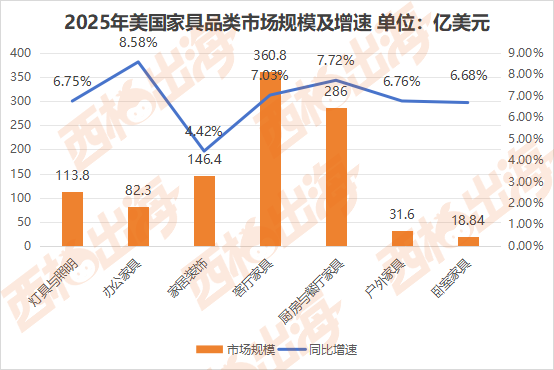
The data at the category level confirms this point. Living room furniture ($36.08 billion) and kitchen and dining furniture ($28.6 billion) together occupy half of the market, reflecting the continuous investment of American families in "public spaces." However, more insightful is that office furniture leads with a growth rate of 8.58%, far exceeding the average. This is not a short-term fluctuation, but a structural demand reshaping brought about by the normalization of remote work.
Consumer Profile: Demographic Changes and Payment Willingness
The demographic structure is often the underlying code for understanding the consumer market. Among the 347 million people in the United States, the group over 55 years old accounts for 30%, about 106 million people. Traditionally, aging is seen as a burden on the consumer market, but in the field of furniture, this is precisely an opportunity. The elderly group has a higher homeownership rate and more stable financial status; they are the core customer group for furniture renewal and upgrading.
Platform Data: Strategic Insights from Amazon TOP30
E-commerce platforms are the best window to observe market behavior. In the Amazon US site's TOP30 sales list for December 2025, mattresses occupied 6 seats, and gaming chairs occupied 3 seats. This distribution is not accidental but the result of the combined effects of category characteristics and platform rules.
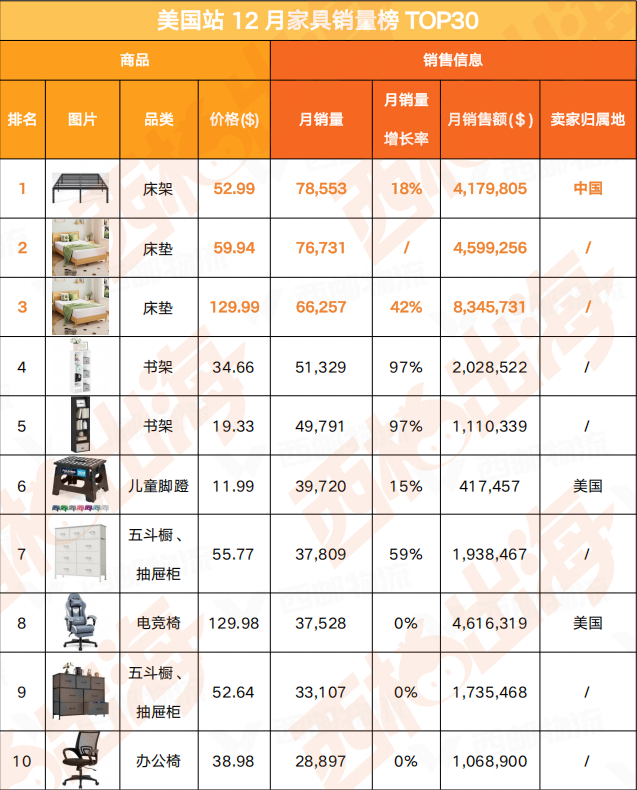
The rise of gaming chairs represents another trend: functional, scenario-based subcategories are reshaping the market structure. The average price of $116.65 for gaming chairs entering the TOP30 indicates that consumers are willing to pay a premium for experiences in specific scenarios.
Strategic Thinking: Finding Growth Space in a Mature Market
The opportunity in the US furniture market lies not in the overall growth rate but in structural adjustments. Silver hair economy, remote work, consumption upgrade, channel migration, each trend corresponds to new growth points. But the key to success lies in whether a sustainable competitive advantage can be established on the right track.

Data does not lie, but data itself is just raw material. The real value lies in whether you can read trends from the data, read opportunities from the trends, and read strategies from the opportunities. This is precisely the core insight that Xiyu Going Overseas' "Furniture Going Global Analysis Report" tries to convey.