 Yamasen Cross-border
The new regulations of the German Battery Act (BattG/BattDG) have been fully implemented. Starting from January 1, 2026, Germany has completely adopted the officially recognized "Organisation für Herstellerverantwortung" (OfH) system, replacing the old recycling model. This means that all battery-containing products sold to the German market must fulfill their environmental recycling obligations and pay relevant fees through the OfH system.
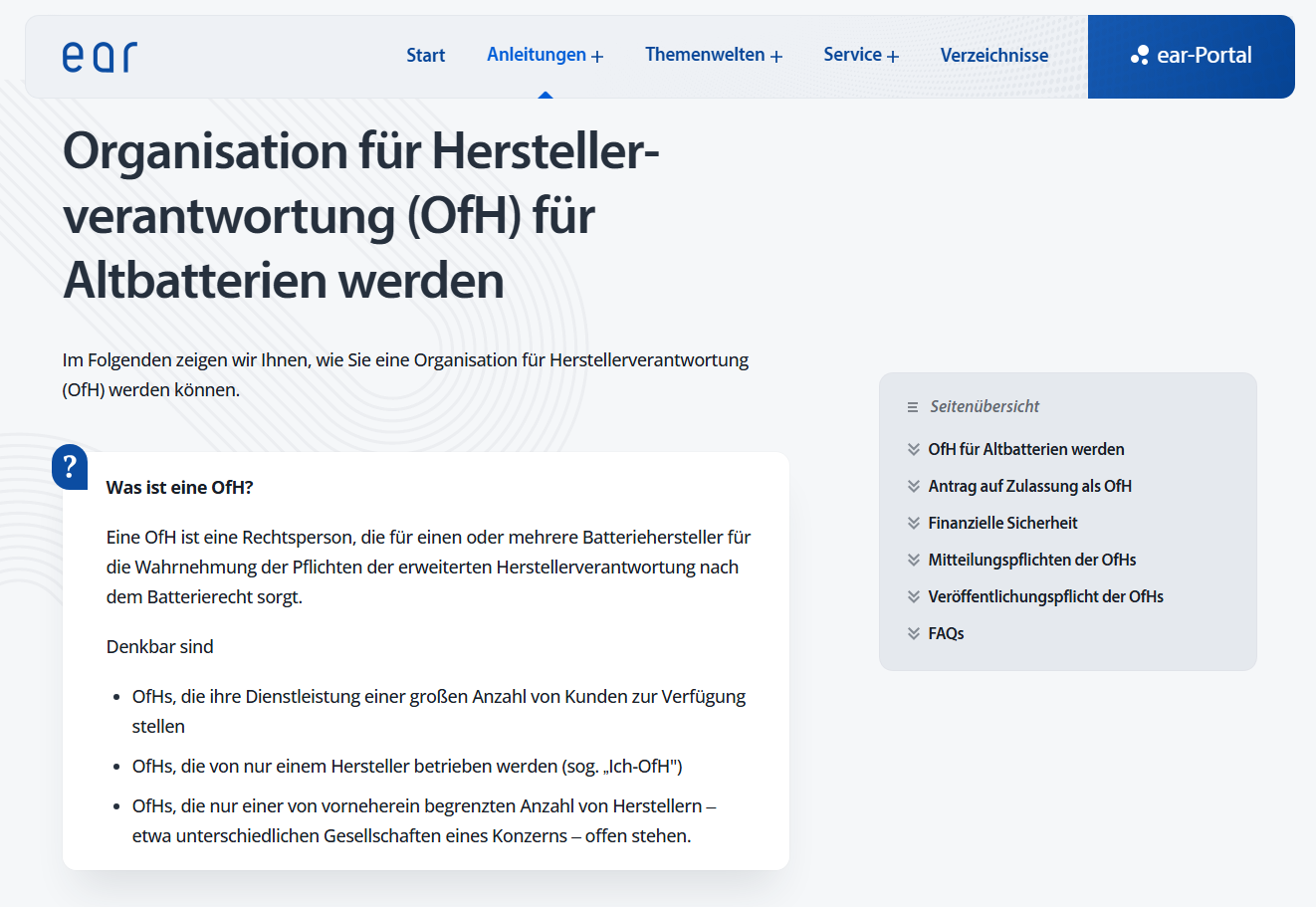
OfH (Organisation für Herstellerverantwortung), or "Producer Responsibility Organization," is an EPR recycling management organization approved by the German Federal Environment Agency (EAR) and officially endorsed. Under the old regulations, recycling was often decentralized and fragmented; under the new regulations, OfH has become the sole compliant bridge. It is not only responsible for reporting data to the EAR but also directly manages the recycling network covering all of Germany. This means that without a legitimate OfH binding, your battery registration number (WEEE-Reg.-Nr.) will become worthless.
Many sellers completed battery law registration early on, but in the face of the new regulations, the following three behaviors are considered "high-risk areas":
Only English name, no AR: Non-German companies must appoint a German authorized representative (Authorised Representative).
1. Self-check method: When querying in the EAR system, if there is no German legal entity (such as GmbH/UG) prefix before the company name, it is considered invalid registration.
2. Not bound to OfH: Still stuck in the old recycling contract, not completed the association with OfH in the EAR system.
3. Missing data declaration: Failure to submit chemical composition (such as lithium, cobalt, nickel content) and historical placement volume as required.
4. The cost of non-compliance: Not just fines, but also removal and blocking from all platforms (Amazon, eBay, Temu, etc.), and even facing customs detention and administrative penalties of up to hundreds of thousands of euros.
To ensure the smooth operation of products in the German market, sellers must cooperate to provide and complete the following four key links: Step 1: Establish a legitimate "AR structure" A real German legal entity with a physical office address must be entrusted as your authorized representative. He is your "compliance substitute" in the legal sense of Germany, responsible for connecting with official supervision. Step 2: Accurate battery category definition The new regulations finely divide batteries into five categories: Portable batteries (most common, such as headphones, remote control batteries) Lightweight vehicle batteries (LMT) (such as electric balance cars, scooter batteries) Starting batteries Industrial batteries Electric vehicle batteries Note: Incorrect category selection will result in subsequent declaration data being invalidated. Step 3: Dynamic data binding with OfH This is not only a process operation but also involves the provision of hardcore materials: Data preparation: The chemical composition of the battery (accurate to metal ratio) and the placement volume for the past three years need to be reported. System operation: Assisted by AR in the EAR system, bind the official OfH for each category separately and submit tax, financial guarantee and other information. Step 4: Terminal label and platform filing After obtaining the latest compliance certificate, the recycling label on the packaging should be updated as soon as possible, and the information completion should be completed in the e-commerce platform backend.