 Cross-border information
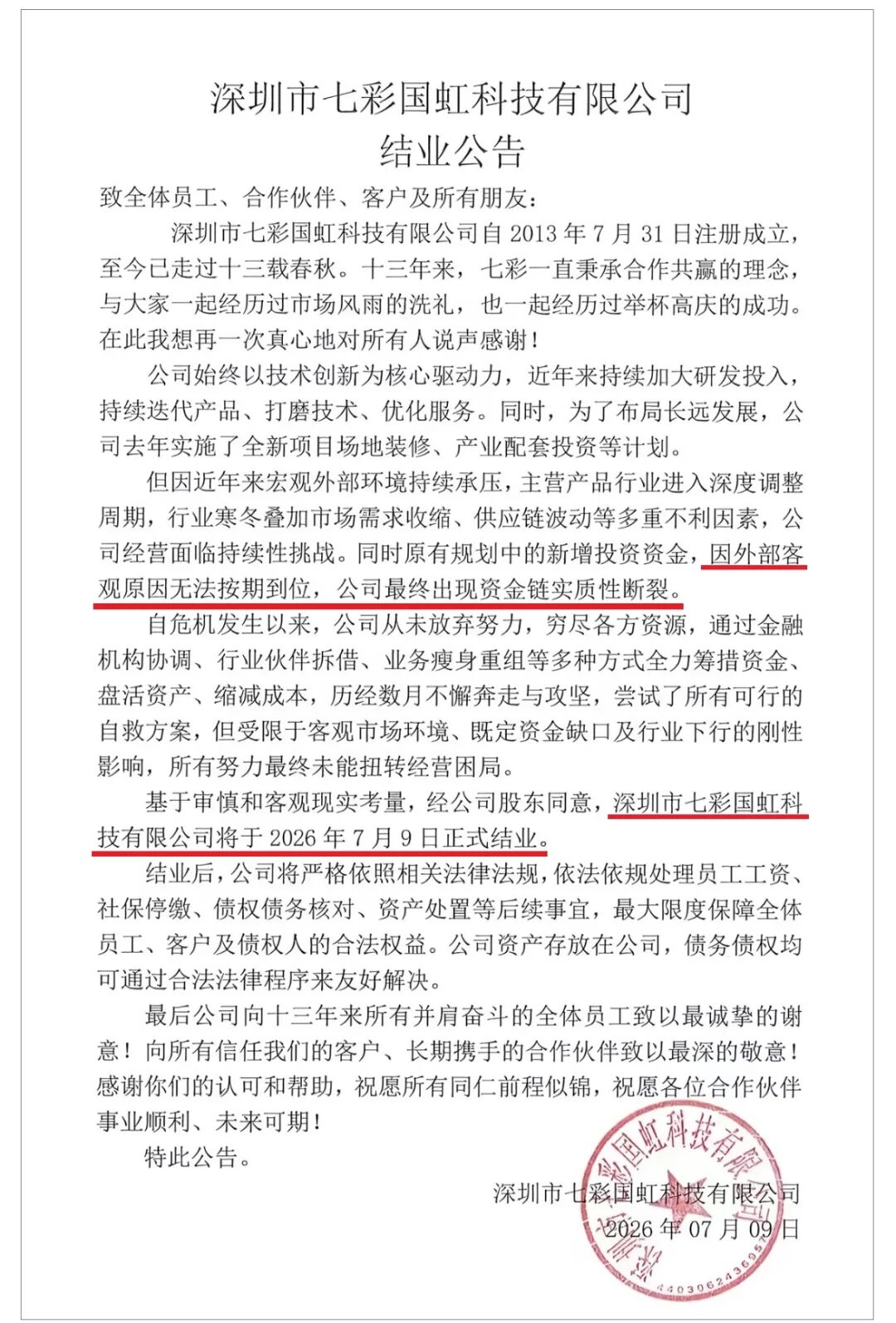
Recently, Shenzhen Qicai Guohong Technology Co., Ltd. officially pressed the stop button.
This national high-tech enterprise with a registered capital of 44 million yuan, having endured thirteen years, ultimately failed to survive the industry winter.
A closing announcement circulating within the industry not only marks the fall of a veteran tech manufacturer but also reflects the deep adjustment pains that China’s cross-border factory manufacturing sector is currently experiencing.
Many may not have heard of this company, but in the cross-border factory manufacturing field, Qicai Guohong is hardly an unknown player.
Founded in Shenzhen on July 31, 2013, the company grew over the past decade into a national high-tech enterprise and a Shenzhen specialized and innovative SME, integrating R&D, design, production, and sales.
It had an 8,000-square-meter factory and a peak workforce of 350 people. Its main products covered consumer electronics such as mobile phone wireless chargers, TWS Bluetooth earphones, car air pumps, and e-cigarette solution boards, also providing OEM services for many well-known brands.
The company held over 70 invention, utility model, and design patents, along with more than 100 international certifications including UL, FCC, and CE, and passed ISO9001 quality management and ISO14001 environmental management system certifications. Just last January, it was newly recognized as a national high-tech enterprise.
Even on the eve of closure, the company was still applying for new technology patents.
How then could a company with such deep technical foundations and full qualifications reach a dead end?
1. Deep industry adjustment turns the track into a red ocean.
The company’s announcement admitted that “the main product sector has entered a period of deep adjustment.” The 3C consumer electronics track Qicai Guohong specialized in has seen fierce competition in recent years. Technologies like wireless chargers and TWS earphones have relatively low barriers, attracting a flood of manufacturers, resulting in serious homogenization and brutal price wars.
Meanwhile, overseas orders remained persistently weak, supply chain costs fluctuated, and profit margins were squeezed to almost nothing. Sustained macro external pressures made matters worse for an already low-margin manufacturing sector.
2. Expansion plans hit by capital “cutoff”.
This can be said to be “the last straw that broke the camel’s back.”
To lay out long-term development, last year the company implemented new project site renovations and industrial supporting investments. However, the originally planned new investment funds failed to arrive on time due to external objective reasons.
Continuous capital consumption from expansion on one side, and promised investment that never materialized on the other, ultimately caused the company’s capital chain to break substantially, making it unsustainable.
3. Self-rescue fails, beyond recovery.
When the crisis struck, the company did not wait idly. The announcement shows it exhausted all resources, making every effort to raise funds, revitalize assets, and cut costs through financial institution coordination, industry peer borrowing, and business streamlining and restructuring.
The boss raced around, seeking loans from banks and peers, even divesting side businesses like cutting off an arm to survive, trying every conceivable method.
However, constrained by objective market conditions, the established funding gap, and the rigid downward impact of the industry, all efforts ultimately failed to reverse the predicament.
In the end, Qicai Guohong issued that paper announcing its closure.
Notably, against the backdrop of many business owners going missing after company failures these days, Qicai Guohong chose a dignified way to say goodbye.
The company pledged to strictly follow relevant laws and regulations to handle employee wages, social insurance suspension, creditor-debt verification, asset disposal, and other follow-up matters. All company assets remain in place, and debts and claims will be resolved through legal proceedings.
This “parting on good terms” attitude is especially valuable in today’s restless business environment.
Qicai Guohong’s collapse is not an isolated incident but a microcosm of China's consumer electronics manufacturing entering a deep adjustment period. Even established companies with national high-tech titles and profound technical accumulation cannot escape the double strangulation of industry cycles and broken capital chains.
Thirteen years of persistence ultimately succumbed to the torrent of the times. This is not just a regret for this company, but a proposition the entire industry must ponder.
In an era of accelerating technological iteration and heated market competition, how to navigate cycles and balance expansion with risk is a survival test every manufacturing enterprise must face head-on.
The End!
-------------
Source: Cross-border Sellers Hub