 Yijia Overseas
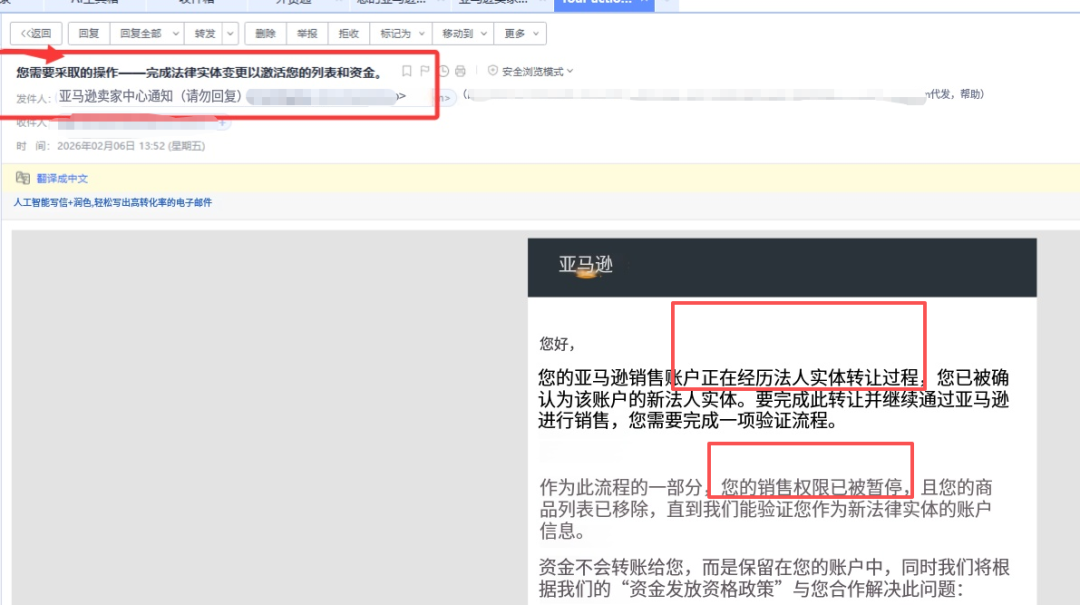
Amazon has recently implemented a stricter review mechanism for Hong Kong-based companies. Data shows that the rejection rate for new accounts registered with Hong Kong companies in the past three months has exceeded 30%, and 20% of existing accounts have been suspended without warning, with funds unable to be withdrawn.
1. Amazon's Review of Hong Kong Entity Accounts
Amazon has initiated a comprehensive verification of Hong Kong company entities, triggering a wave of account suspensions. Data shows that over 70% of Hong Kong company account suspensions are due to the companies sharing virtual addresses.
Many cross-border sellers have already encountered issues. Some sellers, having just completed registration and uploaded a few products, received "review failed" notifications with vague reasons and no possibility of appeal; others, who have operated accounts for 1-3 years without engaging in brushing orders, infringement, or selling fakes, suddenly found their accounts disabled, with the backend showing "compliance review not passed," funds frozen, and customer service providing only templated responses.
The core issue lies in "entity compliance."
2. Why Has "Changing Entities" Become a High-Risk Operation?
In the past, many sellers believed that changing their store entities to Hong Kong companies could enjoy tax advantages, free capital flow, and avoid regulation. However, this practice has now become a risk control minefield, mainly due to the following reasons:
1. Entity Information and Account Behavior Are Deeply Bound
Amazon regards entity information as core identity data, closely related to operational history and capital flow. Frequent or large-scale changes to entities can trigger system warnings.
2. Global Tax Regulation Is Tightening
Under the global tax transparency initiative (such as CRS) and the implementation of new domestic tax regulations in China, the platform needs to verify the authenticity of sellers, and entity changes are often seen as evasive measures, thus falling into the high-risk monitoring range.
3. Virtual Addresses Are the Biggest Risk Point
Especially for Hong Kong companies using virtual registration addresses, they are more likely to be directly identified by the system as "shell companies," and once identified, will trigger a ban.
3. Amazon's Review Further Upgraded
In the past, Amazon focused on formal reviews, but now risk control has shifted from "surface information" to "deep substantive review." It not only requires company registration documents but also reviews elements including but not limited to:
The authenticity of company registration qualifications;
Actual business address and address proof;
Bank account and capital flow path;
Tax compliance and reporting consistency.
Whether it's new registration or maintaining existing accounts, it is recommended to pay attention to the following points:
Avoid using low-priced virtual addresses and try to provide real, verifiable business addresses;
Prepare complete documentation, including bills related to the registration address, utilities, etc.;
Plan taxes and capital transactions compliantly, avoiding contradictions with account entity information.
As platform risk control becomes increasingly strict, compliance has become key to sellers' long-term operations.
When using Hong Kong companies to join Amazon, it is recommended to choose real independent addresses and compliant structures to avoid the risk control hidden dangers brought by shared or virtual addresses.
That's all for the content sharing brought to you by Yiju Overseas. Feel free to leave a message and discuss in the comments section anytime!