
 VIPON off-site promotion
Starting from January 23, 2026, a winter storm codenamed "Fayne" swept across more than 22 states in the United States, with 23 states declaring a state of emergency. This extreme weather event, the strongest in nearly 40 years, not only caused power outages for over 1 million users and the cancellation of more than 20,000 flights, but also dealt a systematic blow to Amazon, the world's largest cross-border e-commerce platform—over 70 FBA warehouses were forced to close temporarily, seller orders plummeted by 75%, and the logistics network was semi-paralyzed.
Logistics Lifeline "Frozen": 70+ FBA Warehouses Closed, Nationwide Distribution Network Semi-Paralyzed
The storm's most direct impact was on the logistics system, with cross-border logistics being the first to collapse.
Warehouse Operations Halted Abruptly. According to industry monitoring, over 70 Amazon FBA warehouses across the United States have been temporarily closed due to the storm, accounting for about one-third of the total number of FBA warehouses in the country. Several core logistics hubs, including Dallas FTW1, FTW2, FTW3, Chicago MDW2, ORD2, and New York JFK8, EWR4, have completely shut down. Among them, the MQJ1 warehouse has been closed since January 20 and is not expected to reopen until February 24; the closure time for the MEM1 warehouse is still unclear.Even for warehouses that remain open, there are comprehensive delays in storage, shelving, and shipping. The appointment waiting period for the GEU2 warehouse has been extended to 10-14 days, and the rejection rate at some locations has soared to 90%, making it difficult to store goods even after diversion.
Transportation Channels Disrupted. Ground traffic is also severely affected. A hundred-car pileup occurred on Michigan's I-196 highway, forcing the closure of this critical logistics channel. The Federal Motor Carrier Safety Administration has urgently relaxed driver driving time limits in 40 states to ensure the most basic material transportation. Express Delivery Issues Widespread Alerts. UPS, FedEx, and USPS, the three major express delivery giants, have collectively issued national delivery delay alerts. Last-mile deliveries are delayed by at least four days, and some areas have even suspended all-day pickup services.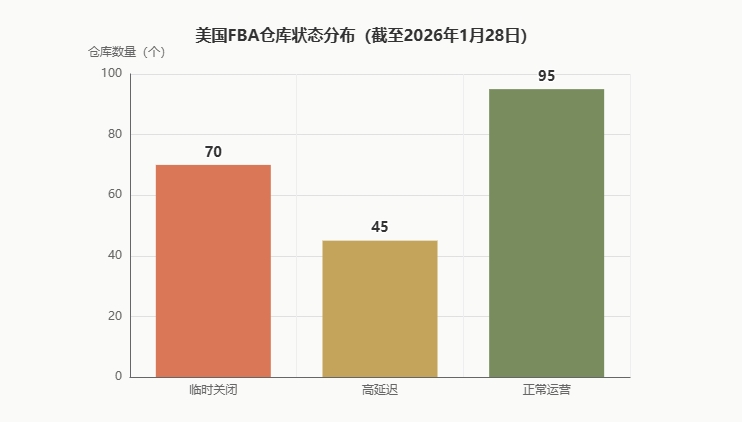
Demand Side "Frozen": Non-Essential Orders Plunge 75%, Essential Items Skyrocket 200%
The storm's secondary disasters quickly manifested on the demand side, dealing a second blow to most sellers, but presenting a stark "ice and fire" contrast.
Non-Essential Categories Experience Cliff-like Decline. There is widespread outcry on social media and seller forums. "Orders dropped by 75%," "sales halved, ACOS through the roof" are common feedbacks. Late January is traditionally a slow sales season and tax filing season in the United States, and the storm completely suppressed the consumption of non-essential items, with demand for most categories except snow shovels and generators nearly zero. Orders for home decoration, ordinary clothing, outdoor leisure, and other categories have generally been halved, with many sellers reporting sales plunging by 75% compared to usual, and a 30% decrease year-on-year.A seller specializing in home goods said that items that used to sell hundreds of units a day often register zero sales after the blizzard, with advertising costs unchanged, but conversions are scarce.
Essential Categories See Surge in Orders. In contrast to the plight of most sellers, there has been an unexpected "hoarding wave." After offline supermarkets were sold out, demand spilled over to online. Orders for winter emergency supplies such as snow boots, small heaters, rechargeable flashlights, snow shovels, and generators have increased sharply, with some sellers even facing stock shortages.Google Trends data shows that searches for "power outage heaters" soared by 1600%, and queries related to "snow shovels" increased by 350%. Some sellers have shared backend data showing that a related product's daily order volume broke through 2000 units, a 200% increase from the previous day, even surpassing the peak of Black Friday.
Crisis Response Strategies: How Sellers Can Survive the Snow Disaster
In the face of this force majeure natural disaster, anxiety is useless; rational action is key. Following the principle of "less movement, more observation, and fine-tuning" is essential to smoothly weather the crisis.
Emergency Response for Warehousing and Logistics. Immediately log in to the seller backend, check the IPI score and inventory status, and confirm whether the goods are located in closed warehouses. Suspend shipping to warehouses in severely affected areas, and new shipments can be prioritized to less affected warehouses such as those on the West Coast, with a buffer period of 3-5 days. Consider enabling "Order Holiday Mode," or extend the delivery commitment time in batches through the "Manage Orders" page, and communicate proactively to reduce the risk of negative reviews. For goods already in transit, track logistics status through freight forwarders, adjust storage appointments in time, and some sellers choose to divert goods to third-party overseas warehouses to reduce dependence on FBA. Operations and Advertising Strategies. For non-essential items, it is not recommended to blindly raise bids or completely shut down advertising. A strategy of "reducing budget and observing data" can maintain traffic entry at low cost and monitor market recovery signals. Compliance is the Bottom Line. Resolutely prevent price gouging. The surge in demand has given rise to improper profit-seeking behaviors. According to American media reports, the prices of some winter supplies on Amazon soared within a few days, with the highest increase exceeding 90%. For example, the price of a certain type of ski boot increased from $22.85 to $43.70. This behavior of "raising prices during disasters" has triggered price fraud supervision in many places in the United States, and media such as The Washington Post are highly concerned. Amazon has made it clear that it has "zero tolerance" for price fraud and will conduct strict investigations through the system, with violators facing severe penalties.When faced with force majeure, more important than complaining is to review: Are you overly dependent on a single logistics channel? Is your supply chain layout diverse enough? Is your inventory turnover rate healthy? Those sellers who can stabilize their position or even seize opportunities during crises often build more resilient operating systems in their daily operations.