 VIPON off-site promotion
On December 5, 2025, at the Amazon Global Selling Cross-Border Summit, a new term suddenly became the focus of everyone's attention: GWD, which stands for Global Warehouse Distribution.
Amazon also announced at the same time that the first GWD will be located in Shenzhen and plans to be fully open to Chinese sellers in March 2026. As soon as the news came out, from freight forwarders to supply chains, from headhaul teams to seller circles, everyone began to discuss: What exactly does Amazon want to do? What will this warehouse change?
1. What exactly is GWD? It's not just a "larger FBA warehouse"
If FBA is regarded as the "destination country warehouse", then GWD is the "global entrance" established by Amazon at the source of the supply chain.
In the past, the way cross-border e-commerce was stocked was as follows:
Stock up in the United States
Stock up in the UK
Stock up in Germany and Japan respectively
Each country has independent customs clearance, independent headhaul, and independent inventory planning, which results in high costs, long links, and heavy inventory pressure.
But the logic of GWD is:
"Sellers send the goods to Shenzhen, and Amazon takes care of the rest."
Specifically:
After the goods enter the Shenzhen GWD, one warehouse completes
warehousing → customs clearance → cross-border transportation → global schedulingAmazon automatically distributes to FBA forward warehouses in the UK, Germany, the United States, etc., according to algorithms
After the consumer places an order, it is shipped from the nearest warehouse, which can achieve the fastest next-day delivery
In one sentence:
Previously, sellers stocked up by country; in the future, Amazon will uniformly schedule global inventory.
GWD is not just a warehouse, but also Amazon's "supply chain AI brain".
2. Why was the first warehouse chosen in Shenzhen? The answer is hidden in the supply chain
Amazon executives were very straightforward at the summit:
Shenzhen is the city with the densest global cross-border sellers.
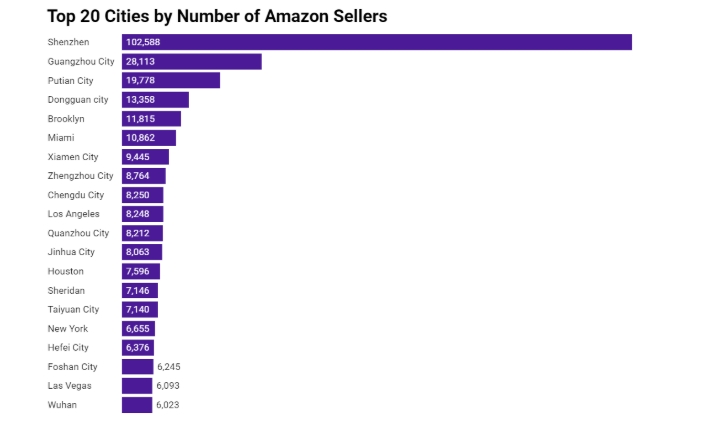
Image source: SmartScout
But there are three deep reasons:
1. High supply density makes the scheduling algorithm smarter
Industrial chain concentration means higher SKU density and replenishment frequency.
This is crucial for GWD's machine learning model.
2. Mature supply chain, can achieve scale effect at the source
The core value of GWD comes from "scaled scheduling".
Shenzhen is precisely the city that can best support the scale.
3. Shenzhen is the center of Amazon's global supply side
Chinese sellers are an irreplaceable supply force in the Amazon ecosystem.
Putting the first GWD in Shenzhen is the best choice for "transforming cross-border links from the source".
Therefore, it's not "why Shenzhen", but "who else could it be besides Shenzhen".
3. How much practical benefit does Amazon GWD bring to sellers?
What sellers care most about is:
"How much money can I really save?"
The answer is: not just a little.
1. No need to stock up by country
Before, you had to: put some in the UK, some in Germany, and some in the US.
Now:
All sent to Shenzhen GWD → Amazon automatically distributes.
Centralized stocking means:
Lower capital occupation
Lower risk of overstock
Higher inventory utilization
This is a structural cost reduction.
2. The headhaul link changes from "multi-stage" to "one-stop"
Traditional cross-border headhaul:
China → Transit → Customs Clearance → Destination Country → FBA Warehouse
GWD model:
China → Amazon Shenzhen GWD → Global FBA Forward Warehouse
Reduce the number of customs clearances, transits, and uncertainties.
3. Official forecast: cost reduction of 20%-40%
This is key data announced by Amazon at the summit.
It is very attractive to sellers with high unit price, medium and large items, and high replenishment frequency.
4. User delivery time is directly upgraded to "next-day delivery level"
Forward warehouses are closer to consumers and deliver faster,
The user experience score and traffic weight of the listing will be increased.
Therefore, GWD is not just a warehouse upgrade, but an upgrade of the cross-border operation model.
4. Will Amazon GWD impact the freight forwarding industry?
After the release of GWD, the hottest sentence in the seller group was:
"It's over, small freight forwarders will be replaced!"
Indeed, the impact is obvious:
What will shrink:
Customs clearance by country
Multi-stage headhaul
Transfer warehouse in destination country
These are all aspects that GWD will absorb on a large scale.
What will become more important instead:
Supply chain planning capability
Inventory prediction system
Full container load and full truck load solutions
Cost analysis and intelligent warehouse allocation
Professional combined warehouse solutions for complex categories
That is to say:
GWD will eliminate extensive freight forwarding, but will enhance the value of professional services.
5. What should sellers do now? Three types of sellers should move early
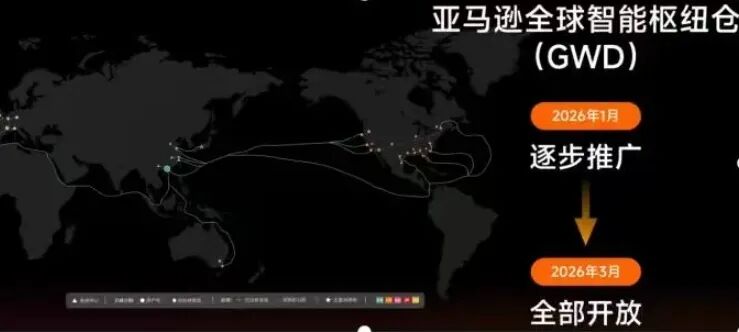
Image source: Amazon
There is still time before the full opening in March 2026, and these three types of sellers should plan ahead:
1. Medium and large item sellers
Cost reduction is the most direct, and it is worth testing first.
2. Categories that rely on timeliness (prone to stockouts, high replenishment frequency)
GWD can effectively alleviate stockout and long-link replenishment problems.
3. Sellers who want to do multi-site layout
Especially for combinations of multiple European countries, the cost of trial and error will be significantly reduced.
It is recommended to understand in advance:
Warehouse entry standards
Packaging and labeling specifications
SKU classification requirements
Connection plan with existing headhaul
The earlier you prepare, the larger the dividend window may be.
In my opinion, GWD is not just an intelligent hub warehouse, but also an increase in Amazon's new infrastructure.
END