 Seller's Home
Over the past two days, the buzz around "Niu Lai" has spread overseas.
"Niu Lai" is a Chinese animated film widely mocked for its crude production. In the first nine days after release, it earned only 7,169 yuan at the box office and was watched by just 236 people nationwide. Yet it unexpectedly triggered a nationwide curiosity-driven rush: "It's so bad that I have to see it for myself." Within days, daily box office jumped to 8.2 million yuan, and total box office surpassed 25 million — an extreme example of "the worse it is, the hotter it gets."
Even more unexpectedly, this curiosity craze quickly spread overseas, with BBC, Bloomberg, The Guardian and other major international media covering it, making the film a hot topic abroad.
Meanwhile, Chinese sellers' product-sourcing instincts and execution speed once again exceeded expectations. Some Amazon sellers have already turned "Niu Lai" into products — modeling, 3D printing, and listing. A Yiwu seller said he has already shipped 6,000 orders.
01
Amazon Sellers Stage a Blitz
On the day "Niu Lai" went viral on social media, sharp cross-border sellers were already moving. A 3D print farm owner told media that after spotting the film's "hit potential," his team immediately used AI 3D large-model-assisted design. From screenshot references to a printable STL model file, the whole process took less than one hour. From August 15 to 17, they printed tens of thousands of Niu Lai figures and earned more than 100,000 yuan.
On Amazon's US and European marketplaces, searching for "Niu Lai" brings up many related products, priced from $4 to $25, covering different consumer tiers.
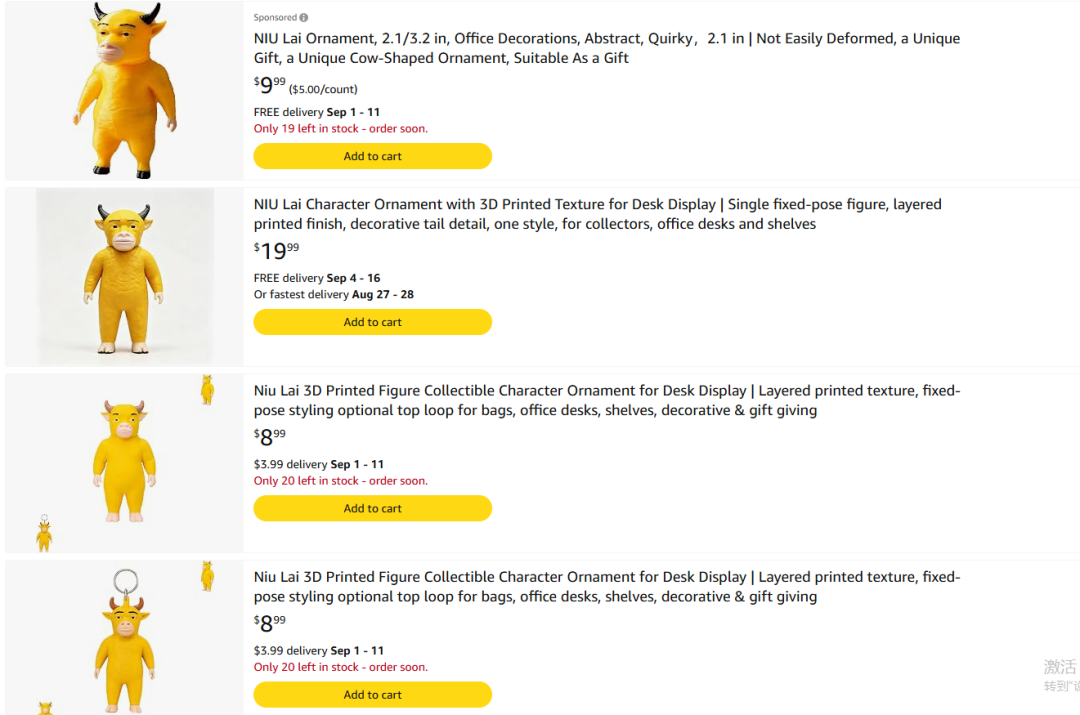
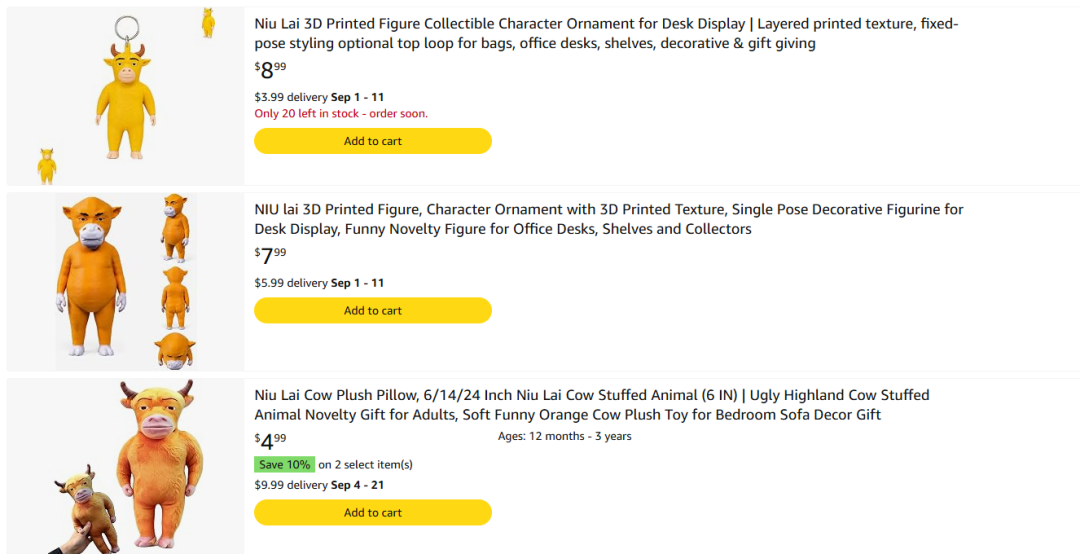
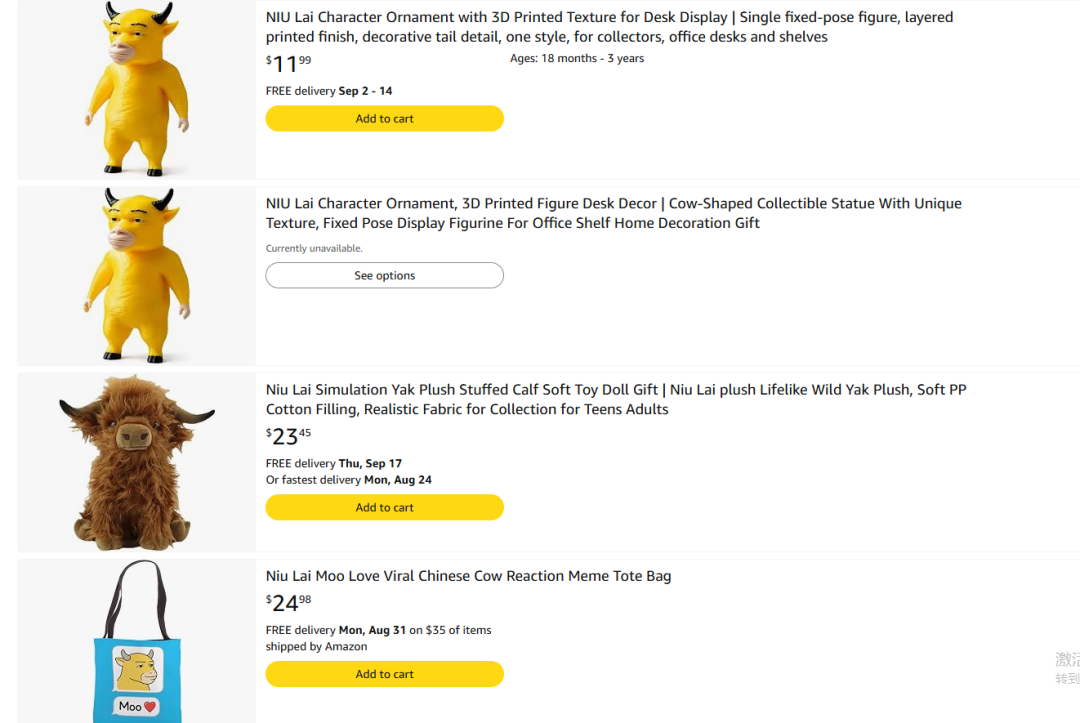
More notably, the listing times for most of these products are concentrated between August 15 and 17, almost in sync with the film's box office surge.
Some sellers completed modeling and quickly prototyped with 3D printing before posting links the same day. Others used Fulfilled by Merchant (FBM) to test the waters, bypassing inventory preparation and warehousing time.
Small and medium sellers today no longer rely on traditional product selection logic. Instead, they treat "capturing social sentiment, rapid modeling, flexible manufacturing, and seizing traffic entry points" as core competitive methods. As 3D printing and AI modeling tools become more accessible, products that once took months for mold development can now go online within hours.
Compared with heavy upfront spending on molds, inventory, and sea freight, 3D printing offers a lower-cost way to test demand. It is especially suitable for:
- Trend-driven products with rapid heat and short life cycles;
- Decorative items with distinctive shapes suited to visual sharing;
- Products requiring fast iteration in size, color, or combinations;
- New products with unproven demand that are not suitable for heavy stocking.
Many sellers are now asking: Is it too late to jump in?
02
Is Money on a Hot Trend Really That Easy to Grab?
Hot-trend products easily create the illusion that as long as you list first, you will sell out. But the reality is the opposite. The bigger the trend, the faster competition rushes in; the higher the heat, the greater the risks of infringement, complaints, and price wars.
Especially when products involve character images, film or TV works, brand logos, artistic designs, internet memes, or cultural symbols with clear origins, sellers must first figure out whether they are public elements or content protected by copyright, trademark, or design rights.
"Creating a model" does not equal having the right to sell, and "3D printing" does not mean avoiding infringement. Platforms are increasingly strict with IP complaints. Even if a listing gets short-term sales, it may be taken down due to complaints and even damage account health.
Beijing Jiawei Law Firm partner lawyer Zhao Zhanling said in an interview: "Without permission from the film copyright holder, making and selling toys containing the film's character image or substantially similar to it may infringe reproduction and distribution rights."
Among cross-border sellers, there is a clear gap between common misunderstandings about IP and legal reality. Some sellers believe, "I made my own model and 3D-printed it; I didn't use the original mold, so it's not infringement." In fact, the law protects the work itself, regardless of manufacturing method. Reproduction itself is infringement, whether by injection molding or 3D printing.
Some sellers also say, "I just changed the expression or color slightly, so it's fine." That is also wrong. The legal test is "substantial similarity," not "exact identity." As long as the core recognizability remains, minor changes are not a defense.
In fact, as "Niu Lai" fever climbed, some related merchandise links became invalid or were delisted as soon as they went up. As of press time, some product pages on Amazon show "Currently unavailable." Whether they sold out or were taken down is unknown. This is a warning to trend-chasing sellers: trends can be chased, but blindly monetizing IP is a high-risk move in cross-border e-commerce.
3D printing and AI modeling have made chasing trends easier than ever. But no matter how tempting a sales explosion is, don't let infringement become its price.
This article is for analysis only and does not constitute investment advice.