
 Cross-border e-commerce Hugo.com
This deep dive into LUSBY explains how a new AI glasses brand used interest-based e-commerce to enter overseas markets, from first-person content educating users to local creators building real scenarios and rapid product iteration. It shows Shenzhen manufacturing reconnecting with overseas content channels and a path from selling products to building brands.
A rough TikTok video went viral: an ordinary American blue-collar worker wore black-frame glasses to record a first-person view of repairing roof tiles.

Comments flooded in: "What camera is this?" "Where can I buy it?" "So convenient for work!"
The video came not from a Silicon Valley AI unicorn but from LUSBY, a post-2000s startup in Bao'an, Shenzhen. With this hit and its content playbook, LUSBY lifted monthly sales from $50,000 to $1 million in four months and topped the TikTok Shop US AI glasses category.
01 Making AI glasses ordinary people can afford
Founder Rong Jianhua says the team started developing smart glasses around 2018-2019, but AI was immature and market response weak. A post-2000s founder, he dropped out of university and worked as a delivery rider, receptionist, and maternity center photographer. These experiences sharpened his sense of content and real life, leading to TikTok content commerce.
In 2025, real-time translation and AI image recognition matured, and he saw the opportunity. The smart glasses track was exploding, with Meta-Ray-Ban and many Chinese manufacturers entering. Competition focused on specs, computing power, and models, but high prices left a value gap. LUSBY aimed at this gap.
The team found ordinary consumers care less about how smart glasses are and more about solving real problems: recording travel, hands-free video, and real-time translation. So they cut AR screens and complex sensors, kept first-person recording, real-time translation, and a light fit, and priced the product at about $60.
"We no longer define who should buy AI glasses. We want them to enter ordinary people's daily habits," Rong said. The internal mantra became: don't build AI just to show AI; make it a daily capability.
02 Using TikTok creators' native feel to drive traffic
For innovative products, traditional search e-commerce fails because consumers don't search "AI glasses." LUSBY bet on TikTok's "goods find people" model to educate and activate the market.
Instead of expensive top KOLs and tech reviewers, the team reached over 200 US mid-tier and small KOCs. They gave no scripts, only asked creators to wear the glasses during daily work or play and upload videos. This scriptless approach produced hits—a tattoo artist, US college students, a mother at a baseball game—and the roof-repair video helped LUSBY reach blue-collar and mass markets.
They analyzed viral videos frame by frame and replicated high-converting scenes across hundreds of creator videos. A split-screen visual template showed third-person and first-person views side by side. "The visual contrast doesn't even need voiceover. Users stop scrolling and are hooked," Rong said.
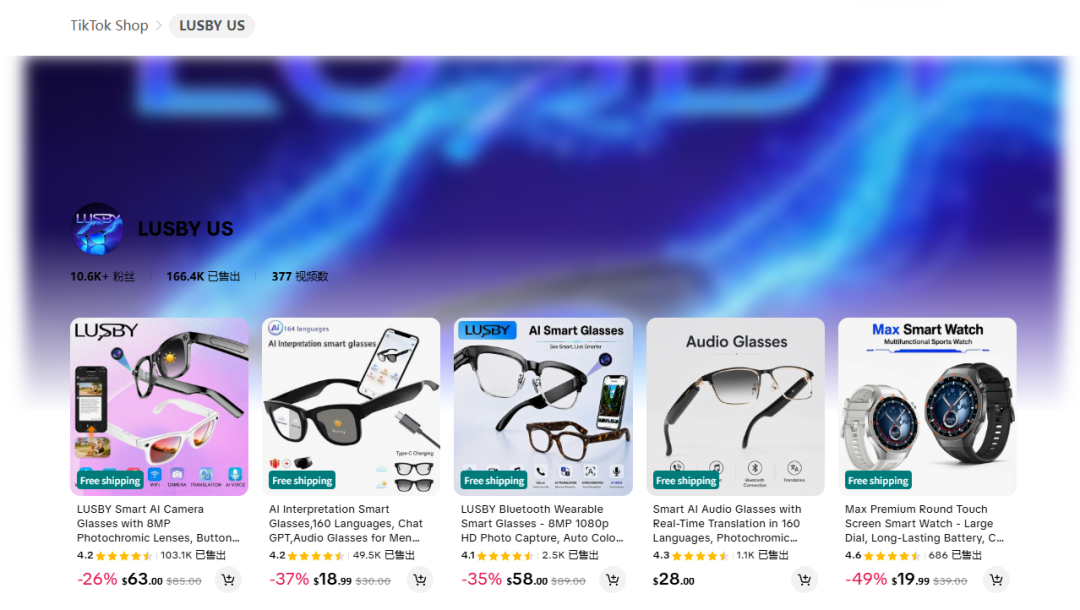
Livestreams also matter. Hosts show real-time capture quality and demonstrate real-time AI translation in over 160 languages. In daily operations, short videos bring 200-300 orders per day, while a single livestream can exceed 1,000 orders; Black Friday peaked at 2,000. Rong said short videos grow steadily, livestreams break the ceiling, and live auctions are being tested for impulse purchases.
With this playbook, LUSBY went from zero to No. 1 in TikTok Shop US AI glasses in about four months. The team expanded from a few people to over 20, mostly post-2000s. Rong said content commerce closes the loop from after-sales and reviews to R&D and production, letting brands hear the market immediately.
03 Shenzhen manufacturing from "made" to "created"
"Shenzhen factories have many great products but lacked good sales channels. Content commerce helps Shenzhen factories shift from 'made' to 'created,'" Rong said.
LUSBY's real foundation is Shenzhen's factory supply chain. Early on, a first-generation product had a complicated dual-side touch startup, causing bad reviews. Because LUSBY is close to factories, the team fed user feedback to R&D and re-launched within one month with a simple single-side startup, resolving the problem.
Later, from reviews, the team found many Western users have light-colored pupils and are sensitive to sunlight. They quickly launched photochromic lenses that darken based on UV intensity. This lifted click-through and repurchase rates, boosting daily orders from 100 to 300.
"Good ideas can land the next day. Only Shenzhen can iterate this fast while keeping costs down," Rong said. Bao'an District alone has 60 smart glasses supply chain enterprises, providing deep support for rapid R&D.
From "made" to "created," LUSBY proves that when Shenzhen's supply chain efficiency meets TikTok's content ecosystem, Shenzhen manufacturers can go global as independent brands.
Written by CifNews
(Source: CifNews Editorial Team)
SellerHome Review
Low-cost AI glasses scaling through TikTok creator content validate the US-market power of "cost-effective hardware + native short video." Sellers should focus on creator distribution rhythm and content localization rather than simply cutting prices to grab volume.
Source: CifNews
Original link: https://www.cifnews.com/article/188967