 Cross-border information
For Chinese cross-border sellers on the European market, July 1 this year is a watershed worth remembering.
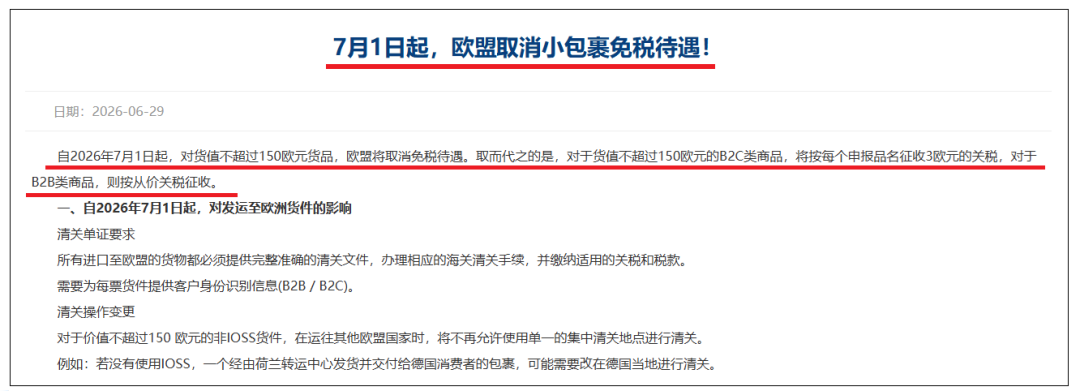
On that day, the EU's long-planned new tariff policy for low-value parcels officially took effect, ending the years-long "duty-free benefit for small parcels under €150"!
From that day onward, cross-border B2C parcels from outside the EU will be subject to a fixed tariff of €3 per product category.
The policy has just been in effect for over a month, and the market has already given very direct feedback.
According to customs statistics cited by France's Ministry of Economy: after the new rules took effect, the number of cross-border small parcels from China entering the EU dropped by 30%-40%!!
Many say this data is even conservative, and the decline may exceed 50%.
The once-bustling European cross-border track suddenly cooled down, and a large number of sellers began to reassess whether the European market is still worth sticking to.
Many people do not have a strong sense of this policy and think that €3 is not a huge amount and should not shake the entire industry.
But if you put that amount into the real scenario of cross-border small parcels, the impact is far greater than the number appears.
Over the past few years, Europe has become one of the most important markets for Chinese cross-border e-commerce. In 2025, nearly 5.9 billion cross-border small parcels under €150 entered the EU, four times the 2022 figure, and 93% of those parcels came from China.
Accessories costing a few yuan, household gadgets under €10, affordable 3C accessories, and daily necessities have been continuously delivered to European consumers thanks to the duty-free benefit of direct-mail small parcels, and have supported a large number of sellers following the low-price, wide-listing route.
What makes the new policy special is not simply the €3 charge, but that it is levied by product category, not per parcel.
For example: if a parcel contains a phone case, a hair tie, and a nail clipper, and these three items fall into different HS code categories, the tariff will be €9, not €3. If the order has complex styles and categories, the taxes can easily exceed the selling price of the products.
For a small item sold at €4–5, the new tariff alone could be €3–6, completely eating up the profit.
In addition, sales data from major platforms also clearly confirm the impact of the policy.
Third-party research firm Joko, based on the purchase records of 1.5 million French consumers, found that from June to July, Temu's sales dropped 50% month-on-month, AliExpress dropped 37%, and Shein, which had already deployed local warehouses in Europe, was less affected, with sales falling only 15%.
The macro data from platforms is alarming enough, but those who truly feel the biting chill are the thousands of small and medium cross-border sellers rooted on the front line.
In industry communities, too many real stories are already happening.
A Yiwu seller of small daily commodities, mainly selling hair accessories, small storage items, and kitchen gadgets, had long relied on postal small parcels shipped directly to the EU.
After the tax reform, tariffs on mixed-category orders multiplied, and every parcel had to be formally declared to customs, with freight forwarders charging extra customs clearance handling fees, pushing overall costs up by more than 35%.
He tried raising prices, but lost buyers badly. "The route of moving high volumes at low prices is no longer viable. You either build overseas warehouses or switch to higher-value products, but either path requires a large amount of capital, and small sellers simply cannot withstand it," the seller said helplessly.
Another Shenzhen seller of small 3C accessories, Mr. Zhang, said the European site had been his base for four years.
The main products in his store were data cables, phone stands, and protective cases, mostly priced between €6 and €12, following a low-margin, high-volume model, with a net profit of usually only €1–2 per order.
After the tax reform took effect in July, many items alone required €3 in tariffs, meaning each order sold at a loss.
"I used to stably get 180–220 European orders a day; now there are only twenty or thirty a day. I dare not list low-price models. If I raise prices even slightly, European buyers switch directly to local shops. I can only gradually shift my focus to the North American site, while keeping higher-priced products on the European site to test the waters," he said helplessly.
Faced with drastic market changes, sellers' mindsets have also clearly diverged.
Some sellers choose to temporarily scale back their European business, clear inventory, and then wait and see for a while;
Some sellers with sufficient capital are rushing to explore overseas warehouse resources in Poland, Germany, and the Czech Republic, shipping goods into the EU in advance and switching from domestic direct shipping to local fulfillment to avoid small-parcel tariffs;
A few sellers insist on staying, drastically cutting all SKUs priced below €20 and keeping only products with brand value and pricing power, using higher margins to absorb compliance and logistics costs.
It should be noted that the €3 fixed tariff is only a transitional policy, not a long-term rule.
According to the timetable published by the EU, this fixed charge will run until July 2028. After the transition period ends, all imported goods will be subject to conventional tariff rates according to their corresponding customs codes, and supervision will only become stricter.
At the same time, in November this year, the EU will also implement a mandatory product traceability code system, raising the requirements for full-chain tracking of cross-border parcels. In the future, customs clearance and compliance thresholds will continue to rise.
A wave of policy changes has already arrived, and an industry reshuffle is truly unfolding.
The European cross-border market will not disappear in the future, but the rules of the game for entering it have completely changed.
-------------
Source: Cross-border Seller Hub