
 Cross-border information
Among the mechanisms that frustrate Amazon sellers most, listing piggybacking is one.
Under this platform-tolerated practice, many sellers spend time and effort building a hit listing, only to see it hijacked by an unexpected rival; some even lower prices maliciously to steal the Buy Box.
Therefore, Amazon sellers must guard against both external threats and internal thieves.
AMZ123 recently learned of a case in which an employee stole company product information and ran a competing Amazon store.
An internal notice circulating online shows that Wu, a former employee at a Shenzhen cross-border company, used his position and access to provide hot-selling product information, links, images, listing materials and core operating data to his own competing Amazon store.
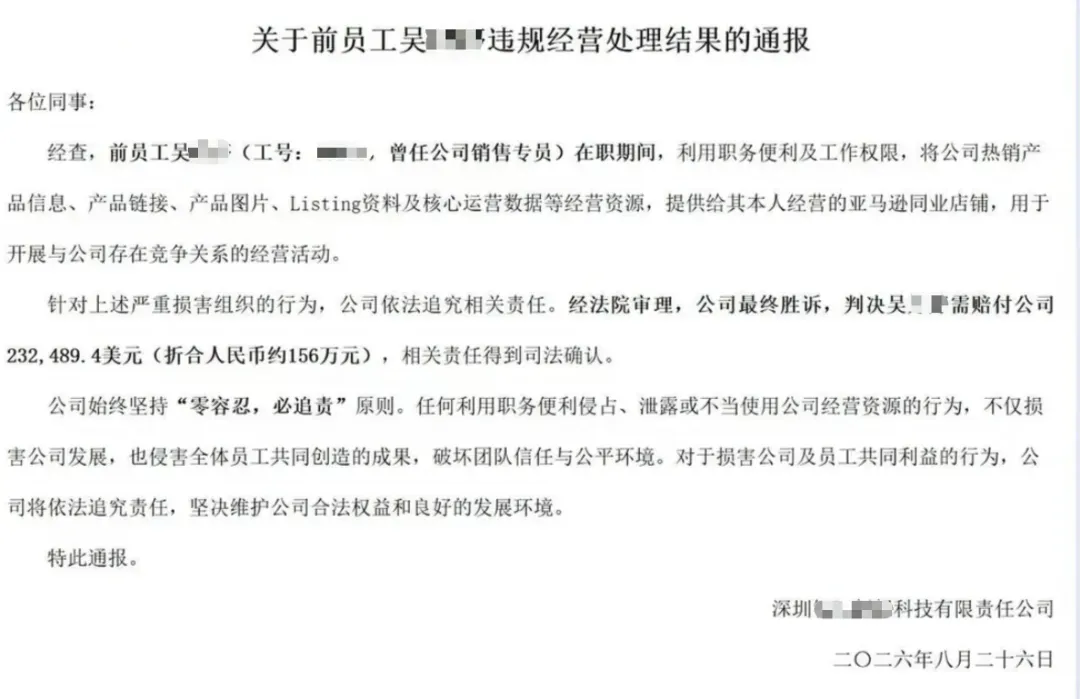
After court proceedings, the company won, and Wu was ordered to pay $232,489.4 (about RMB 1.56 million), with liability judicially confirmed.
The company, based in Longgang, Shenzhen, has over 500 insured employees and sells beauty, home, 3C and dozens of other categories on Amazon, eBay and AliExpress, reaching more than 100 countries and regions in Europe, America, Japan and the Middle East; it is a major cross-border seller.
According to the notice, Wu was a sales specialist in platform operations and product promotion, with direct access to store data and a chance to target hot products with high sales and margins. Familiar with the company’s rhythm, he grabbed placements, intercepted traffic, and gained an edge through lower pricing.
Once exposed, the case sparked heated discussion in the industry:
“Really? Copying everything outright is too outrageous.”
“How was it discovered? He probably made even more—why didn’t he quit?”
Some sellers found the blatant copying hard to believe; others said such “using the old employer’s map to attack the old employer” tactics are not rare and are harder to guard against than external piggybacking.
Some insiders said Wu was caught because he used his boss’s credit card to pay for advertising on his own store. But this comes from an online tip with only a chat screenshot, so its authenticity is uncertain.
As of publication, the company has not publicly released the notice, so the report remains unconfirmed.
Undoubtedly, employees secretly running similar stores, stealing product information and violating rules through piggybacking are common in cross-border e-commerce, becoming a “sword of Damocles” over many business owners.
AMZ123 notes that cross-border e-commerce operations roles attract many job seekers largely because of a “payoff equals effort” growth path. Many hope to learn enough and then strike out on their own.
In the industry’s early wild growth, many small and medium sellers worked in small teams with loose management and open data, with little awareness of confidentiality or risk control. After operating stores for a while, employees often learned platform rules and grasped product selection and supply chain resources, sparking ideas of running a side business or becoming independent.
Most use experience and methods learned from the company, but a minority cannot resist the lure of high product margins and low piggybacking costs—earning wages while using company resources to feed their own stores.
For the latter, for a long time many sellers chose to swallow losses because evidence was hard to collect and legal proceedings were costly. Over time, the industry came to view employees privately opening stores to seize resources as normal.
Now, as the industry enters an era of compliant and refined operations, more companies are adopting a zero-tolerance, must-account stance toward such gray practices.
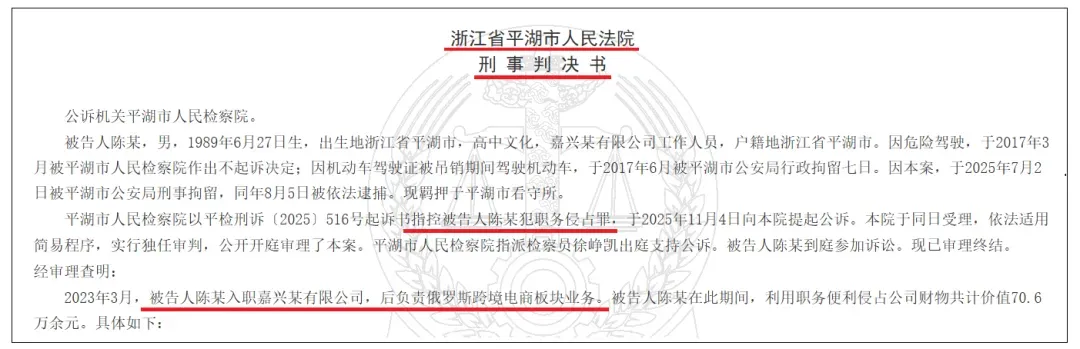
In April, a published judgment showed that Chen, an operations employee, was sentenced to two years and two months in prison plus a 60,000 yuan fine for misappropriating company property, and must repay the company 706,198.62 yuan.
In fact, sellers do have preventive measures:
For example, require employees to sign confidentiality and non-compete agreements upon onboarding, explicitly prohibiting running similar businesses during employment; divide data access permissions by role and rank; and standardize workflows so core files are transferred through internal systems.
However, such measures may create a trust gap between employees and the company. Balancing employee motivation and store data security remains a difficult challenge.
What do you think? Welcome to discuss in the comments.
AMZ123 Comment
The piggybacking risk is another warning: prevention is key. Sellers should establish listing monitoring, immediately collect evidence and complain when piggybacking occurs. Conduct background checks when hiring to prevent former employees from targeting your links. Compliant operation is the foundation of long-termism.
Source: AMZ123 Cross-border E-commerce
Original link: https://www.amz123.com/t/5uScaBuo