
 Cross-border e-commerce Hugo.com
Recently, Willow Innovations, a leading U.S. wearable breast pump company, and its affiliates filed a Section 337 investigation complaint with the U.S. International Trade Commission (USITC), naming 12 companies including Lute Innovation and Anker Innovations as respondents, involving “Certain Wearable Breast Pumps, Related Milk Storage Containers, and Components Thereof.”
01
A precise strike covering the entire supply chain
Willow asked the USITC to issue a limited exclusion order (LEO) and a cease and desist order (CDO) against the named respondents, claiming that the relevant products imported into the U.S., sold for importation, or sold after importation by the 12 companies infringe five of its U.S. patents, covering invention patents and design patents.
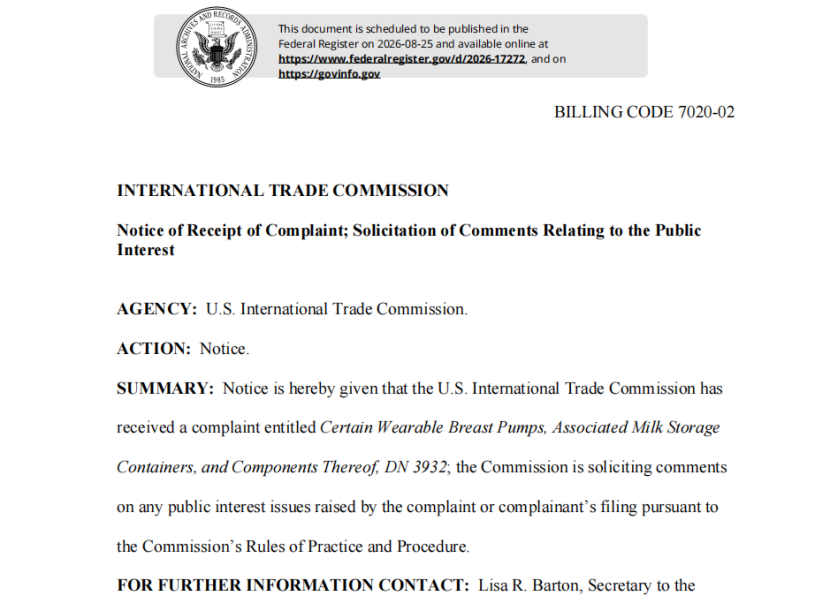
Image source: USITC notice
Specifically, the 12 respondents are divided into three main groups:
Momcozy brand affiliates: centered on parent company Lute Innovation, extending upstream to contract manufacturing and including multiple companies responsible for U.S. import and distribution.
Eufy brand affiliates: mainly Anker Innovations and its two U.S. subsidiaries—Fantasia Trading LLC and Power Mobile Life LLC.
Manufacturing and transit nodes: Shenzhen TPH Technology Co., Ltd. and TPH Technology Malaysia Sdn Bhd, among other production and transit companies, are also included in the investigation list.
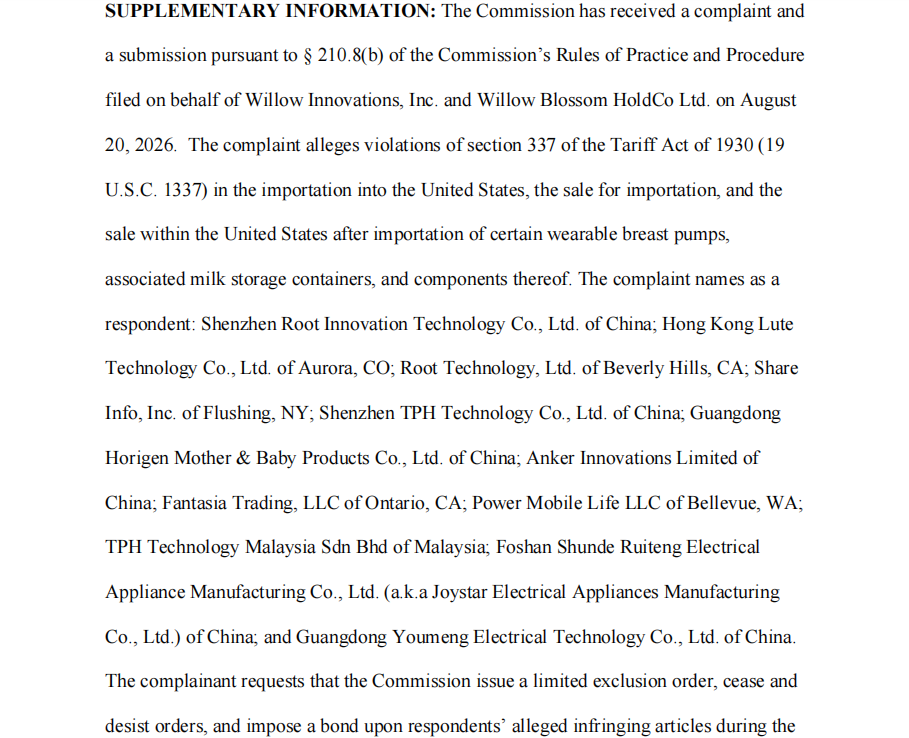
Image source: USITC notice
This Section 337 complaint is not an ordinary patent dispute, but a strategic escalation by Willow. The respondent list clearly covers the entire chain. The investigation targets not only end brands but also upstream manufacturing, transit trade, and downstream import and distribution entities, aiming to prevent China’s wearable breast pump industry from evading the orders by switching contract manufacturers or shifting trade nodes.
The breadth and depth mean that whether a party is a brand owner, contract manufacturer, transit trader, or channel distributor, as long as it is involved with the accused products, it may be blocked from the U.S. market.This is a systematic blockade aimed at the entire upstream and downstream supply chain in China.
Willow’s choice of the USITC as the dispute resolution platform was also carefully calculated.
Federal court litigation generally seeks monetary damages, while the USITC process directly targets market access and can cut off channels before products enter the United States. In a competitive landscape where market share shifts constantly, using patent weapons to block channels is more effective than seeking damages—which is why Section 337 investigations are increasingly used by U.S. companies as a competitive tool.
In June 2026, the Section 337 investigation initiated by U.S. voice technology company Cerence (Investigation No. 337-TA-1504) was a cautionary tale. Amazon was named as a respondent, the case affected many third-party sellers, and some sellers faced product delisting and overseas warehouse inventory disposal risks. Although the industry is different, the procedural risks of Section 337 investigations share common features.
02
Whose market share are Chinese brands taking?
The rapid rise of Chinese brands in the wearable breast pump sector is the fundamental driver of this patent dispute.
According to estimates by Chinese industry research organizations, the global wearable electric breast pump market was about RMB 2.01 billion in 2024 and is expected to reach RMB 3.23 billion by 2031, with a CAGR of about 7%. Among these, the wireless wearable electric breast pump market was about RMB 1.88 billion in 2024 and is expected to reach RMB 2.93 billion by 2031.
In this steadily expanding segment, Chinese cross-border e-commerce brands have grown from followers into core players in the global market.
Momcozy is a representative case of a Chinese brand going overseas. Founded in Shenzhen in 2017, the brand entered the market with a core price range of $150–$200, avoiding the above-$500 high-price range of Western brands such as Medela, Elvie, and Willow while relying on China’s supply chain advantages to achieve high cost-effectiveness at comparable quality.
In 2021, Momcozy topped the U.S. online sales rankings for wearable breast pumps. According to market data, Momcozy holds about 19% of the global wearable breast pump market and about 22% of the North American market, solidly ranking among the category leaders.
In the baby bottle warmer category, according to third-party Amazon data analysis, Momcozy also jumped to the top of the U.S. Amazon market share in August 2025, with a share of 29.93%, up 218.9% year over year.
Today, Momcozy’s product matrix extends from wearable breast pumps to baby bottle washers, smart baby monitors, bottle warmers, diaper pails, maternity pillows, nursing bras, strollers and baby carriers, nasal aspirators, rocking chairs, and other products covering the full range of pregnancy and baby care scenarios.
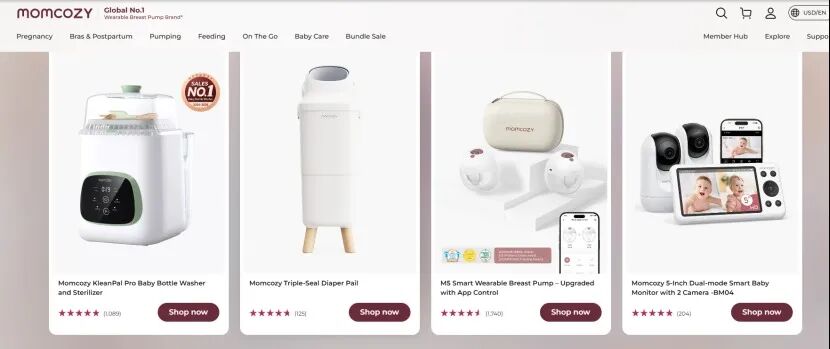
Image source: Momcozy official website
Momcozy’s success is a microcosm of the rise of Shenzhen cross-border maternal and baby brands. More Chinese brands are rapidly expanding in this segment with strong supply chain integration capabilities, forming an industrial ecosystem centered in Shenzhen and covering the entire chain from R&D and production to cross-border sales.
Against this backdrop, Willow is using the Section 337 investigation as a weapon to curb the growth momentum of Chinese brands at the market access level.
The good news, however, is that as of now, USITC public documents still show the status as “complaint received and public interest comments solicited,” meaning the Section 337 investigation has not yet been formally instituted.
The ITC will complete its material assessment and public comment solicitation within a 30–45 day window before deciding whether to formally institute the investigation. This is one of the few buffer periods left for the companies involved. During this period, the USITC will assess whether the complaint meets procedural requirements and has sufficient industry connection, while soliciting public comments on the complaint—including whether other interested parties should be included in the investigation and whether the asserted patents may be invalid.
But this window will not last long. According to Section 337 procedural practice, it usually takes 30 to 45 days from complaint filing to formal institution. Once instituted, the timetable tightens quickly: respondents must submit a response within 30 days after institution, followed by intensive discovery, leaving very limited time for all parties to prepare.
For named respondents and potentially affected companies, the real countdown has begun.
(Source: Cifnews editorial team)
Seller’s Home Review
The U.S. wearable breast pump Section 337 investigation directly targets the entire chain of Chinese sellers. Companies involved need to immediately review product patent risks and prepare to respond. The inclusion of leading companies such as Anker shows high patent barriers in this category. Cross-border sellers should focus on reviewing the patent compliance of products sold in the U.S. market and adjust supply chain and product selection strategies in a timely manner.
Source: Cifnews
Original link: https://www.cifnews.com/article/188485