
 Cross-border e-commerce Hugo.com
Recently, a public demand letter from a Shenzhen cross-border logistics company operating on the US route has once again pushed the months-long U.S. Customs inspection turmoil into the industry spotlight.
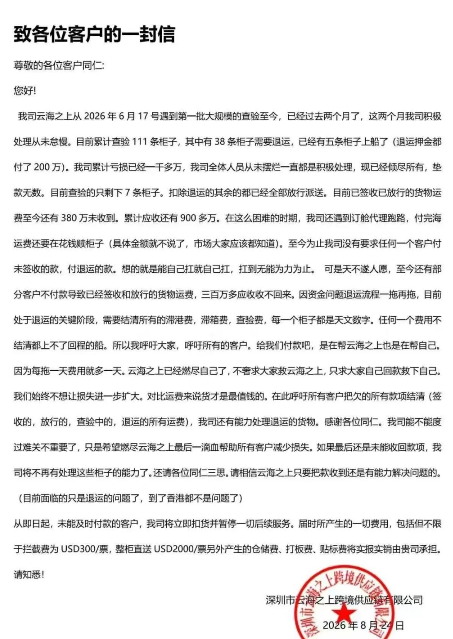
On August 24, Shenzhen Yunhai Zhishang Cross-border Supply Chain Co., Ltd. issued a public demand letter, disclosing that since the first wave of large-scale inspections on June 17, a total of 111 containers have been inspected, and 38 of them require return shipment. Five containers have now been loaded and shipped back, and the return-shipment deposit alone has already cost about RMB 2 million. Yunhai Zhishang also said that the company's losses from advancing funds have exceeded RMB 10 million. For goods already signed for or released, about RMB 3.8 million in freight charges remains uncollected, and total receivables exceed RMB 9 million.
01
111 containers inspected, 38 entering return shipment
From the information disclosed in the open letter, this incident is not an anomaly involving a single container. Instead, after a batch of goods went through inspection, detention, and return shipment in the United States, cost pressure was ultimately passed back to the domestic logistics company.
Yunhai Zhishang said that since the first wave of large-scale inspections began on June 17, the company has had 111 containers inspected, 38 of which require return shipment. Five have already been loaded and shipped back, while some other containers are still being processed. As of the release of the open letter, seven containers had not yet completed inspection, and the remaining goods had been released and arranged for delivery.
However, return shipment is not as simple as just "pulling the goods back."
Once containers enter the inspection or detention process on the U.S. side, costs such as warehousing, port demurrage, container detention, inspection, and drayage continue to accumulate. If the goods ultimately cannot clear customs, return transport must be arranged, and the company must bear the return-shipment deposit and destination-port-related costs.
For logistics companies, the most troublesome issue is "pay first, collect later."
The open letter shows that Yunhai Zhishang has already paid about RMB 2 million in return-shipment deposits, while RMB 3.8 million in freight charges remains unrecovered for goods already signed for or released. As returned containers increase, the company must simultaneously handle new logistics costs and a backlog of customer receivables, further intensifying financial pressure.
The open letter also mentioned that some containers incurred additional costs after the booking agent became unreachable, meaning that although ocean freight had already been paid, additional payments were still required before the containers could be handled. This further increased the company's capital tie-up.
For customers who have not yet settled fees, Yunhai Zhishang demanded prompt payment and said that subsequent costs, including interception fees, direct full-container delivery fees, warehousing, palletizing, and labeling, will be borne by the corresponding customers. The open letter lists the interception fee at USD 300 per shipment and the direct full-container delivery fee at USD 2,000 per full container.
02
U.S. inspections intensify, cargo return risks rise
This incident is not an isolated case; it is a microcosm of the turmoil in the US-route logistics market in 2026.
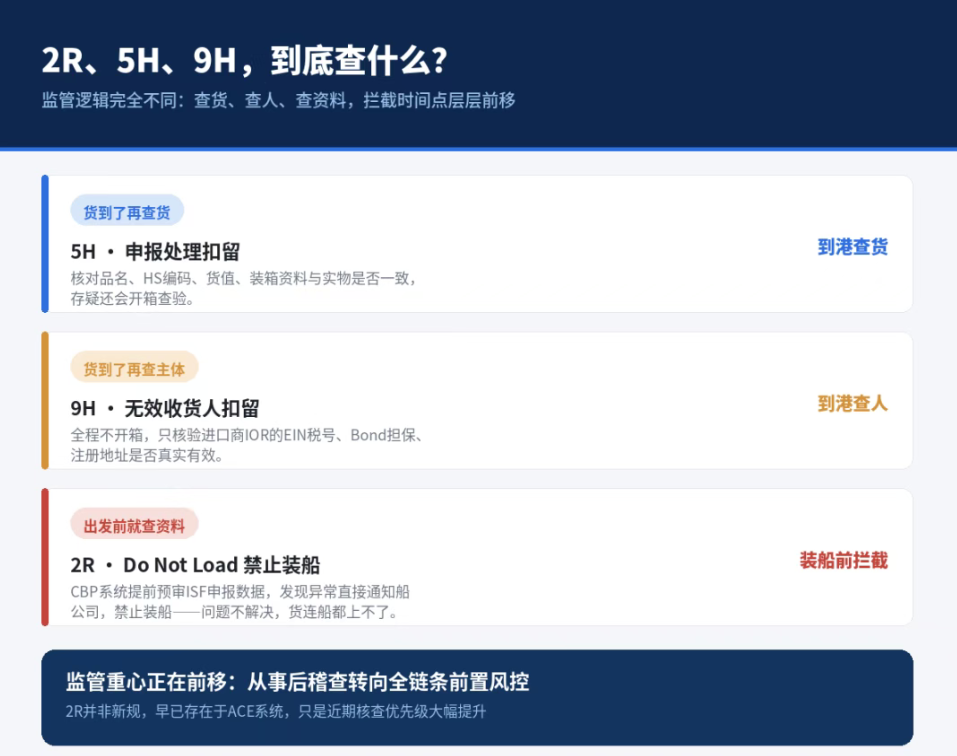
Since the beginning of this year, U.S. Customs has tightened supervision over "trade authenticity." Inspection campaigns code-named "5H" and "9H" have occurred frequently, directly targeting gray practices such as under-declared cargo values and double-clearance tax-inclusive services, leaving large volumes of goods exposed to inspection and return risks.
Just one month ago, another Shenzhen US-route freight forwarder, Meijia Cross-border Supply Chain, also collapsed for similar reasons. Meijia had long attracted cargo with low prices and loose payment terms. After its capital chain broke, it owed more than RMB 20 million to partners and overseas warehouses, leaving 91 containers stuck and 17,000 items stranded. In the end, the overseas warehouse charged sellers a cargo release fee of RMB 40 per kilogram, forcing many small and medium-sized sellers to bear heavy costs.
Recently, U.S.-side regulatory scrutiny has also expanded beyond the goods themselves.
Since August, the industry has also begun paying attention to pre-shipment interceptions such as 2R. Unlike 5H and 9H, which mainly involve reviews after cargo arrives at the port, 2R is more related to Importer Security Filing (ISF) compliance before loading, reflecting that U.S. import regulation is extending further to the pre-shipment stage.
For cross-border sellers, the past operating model of relying on freight forwarders to handle customs clearance, import entities, and declaration documents is coming under greater pressure. Once procurement documents, payment records, invoices, cargo information, and the Importer of Record (IOR) entity in the trade chain cannot match one another, goods may move from normal clearance into inspection, detention, or even return shipment. And once return shipment occurs, the loss is often no longer just logistics costs.
At present, U.S. Customs' dual 5H and 9H inspections are still ongoing, and the compliance threshold will only continue to rise. As the peak-season stocking cycle is about to begin, sellers need to reexamine their logistics cooperation models to avoid being pushed into a passive situation in which both goods and funds are lost because of a logistics-side capital chain break.
(Source: Cifnews Editorial Team)
SellerHome Review
The latest freight forwarder collapse is another warning: with stricter US-route inspections, sellers must reassess their partners' capital chains and customs clearance capabilities to avoid losing both goods and funds. It is advisable to diversify logistics channels, clearly define inspection-risk responsibilities in contracts, and prioritize service providers with overseas warehouse capacity and strong compliant declaration strength.
Source: Cifnews
Original link: https://www.cifnews.com/article/188464