 Echotik data
When coffee spills on the carpet, a pet stains the sofa, or a child messes up the back seat, most people think: leave it until the weekend. Then nothing happens.
Traditional cleaners are powerful, but pulling out the machine, plugging it in, filling water and cleaning the brush is more painful than the stain itself. Shark spotted this "too lazy to deal with it" moment.
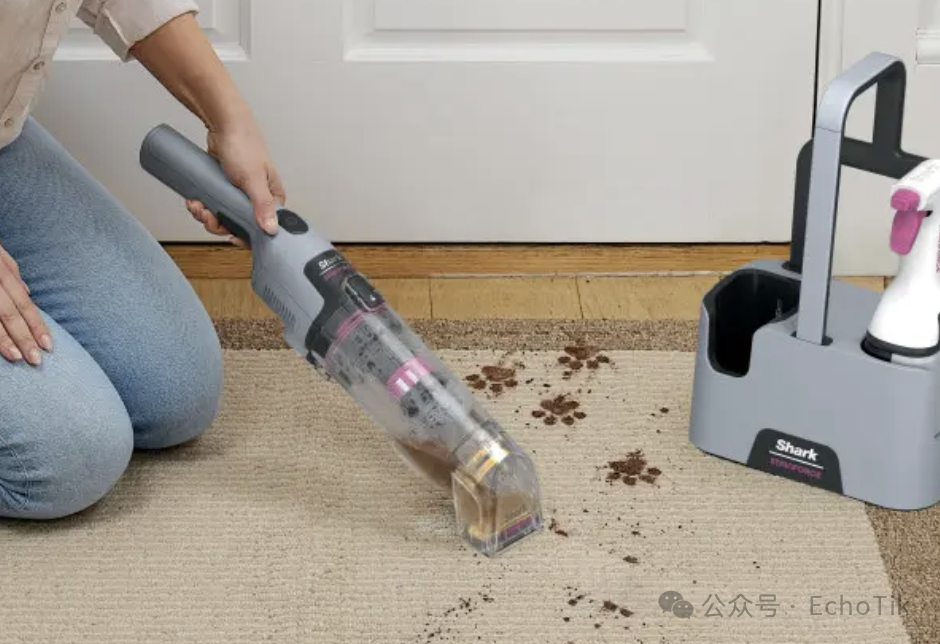
This $220 compact cleaner sold nearly 10,000 units on TikTok. How?
01 A market gap: "too lazy to move the big machine"
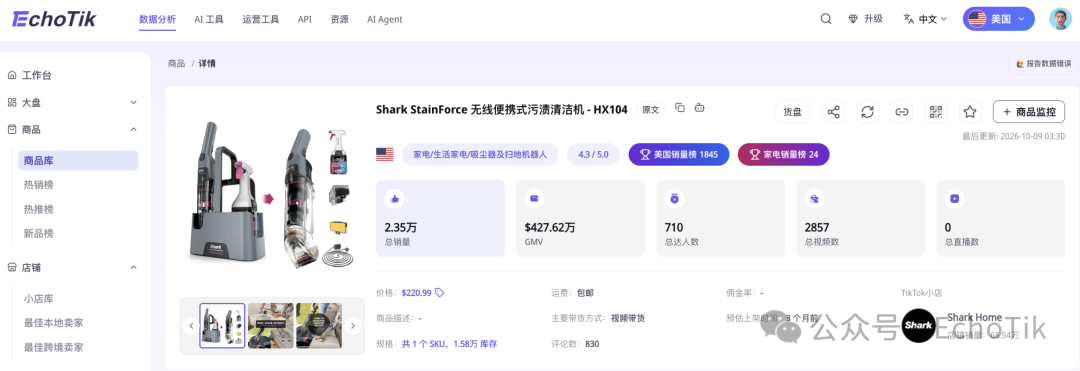
According to EchoTik, Shark's cordless portable stain cleaner is priced at $220.99, with total sales of 23,500 units and GMV over $4.2762 million (about 30.8 million RMB).
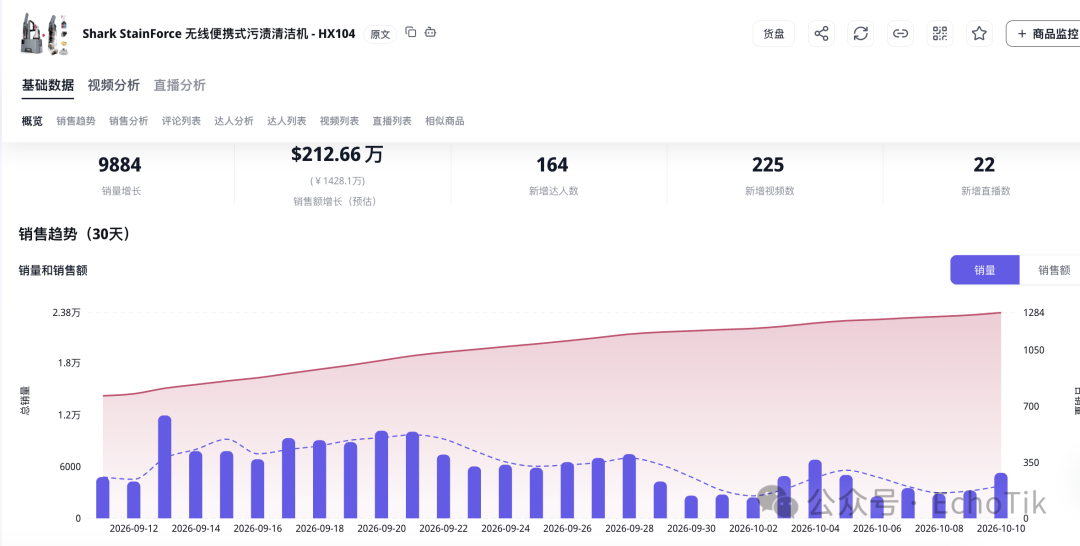
In the past 30 days, it sold 9,884 units, generating $2.1266 million (about 14.28 million RMB), adding 164 creators, 225 videos and 22 livestreams. In total, 710 creators produced 2,857 short videos.
Shark was not the first cleaning machine brand, but it carved out a specific niche.
Big cleaning equipment is overkill for small stains. Most people either tolerate the stain or wipe it with a wet wipe.
Wet wipes have limited cleaning power and can spread stubborn stains.
Shark lowered the cost of doing the job. It weighs under 3 pounds, is cordless and handheld. Its dual-chamber cleaning solution design mixes two formulas only when sprayed, keeping cleaning ingredients active.
It does not target whole-house deep cleaning. It targets everyday accidents: spilled coffee, pet urine, kids' messes.
These moments are small but frequent, yet traditional options are either too heavy or too weak. Shark found the middle ground and nailed it.
02 Is $220 too expensive?
Selling products above $220 on TikTok is already a barrier. But over 50% of this product's sales come from product cards, meaning many buyers actively searched and compared prices, not just impulse buys from short videos.
It can withstand the "is it worth it" test. Similar to the Comfrt heated blanket, when a product shifts from "a cheaper cleaner" to "there is no alternative for this spot," price is no longer the only comparison.
Pet owners, families with young children, car owners—they do not need a cheaper cleaner; they need a ready-to-use solution now.
Fewer substitutes mean stronger pricing.
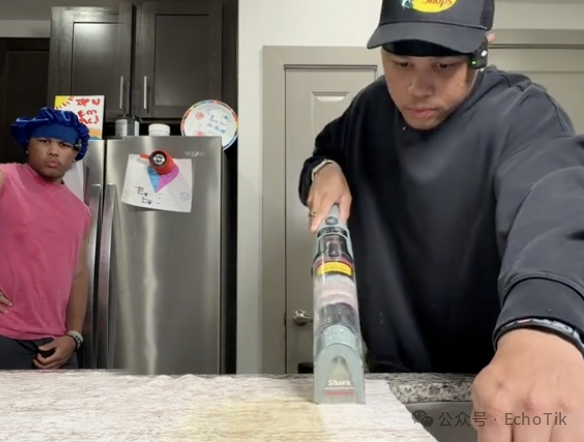
The core of this product's success is not just strong suction or smart sensors, but its fit with TikTok's visual language.
710 creators made 2,857 short videos with one structure: spray, wipe, extract.
The camera points at a dirty sofa or carpet, sprays cleaner, scrubs with the brush, then extracts dirty water. The before-and-after in one video makes the disappearing stain a direct conversion hook.
Creator @Tyla Finds posted a typical video. It reached 8.56 million views and 73,800 likes, driving $265,300 in sales and 1,406 units.
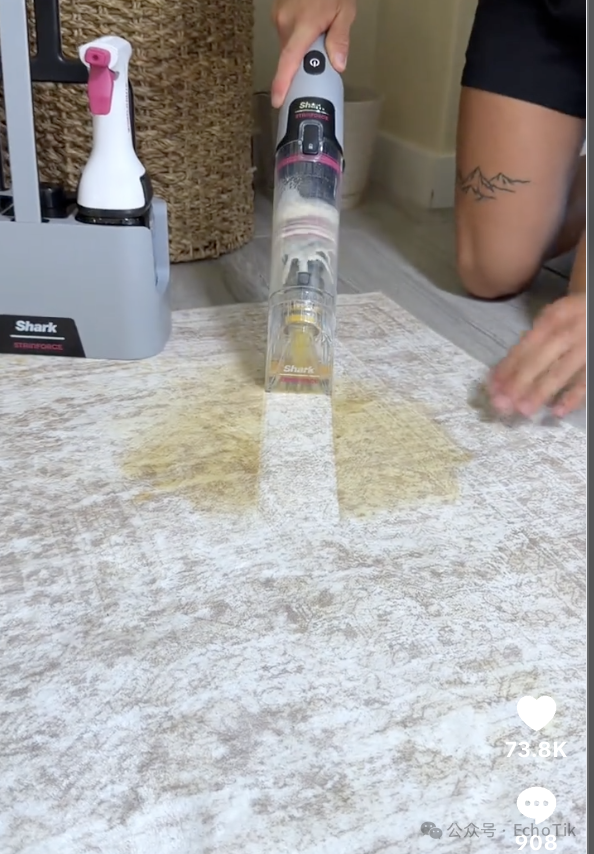
The creator showed a stained sofa becoming clean again. There was no talk about "dual-chamber cleaning design," "20x stain removal," or "cordless portable." The video just showed one thing: this can clean dirt fast.
For a $220+ product, consumers do not need a feature list; they need visual proof that it works. The before-and-after contrast is that proof.
03 A victory of "scenario"
This product's success confirms one thing: in a mature category, find the "too lazy to deal with it" moment and solve it with a product that is just good enough.
The cleaning appliance sector does not lack technology, brands, or channels. It lacks precise judgment of when consumers actually need it.
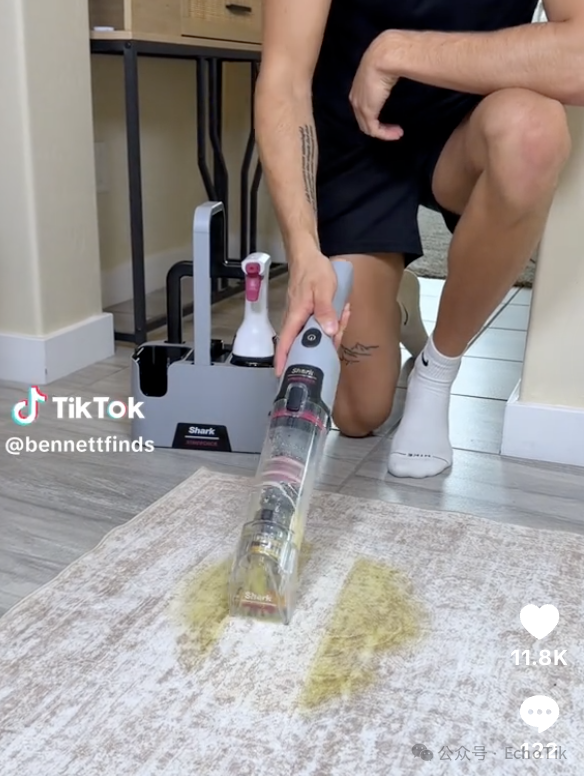
Shark did not make the cleaner stronger, cheaper, or smarter. It turned "handling small stains anytime" from a vague wish into a sub-3-pound device.
710 creators, 2,857 videos, GMV over $4.27 million. Behind these numbers is the same content formula: spray, wipe, extract—and let viewers see the result.
The next product lifted by this formula may be another category, another price band, another "too lazy to deal with it" moment.