 Cross-border promotion in Guangyu
Amazon Big Keywords Can’t Be Scaled at Will: Understand What Makes Them “Big” First
A repeatedly verified but ignored fact: the problem with big keywords is not cost, but structural misalignment in their “bigness.” A silent 2026 Amazon ad algorithm adjustment makes this misalignment more deadly.
Real seller data: a mature listing with 400+ monthly sales had big-keyword clicks over 60% but conversion under 2%; long-tail conversion was 5%–8% with under 20% traffic share. Big-keyword CPC was about 60% higher, and ACOS ended up 3x long-tail ACOS. Another new seller: $233 spend, $184 sales, ACOS 126.8%, 175 search terms burned over $200 with zero output.
These numbers point not to “big keywords can’t be advertised,” but to a more fundamental question: In 2026’s algorithm, what is your big keyword actually buying?
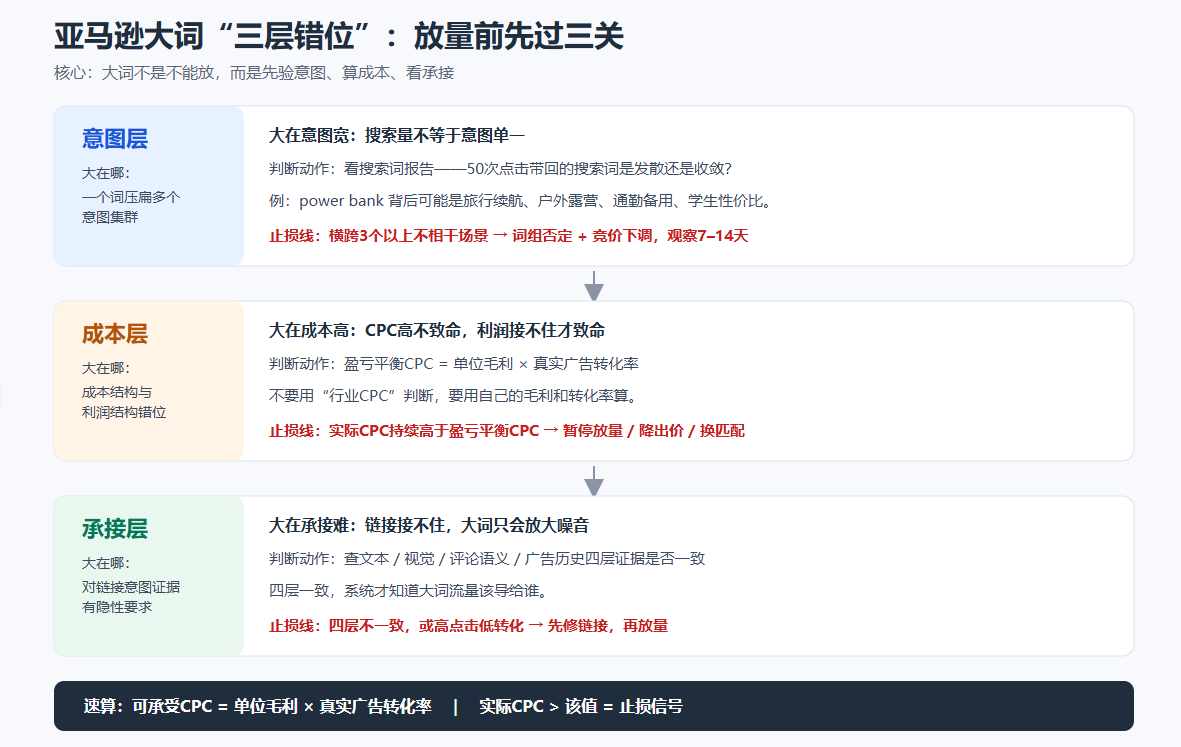
Layer One “Big”: Intent Is Eaten by the Algorithm
Traditionally, “big” means search volume. Top big keywords may have 100,000+ monthly searches and ABA rank under 10,000, like iphone 15 pro max case or tote bag, reaching 700,000–1,000,000. But with COSMO and Rufus taking over traffic distribution, search volume can’t answer how broad searcher intent really is.
COSMO shifts from keyword matching to intent-graph recommendation. It asks what problem the user is truly solving. A single power bank may contain four intent clusters: travel, camping, commuting, student budget. Big keywords are “big” because they compress multiple intent clusters into one character container.
Worse, 2026 SP broad match has an unannounced change. Broad match now prioritizes root category over specific intent. A precise search for 5080 pc (RTX 5080 gaming desktop over $3,000) may be matched to desktop computer. Sellers are forced to switch broad to phrase. Big-keyword broad traffic may systematically drift away from your intended audience.
Layer Two “Big”: Cost Structure Mismatches Profit Structure
Big-keyword CPC is no secret. 2026 Amazon SP average CPC is about $1.22; electronics $1.35–$1.60, health/personal care $1.45–$1.55; high-competition beauty/supplement keywords exceed $3. CPC alone is meaningless; what matters is CPC relative to conversion and margin.
Break-even CPC = unit margin × conversion rate. A $40 margin, 10% conversion product can sustain $4 CPC; a $12 margin, 8% conversion product sustains only $0.96. Big keywords live at the top of the funnel but are expected to be carried by bottom-funnel profit. Big keywords drive discovery; long-tail drives selection. Running both with the same budget and bid logic lets exposure cost erode conversion profit.
Layer Three “Big”: Your Listing Can’t Handle It Yet
Scaling big keywords requires clear intent tags so the algorithm knows where to route that traffic.
During the COSMO transition, non-converting big-keyword clicks still signal listing–intent association. Negating a click-but-zero-conversion big keyword cuts off intent exploration and may narrow intent tags. But if copy, images, review semantics, and ad history lack consistent intent evidence, big-keyword traffic becomes high-click, low-conversion noise instead of calibration signal.
So the correct order is not budget first, but intent evidence first. Only when listing text, visuals, review semantics, and ad click data align can the system route big-keyword exposure to the right people.
How to Use Big Keywords: Three Preliminary Judgments
First, verify intent, not search volume. Look at whether actual search terms in the search term report are divergent or convergent. If 50 clicks span three or four unrelated scenarios, the keyword’s intent breadth exceeds your listing’s capacity. Phased negation plus bid reduction and 7–14 days observation can lower ACOS by 18%–25%.
Second, calculate stop-loss CPC, not industry CPC. Use your unit margin × actual ad conversion rate. If big-keyword CPC stays above that, the issue is not the bid; it’s that the listing isn’t ready for that keyword size.
Third, use structure, not a single ad group gamble. Big keywords should be an intent verifier and tag calibrator at the funnel top with limited budget; phrase match narrows intent; exact match captures validated high-converting terms. The goal is not to make big keywords perform, but to have a structure that catches their signal.
Big keywords can be scaled, but only after understanding what makes them big: broad intent, cost-profit mismatch, and hidden listing-capacity demands. If any layer is unclear, scaling just amplifies uncertainty. 2026 Amazon advertising is not about who dares to bid big keywords, but who calculates first: is this keyword buying signal, or noise?
A “three-layer misalignment” diagram (intent → cost → carrying capacity) with actions and stop-loss lines; or a break-even CPC quick-reference table (unit margin × conversion rate = affordable CPC).