
 Xiao Huangyin said across borders
Recently, many FBM self-fulfilled sellers on the US site have received the following notice from Amazon:
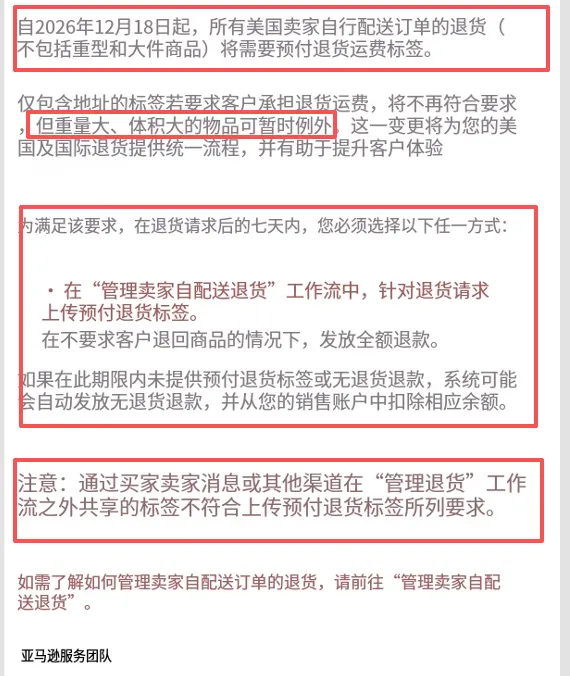
This new rule will officially take effect on the US site on December 18, 2026. Its core requirement is that after an FBM order buyer initiates a return request, the seller must complete the required action within 7 calendar days. If the deadline is missed, Amazon will automatically issue a full refund to the buyer without requiring the item to be returned, and the loss will be deducted directly from the seller's account.
📋 Core Requirements of the New Rule
Mandatory prepaid return labels: The previous practice of only providing a US return address and having buyers pay return shipping is no longer compliant. Except for temporarily exempt heavy and bulky items, all ordinary FBM orders must include a seller-provided prepaid return label.
7-day either/or rule: Within 7 calendar days after receiving a return request, the seller must complete one of two actions: either upload a compliant prepaid label on the Manage Seller-Fulfilled Returns page in Seller Central, or directly issue a full refund to the buyer without requiring a return.
Label upload channel restrictions: Return labels sent via buyer-seller messages or external channels will not be accepted by the platform and will not meet compliance requirements.
Combined with an extended peak-season return period: For orders placed between November 1 and December 31, 2026, the return window is extended to January 31, 2027. A large number of return requests will surge after the new rule takes effect, further increasing processing pressure.
⚠️ High-Risk Sellers
Sellers with return addresses outside the US: cross-border return shipping takes too long to complete the entire process within 7 days, making automatic refunds highly likely.
Sellers in high-return categories such as clothing, footwear, small appliances, and home goods: after a surge in returns, it is easy to miss backend notifications or exceed the deadline.
Sellers who rely on China-based teams to remotely operate the US site cannot respond promptly across time zones and non-working days. The 7-calendar-day countdown includes weekends and holidays, greatly reducing room for error.
🛠️ Practical Response Plan
Complete SKU-level cost calculations in advance: calculate reverse logistics + inspection + repackaging costs by SKU. For low-value items, set a refund-without-return threshold in advance. When return costs approach the item value, choose a full refund without recovering the item to avoid unnecessary logistics losses.
Use a US local return warehouse: connect with a US third-party return processing warehouse in advance and set the return address to a local warehouse. This ensures returned goods can be quickly received, inspected, refurbished, and relisted. The recovery cost for high-value sellable items can be effectively covered.
Create a 7-day countdown tracking sheet: assign dedicated staff to refresh backend return requests at a fixed frequency every day. Build a tracking list by request date, remaining days, label upload status, and refund status. Prioritize orders nearing expiration to prevent missed deadlines.
Update product data in advance: verify the actual packaged weight and dimensions of all active SKUs. This helps avoid extra carrier charges for return shipping due to oversized or overweight packages after buyers pack items themselves, which would further increase return costs.