 Cross-border information
Recently, many cross-border sellers are stuck on Amazon's real address verification:
They submitted broadband bills on time, with complete information and matching addresses, no PS edits—yet the system still rejected them directly and verification failed.
Many sellers are puzzled: all are internet bills. Why do others pass while mine keep getting rejected?The root cause is not the bill format, but that your "broadband bill" is not recognized by Amazon at all.
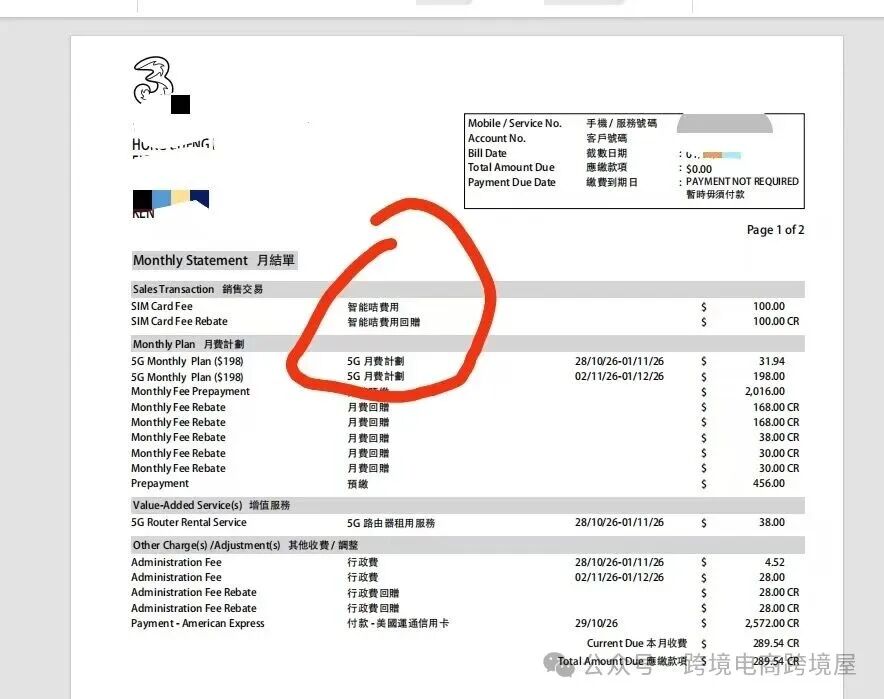
Recently, many rejected sellers share the same pitfall:their "broadband bills" are not traditional fixed-line fiber broadband, but 5G broadband, portable Wi-Fi, wireless data plans, IoT SIM card bills.
These bills may show "network service fee," "broadband package fee," "5G monthly fee," etc., looking identical to regular broadband bills and highly misleading.But the essence remains: they are mobile SIM card charge bills, not fixed-address broadband proof.
Countless sellers fall into this visual trap, submitting repeatedly and being rejected repeatedly; multiple invalid submissions may even trigger light account risk control. Amazon's underlying review logic: it does not check internet access, only "fixed operating premises."Most sellers misunderstand the core purpose of address verification from the start. Amazon asks you to submit utility, broadband, or property bills not to prove you can access the internet or pay bills,but for one core purpose:to verify that the address registered in your backend is a real, fixed, long-term actual operating address. The operator installs lines to the door, fiber into the home, bound to a unique door number, fixed building and room.The line cannot move, and the address is permanently bound and cannot be changed.This bill directly proves:someone is working long-term and genuinely operating at this address. Portable Wi-Fi, 5G wireless broadband, data cards, IoT cards have no physical wiring and no fixed location binding.Devices can be carried anywhere—today in Guangzhou, tomorrow in Shenzhen, and any city the day after. It only proves you paid for a network package; it cannot prove that the address registered in your backend is truly operating. Simple summary: ✅ Fixed-line broadband = address proof (accepted by platform) ❌ 5G/SIM wireless broadband = consumption proof (directly rejected) Using a "movable data bill" to prove a "fixed operating address" is logically contradictory; rejection is not unfair. It is not the platform making things difficult; the 2026 review rules have been fully upgraded. In the past two years, any phone bill or data bill could pass.But this year, Amazon KYC and address verification rules have been completely updated. Since August this year, European and UK sites first implemented the VOEC tax compliance framework.Platform review has upgraded from merely verifying company qualifications and tax number authenticity to:verifying registered address = actual operating address, strictly checking virtual registration, multiple accounts at one address, and shell companies. Previously, accounts removed in large numbers had core problems: secretarial company registered addresses, virtual addresses, no actual operating premises.5G wireless bills and data card bills naturally match the profile of "remote registration, shell operations," and therefore become key targets for system interception. The platform no longer only sees "who you are" but strictly checks "whether you are really doing business here."All movable, unbound, no fixed-location proofs are invalid. High-frequency hidden pitfalls: fixed-line broadband can also be rejected! Not only wireless broadband; many sellers using regular fiber broadband still fail due to detail loopholes: 1. Address discrepancy leads to direct rejection. The backend registered address, business license address, and bill installation address must be exactly the same.Differences in building numbers, uppercase/lowercase, spaces, building/unit, room/suite wording will be judged as address mismatch. 2. Account holder mismatch. Corporate accounts should prioritize company-name broadband bills; a legal person’s personal broadband without proof of relationship can easily get stuck. 3. Invalid simple bills are not accepted. Minimal payment receipts or screenshots showing only the amount, without a complete installation address, carrier official logo, or bill number, are not considered formal bills. 4. Expired materials are invalid. All address proofs must be complete official electronic bills issued within the last 180 days. According to Amazon’s latest review standards, proof priority from high to low: 1. Water/electricity/gas bills, fixed-line telephone bills 2. Official fixed-line broadband bills (wired into the home, with unique installation address) 3. Company corporate bank statements, legal person real-name bank statements 4. Formal site lease contract + property invoice (auxiliary proof) Also keep in mind two taboos: ❌ Never submit: 5G broadband, portable Wi-Fi, IoT cards, mobile SIM phone bills ❌ Without complete compliance materials, never arbitrarily change the backend operating address; it can easily trigger a second deep KYC review, blocking peak season sales. Amazon compliance is no longer just "complete documents will pass."Many sellers fail address verification not because of insufficient materials, but because of outdated understanding. Source: Cross-border E-commerce Kuajingwu