
 Cross-border information
Large-Scale Section 3 Audits
According to reports, many European marketplace sellers said their stores had no fake reviews or infringement complaints and were operating normally, but they suddenly received account suspension notices. Overnight, all listings were removed and account funds were also frozen.
The only option is to complete video verification within 14 days; otherwise, the store may be permanently closed.
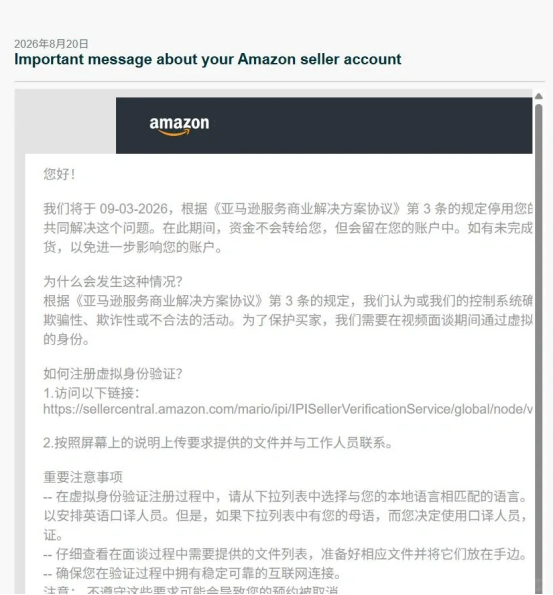
Image source: seller report
The core of Section 3 audits is that once the system determines an account has deceptive, fraudulent, rule-circumventing, or illegal operating risks, it can suspend the store, freeze funds, and launch a full investigation without prior warning.
Section 3 audits are not new to sellers, but in the past the process was violation first, warning next, then punishment, so sellers clearly knew what was wrong with their accounts.
This round of audits focuses on using AI technology to review long-term store operating records. As soon as the risk control system identifies potential risks, it can directly trigger account suspension, and the burden of appeal rests entirely on the seller.
In other words, even if you are now running a pure white-hat compliant operation, any past violation traces can still be flagged and lead to suspension.
These include category misplacement to bypass review, variant merging tied to zombie links, hiding restricted product attributes (such as battery-containing, FDA-related, or children's products) to list in gray areas, keyword stuffing in Search Terms, and historical title and image modification records.
Some sellers believed they had not actively violated rules, but early authorized brand owners had violation records, they shared login devices, or their registration information and actual business addresses had slight differences. These became the hardest-hit groups in this sweep.
Only One Chance for Video Verification
For this round of Section 3 audits, the most important step is still video verification. Carefully read Amazon's email to see whether it contains keywords such as "identity verification," "linked accounts," "fraudulent activity," or "product authenticity." The appeal logic differs completely depending on the reason, so do not use a one-size-fits-all template.
If it is an identity issue: prepare the latest business license, legal representative's ID, bank statements from the past 90 days, and credit card statements. All materials must be clear scanned copies, not screenshots or edited images, and the names, addresses, and company names must exactly match the backend registration information;
If it is a product authenticity issue: prepare purchase invoices from the past three months, supplier business licenses, logistics documents, and brand authorization chain documents. The invoice amounts should match store sales; for example, there should not be 100,000 in sales but only 10,000 in purchase invoices;
If it is a linked-account issue: thoroughly sort out all connection relationships, explain why the accounts are linked or why it does not constitute an improper link, and provide proof of independent operations.
Throughout the video review, the legal representative must attend in person and truly understand the business. Even if they are not very professional in their wording, the logic must be clear and the details accurate. You may not know specific operational tasks, but at least you should know what products the company sells, who the suppliers are, approximate profits, and who is using the payment account.
For sellers who have not received an audit notice, prevention is always better than appeal, so quickly check listing adjustment records, variation relationships, ASIN creation records, and keyword edit logs from the past one to two years, and promptly clean up potentially risky listings.
In addition, do not easily believe all the scams claiming guaranteed Section 3 approval on the market. As long as a store has genuine physical operations, a complete supply chain, and complete documentation, the video verification pass rate is high with thorough preparation, so there is no need to panic excessively.
Cross-border compliance is no longer a bonus but a survival baseline. In the AI risk control era, historical violation traces will eventually be reviewed and cleaned up. Pure white-hat, standardized operations are the only long-term path.
Have you recently received a Section 3 notice? What problems have you encountered during the appeal process? Feel free to share in the comments.
Source: Minge Cross-border Notes