 Xiao Huangyin said across borders
To gain insights into Amazon consumers' demand structure and crack the growth logic of non-standardized products, it is necessary to start from the "essence of demand" and systematically decompose it in combination with platform mechanisms, user behavior, and operational strategies.
1. Understand the essential characteristics of non-standardized products
Non-standardized products refer to products that lack unified specifications, functions, or highly personalized usage scenarios, such as home decoration, pet supplies, outdoor equipment, niche clothing, etc.
Three major pain points of non-standardized products:
1. Search terms are scattered: Users express their needs in various ways, and keywords are severely long-tailed.
2. Conversion paths are complex: Decisions depend on multi-dimensional information such as scenarios, emotions, visuals, and reviews.
3. Low repurchase rate: One-time purchases dominate, making it difficult to form a stable traffic closed loop.
Therefore, the "big word + high conversion" advertising model for standardized products cannot be applied, and a promotion system centered on "demand scenarios" needs to be constructed.
2. The five-level model of consumer demand structure (Amazon context)
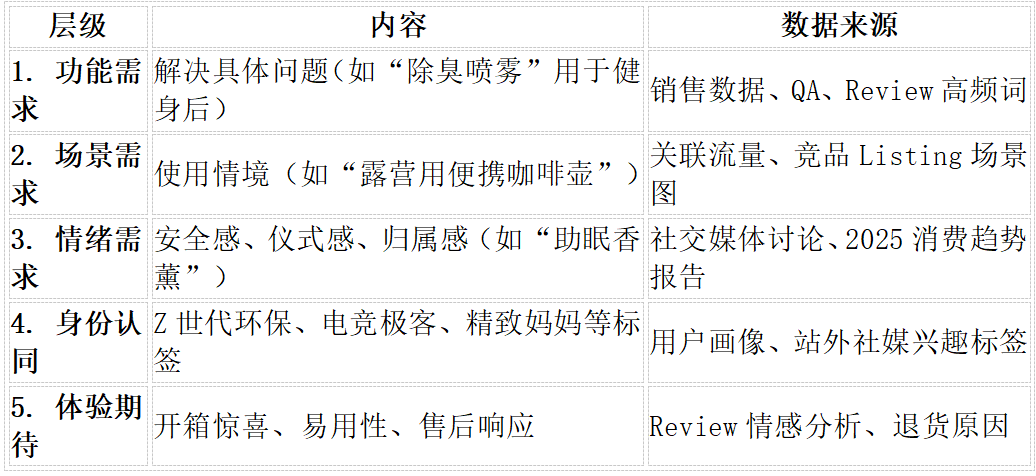
Key insight: The success of non-standardized products = accurately matching scenarios + activating emotional resonance + strengthening identity labels
3. The "three-stage advertising architecture" for non-standardized product growth (practical approach)
▶ Stage 1: New product cold start (0-2 weeks)
Goal: Quickly be indexed by Amazon and establish initial relevance tags
· Automatic advertising: Only enable Close Match + Loose Match, high bid testing
· Synchronous reviews: Accumulate trust signals through Vine or early reviewer programs
· Negative invalid traffic: Eliminate obviously irrelevant words (such as competitor brands, incorrect categories)
▶ Stage 2: Traffic expansion period (2-8 weeks)
Goal: Seize high-potential long-tail keywords and rush to the homepage exposure
· Broad match group: Run out potential demand words (such as "gift for dog lover who has everything")
· Precise long-tail keyword group: Focus on high-conversion scenario words (such as "travel yoga mat for women")
· Product positioning advertising: Place complementary (Complement) and substitute (Substitute) ASIN
· Display advertising: Target category pages + competitor detail pages, intercept related traffic
▶ Stage 3: ROI optimization period (8 weeks +)
Goal: Reduce ineffective spending and consolidate core traffic pool
· Negative inefficient words: ACoS > target value and no conversion words are all negative
· Budget tilt: Allocate 70% + budget to Top 3 high-conversion advertising campaigns
· Matrix coverage: Cover the entire path of "search-browse-remarketing" through SP + SB + SD advertising combination
✅ Core principle: Non-standardized product advertising is not about "finding big words", but "weaving demand nets"
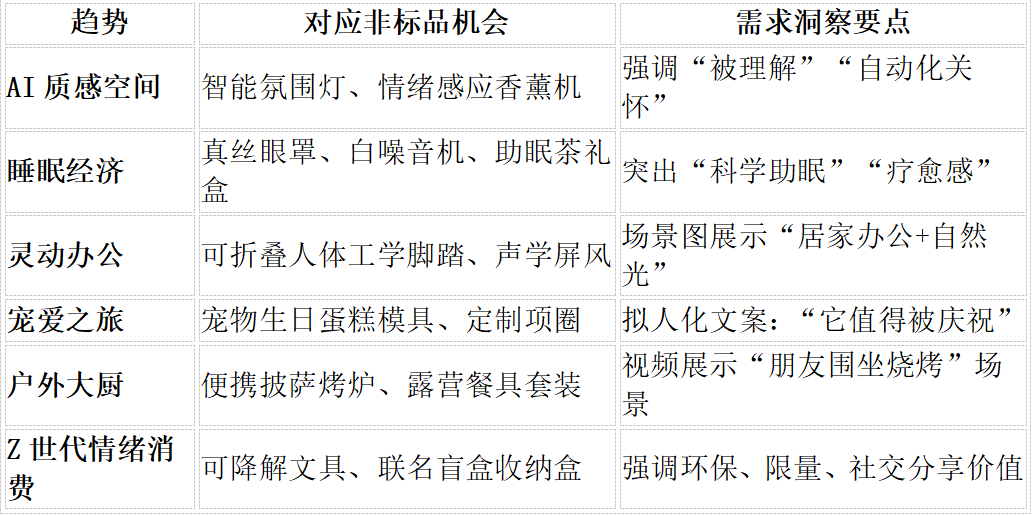
4. Combining 2025-2026 consumption trends, tapping high-potential tracks
According to Amazon's "2025 Global Consumption 10 Trends" and the 2026 seller ecosystem report, the following non-standardized product directions have structural opportunities:
5. Long-termism: From "selling products" to "managing demand assets"
By 2026, Amazon has entered the "operational capability dividend period", and top sellers rely on:
· Demand database: Continuously accumulate high-value long-tail keywords, scenario tags, user profiles
· Content assets: A+ pages, videos, brand stories strengthen emotional connections
· Brand compound interest: Feed back Amazon weight through independent stations + social media
As the report says: "The logic of hot sales is ebbing, and refinement and long-termism have become the main theme."
Conclusion: The growth code of non-standardized products
It's not about "making more people see", but "making the right person heart skip a beat".
Through demand structure insights × scenario advertising architecture × trend track positioning, non-standardized product sellers can completely achieve differentiated breakthroughs in the highly competitive environment of 2026.
If you need specific category (such as pets, home, outdoor) advertising structure templates or keyword mining methods, please further explain, I can provide customized solutions.