
 Cross-border promotion in Guangyu
Every year at the beginning, the adjustment of FBA fees is a mandatory "stress test" for sellers' profit models. The adjustment plan for 2026 is particularly crucial. Through a series of rate changes that are detailed down to product dimensions, weight, and inventory age, it clearly reveals Amazon's future plans for its logistics network: to encourage high-value, fast-turnover inventory and penalize inefficient and redundant assets. Understanding this set of "economic levers" is the financial foundation for sellers to remain competitive in the new year.
1. Detailed Explanation of Rate Adjustments: Understand the Core Changes in One Picture
The following table sorts out the most core fee changes related to most sellers. These changes together constitute the cost fundamentals for the new year:
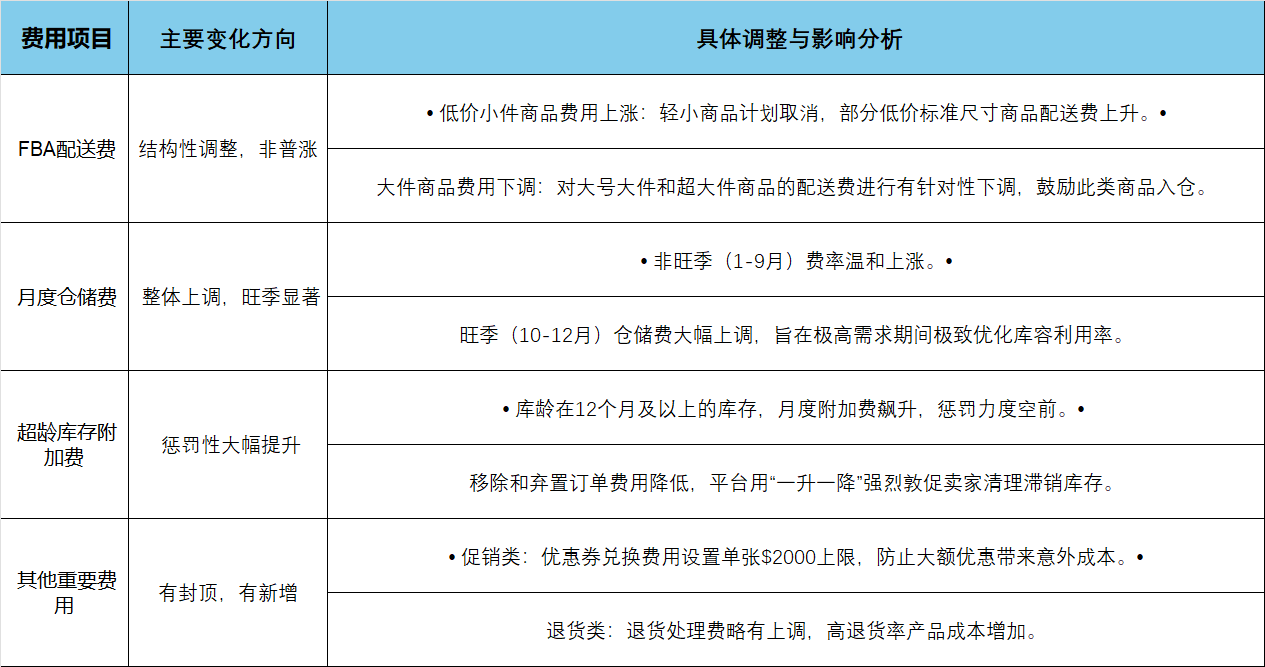
2. Decoding Platform Intentions: Four Strategic Signals Behind Rate Adjustments
Behind these numerical changes are the strong strategic signals Amazon is sending to the entire seller ecosystem:
1. Signal One: Optimize Inventory Structure and Improve Network Efficiency
By significantly increasing the delivery cost advantage of oversized products, Amazon hopes to attract more categories such as furniture and home appliances to settle in FBA, so as to balance the capacity load of its logistics network. At the same time, by sharply increasing the fees for over-aged inventory, it strongly drives out "ineffective inventory" with slow turnover, making room for best-selling products and maximizing warehouse efficiency.
2. Signal Two: Guide the Optimization of Product Value and Volume
The cancellation of the light and small products plan and the increase in delivery fees for low-value products mean that the profit margin of the "small profit and quick turnover" micro-product model in FBA is further compressed. The platform prefers to serve medium and above value products that can bear higher delivery costs and bring higher total profits.
3. Signal Three: Strengthen Supply Chain Discipline in Peak Season
The significant increase in peak season storage fees is the platform's use of economic means to "manage expectations". It requires sellers to conduct more accurate peak season sales forecasts and inventory planning. Blindly hoarding and preparing goods will pay a huge price, thus forcing the entire supply chain to evolve in a more refined and flexible direction.
4. Signal Four: Promote the Transparency and Controllability of the Whole Chain Cost
Setting a cap on coupon fees and fine-tuning return fees reflect the platform's assistance to sellers (especially medium and large sellers) to better predict and control overall operating costs, reduce "unexpected overspending", and make financial management more certain.
3. Seller Action Guide: Four Steps of Refined Profit Management
In the face of the new cost structure, sellers must shift from "extensive accounting" to "refined profit management".
Step One: Immediately Initiate "SKU-level" Profit Recalculation
1. Tools First: Be sure to use the latest "Profit Analysis Dashboard" on the Amazon Seller Platform, which has integrated new rates.
2. Item-by-item Review: For each active ASIN, recalculate the net profit per unit of product according to its size segment, weight, and historical selling price. Focus on those products at the "critical point" of fee adjustment (such as size and weight critical values). Fine-tuning packaging may bring about fee downgrades.
Step Two: Optimize Inventory Structure Based on New Logic
1. Clean up Redundancies Immediately: Immediately develop a clear schedule for clearing inventory over 6 months old (promotion, off-site, clearance, abandonment), and take action before high over-age fees are incurred.
2. Evaluate Product Value Matrix: Re-examine the product line and evaluate the cost-effectiveness of continuing to use FBA for low-value, large-volume or low-sales products. Consider switching to FBM (Merchant Fulfilled) or directly eliminating them.
Step Three: Adjust Pricing and Promotion Strategies
1. Scientific Price Increase: For core products that are significantly affected by the increase in delivery fees, based on new profit data, carefully and gradually test price elasticity and transfer part of the cost to consumers.
2. Make Good Use of Promotion Tools: When setting high-value coupons, clearly understand the $2000 cost ceiling so as to design bolder promotional activities. At the same time, due to the increase in return processing fees, it is necessary to more strictly monitor products with high return rates and optimize product quality and description accuracy from the source.
Step Four: Plan a More Resilient Supply Chain
1. Accurate Forecast and Multiple Replenishments: To avoid high storage fees during peak season, it is necessary to adopt a "small batch, multiple batches" replenishment model. Relying on more accurate sales forecasts and "Amazon Logistics Capacity Manager", dynamic replenishment is carried out.
2. Explore Logistics Portfolio Solutions: For oversized or highly seasonal products, you can evaluate the mixed model of "FBA (core inventory) + third-party overseas warehouse (buffer inventory)" to balance timeliness and cost.
Conclusion
The FBA fee adjustment in 2026 is Amazon's latest "rental plan" as a "logistics giant" to its platform "tenants". It no longer provides inclusive convenience, but through highly differentiated pricing, it guides resources to flow to the places with the highest efficiency and value. For sellers, this requires us to upgrade our roles from "cross-border e-commerce operators" to "global supply chain cost accountants". Victory will not belong to the largest sellers, but to those "refined operation experts" who can read data accurately, calculate precisely, and adjust agilely. Your profit defense battle begins with a thorough understanding of this new rate table.