
 Cross-border e-commerce Hugo.com
Ahead of the World Cup, a group of "special fans" are entering the stadium.
They have no tickets and don't check scores, yet they flood social media — dogs, cats, even ducks and hamsters dressed in team colors.
During the 2026 World Cup, pet jerseys have become a hot consumption trend in football markets like Mexico. Many sellers have launched pet versions of national team jerseys, with some products even in short supply.
"Pet economy + sports consumption + social content" — this category is stacked with trending attributes.
A pet jersey priced around $10 connects to a global pet market worth hundreds of billions of dollars and the traffic dividend of a mega sporting event every four years.
Pet apparel market grows, jerseys become a breakout segment
Pet clothing is emerging as a new growth direction in overseas pet consumption.
Data shows the global pet apparel market is expected to reach about $7.29 billion by 2026 and grow to $11.14 billion by 2034, maintaining a CAGR of around 5.4%.
The key driver isn't just decoration or warmth, but the trend of "pet humanization."
More overseas consumers treat pets as family members, buying them clothing and accessories and showing them off on social media. In the UK, pet clothing searches are rising, with many consumers seeking matching outfits with their pets.
At the same time, pet jerseys perfectly fit consumption scenarios like watching sports, family gatherings, pet social sharing and holiday marketing.
Compared to ordinary pet clothes, jerseys carry stronger emotional value — making pets feel like part of the team.
Amazon, TikTok Shop, Temu: pet jerseys are gaining traffic
Pet jerseys have already formed a mature consumer market on e-commerce platforms.
On Amazon US, under categories like "Pet Supplies → Dogs → Apparel & Accessories → Shirts" and "Sports & Outdoors - Fan Shop - Pet Gear - Pet Clothing - Pet Jerseys," you can find many football, basketball and baseball-themed pet jerseys, where World Cup, national team and team elements are hot trends.
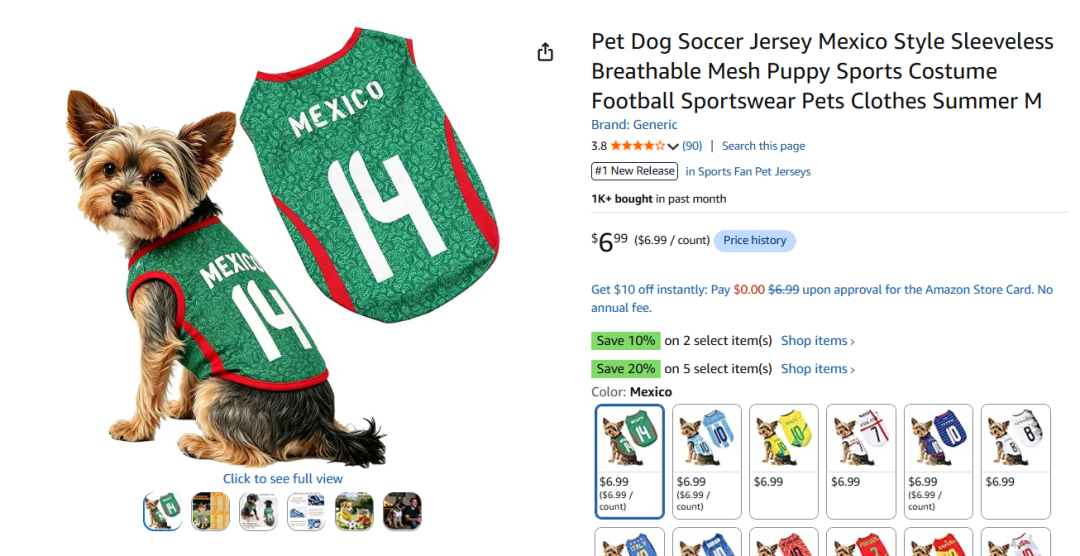
Product types fall mainly into three categories:
Type 1: Event-themed models, like World Cup national team jerseys or NFL/NBA team pet clothes. Their biggest advantage is clear traffic — during events, consumers search with strong intent and make quick purchase decisions.
Type 2: Personalized custom items, including pet names, owner numbers or DIY team designs. These command higher prices and suit content-driven e-commerce better.
Type 3: Daily sporty pet wear, such as baseball-style, basketball-style or football training jerseys, with a longer lifecycle than event-specific ones.
Price-wise, ordinary pet jerseys mainly range from $5 to $15, customized options with team or player names and numbers go for $15–$25, while officially licensed versions can exceed $30.
TikTok amplifies the value of sharing
Amazon validates demand; TikTok amplifies emotional spread.
Pet products inherently possess short-video sharing appeal — a dog wearing the same team jersey as its owner, paired with match day, family gathering or fan celebration scenes, easily generates viral content.

Image source: TikTok
Content on TikTok around these products mainly revolves around "emotional consumption." Themes like "my dog supports this team too," "watching the game with my pet," or "the whole family in matching outfits, including my pet" trigger purchases more effectively than simply showcasing products.
More than relying on search traffic, pet jerseys are well-suited for content-driven e-commerce.
Copyright risks cannot be ignored
The biggest barrier for pet jerseys isn't design or production — it's copyright.
Some sellers mistakenly think "a smaller size means it's not team merchandise." But team logos, badges, player names and event symbols all fall under intellectual property protection. Unauthorized use may lead to delisting or even account bans.
Many low-priced products use similar color schemes, downplay logos or create original team elements as a workaround. This indeed reduces infringement risks and is a common entry path for many small and medium sellers.
But for those aiming for long-term business, it is recommended to:
Obtain proper licensing;
Develop original team-style designs;
Build pet + sports lifestyle products.
China's supply chain has quick-entry advantages
Although pet jerseys are a relatively niche category, the supply chain barrier isn't high.
China's apparel industrial clusters already possess mature capabilities in small-batch quick response, custom printing, multi-size production and rapid development. Pet clothing is structurally similar to adult sportswear — fabrics, printing, cutting and packaging can all be quickly adapted.
Opportunities extend beyond a single "pet garment." Sellers can build a full product matrix around events, such as pet jerseys, pet scarves, pet hats, matching owner-pet outfits and match-day pet kits.
Final thoughts
Pet jerseys aren't a tens-of-billions-dollar mega category, but they have become a new entry point combining sports consumption and the pet economy.
Their value lies in the short-term explosion driven by events, ongoing social-media amplification, and long-term consumption fueled by pet humanization. The biggest opportunity isn't waiting for a hit product — it's positioning before each event cycle begins.
The 2026 World Cup is just the beginning.
The fusion of global sports events and pet consumption will likely create more new niche opportunities in the coming years.
Seller's Home Commentary
The pet economy is evolving from "peripheral" to "essential," and this $10 pet jersey hits the sweet spot of social-media sharing and emotional consumption. Sellers should seize team collaborations and holiday-limited editions, prioritizing aesthetically appealing, multi-size supply chains to meet demand spikes of over a thousand orders per month.
Source: Cifnews
Original link: https://www.cifnews.com/article/187669