 Amazon Global Store opening
"Less than a month after listing, the return rate soared to30%, and the money spent on advertising exceeded the profits."
Lin Wanyi first tasted the bitterness of cross-border e-commerce during an attempt in the pet supplies category. Products that sold well domestically were coldly received in overseas markets, with high return rates and ineffective advertising. At that moment, he truly realized:The difficulty of cross-border lies not in the product, but in the user.

Lin Wanyi was not a"grassroots"seller. In 2011, during his university years, he started domestic e-commerce, mainly dealing in handicrafts and small furniture, with the highest annual sales reaching170–180 million RMB. At that time, he called himself"a small seller on the assembly line," relying on scale and channels, and caught up with the dividend period of domestic e-commerce.
But by2022, domestic orders declined and production capacity was excessive, so he had to lead a team of more than 70 people to start cross-border transformation, with the first stops being the United States and Canada. Today, his cross-border business has an annual GMV of nearly200 million RMB, covering the United States, Canada, Europe, the UK, Japan, and Australia.
Looking back at the cross-border journey of these years, Lin Wanyi found that what really promoted the growth of the team was not the optimization of advertising methods or the adjustment of new product rhythms, butrepeated revisions and understandings of users.

When he first started in pet supplies, Lin Wanyi took many detours. Initially, for convenience, he casually dressed a cat in clothes and took photos, uploading the images to the product page, thinking that was enough.
But problems quickly arose: within a month, the return rate for this pet clothing item soared to30%, and the comments were full of dissatisfaction:"Doesn't fit at all!" "The photo shows a kitten, but my cat is too tight when wearing it."
"That's when I realized that the model for pet products is more important than the product itself."Lin Wanyi said.
Since then, he has completely refined the operation of the pet category:
◉ Model Matching : Specifically hired corgis, Shiba Inus, and other medium-sized dogs to take photos for clothing models, and used ragdoll cats and British Shorthairs to demonstrate the effectiveness of cat scratchers;
◉ Parameter Segmentation : Directly write on the product page "Suitable for cats/Shiba Inus/corgis weighing 10–12 pounds," instead of vaguely saying "small, medium";
◉ Direct Copywriting : Avoid vague words, do not say "suitable for most pets," but clearly indicate weight, chest circumference, and neck circumference;
◉ Size Comparison : Use model photos to show weight and actual wearing effects, allowing users to judge intuitively.
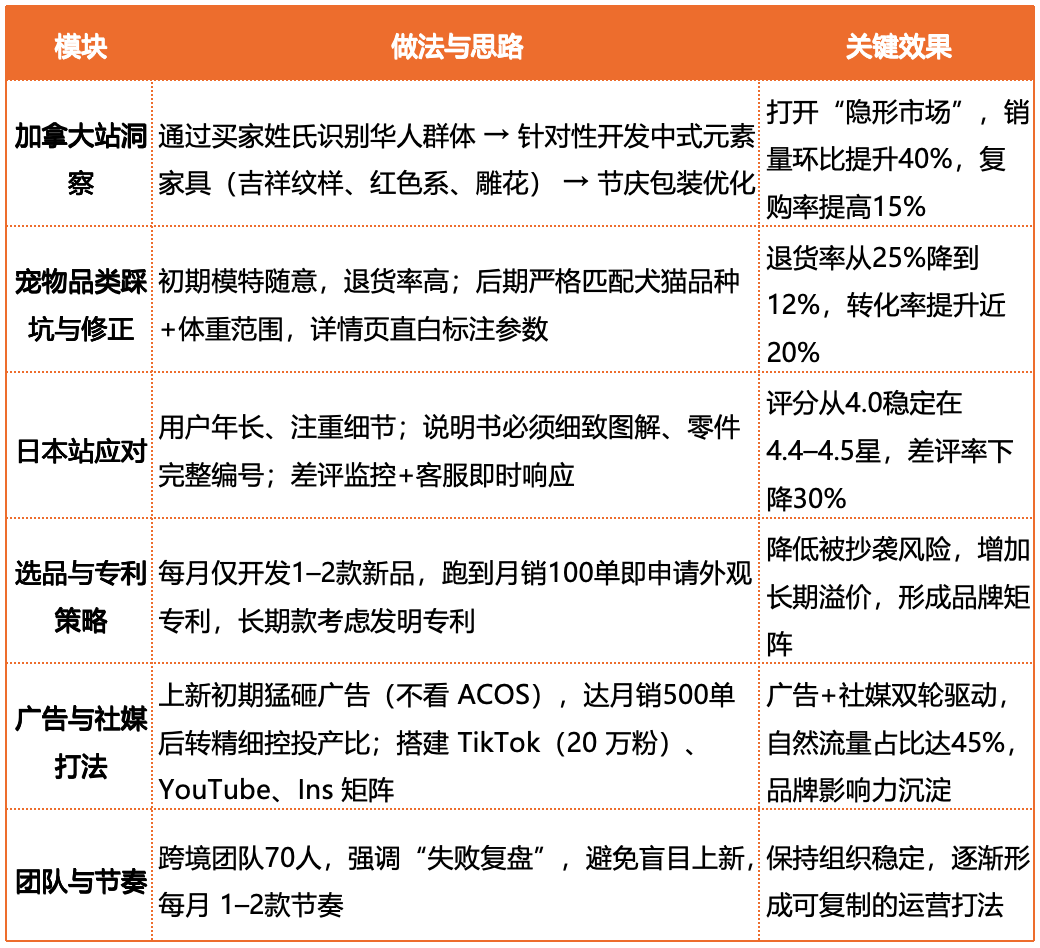
These improvement measures reduced the return rate of the high-return pet clothing item from25% to 12%within three months, and the conversion rate increased bynearly 20%.
"Choosing the wrong cat or dog model is more fatal than a product design mistake."This is a phrase he repeatedly emphasized.
After this"lesson,"Lin Wanyi began to pre-register appearance patents for hot-selling pet productsto prevent competitors from imitating the styles they worked hard to develop. He joked:
"Sometimes the effort you put in is not in designing products, but in designing trust."

When Lin Wanyi first entered the Canadian market, he didn't have much expectation. Following the usual logic, he simply copied children's toys and furniture that were successful in the US market. Sales were initially flat, with no particular highlights.
The turning point came from an accidental observation. While checking the order backend, he noticed that a considerable proportion of buyers had surnames like"Wang, Li, Zhang". This made him realize that there was a neglected group of consumers in the Canadian market—the Chinese community.
"What they buy is not just a product, but also a cultural identification."Lin Wanyi summarized.
He immediately adjusted his strategy:
(1)Added Chinese elements to the furniture design, such as carving techniques, auspicious patterns, and red color schemes;
(2)Highlight festive attributes on packaging, such as for the Spring Festival and moving scenes, and even added Simplified Chinese to the instructions;
(3)Increase advertising coverage in areas with a higher concentration of Chinese communities.
The results were immediate: a storage cabinet with Chinese patterns sold only20 units per day on the US site, but broke through35 units per dayon the Canadian site; sales even doubled during Chinese festivals. Overall, Canadian site sales increased by40%month-over-month, and repurchase rates increased by15%.
"The US site gave me sales, but the Canadian site let me see identity."
This was his biggest gain in the first year of cross-border business:The market is not a whole, but composed of different identity and cultural slices. Find that slice, and you can run differentiated products.
To support such differentiation, he gradually slowed down the pace of new product launches, developing only1–2 new products per month, and applying for appearance patents when monthly sales reached100 units. The slow pace of development was to ensure that each niche group could truly make purchases.

"Japanese customers are really the most troublesome for me," Lin Wanyi said frankly.
On the Japanese site, he found that the consumer group was older, with simple aesthetics, and more concerned about product durability. But what really frustrated him was their shopping habits.
"They clearly understood the instructions, but still wrote in negative reviews: I understand, but I have another question."
This"using negative reviews as Q&A"habit almost dragged down the product rating.
To deal with this"stringency,"he had to double down on refinement:
◉ Instruction Optimization : Limit each page to3–5 steps, number all parts, and make illustrations clear enough to distinguish even small components at a glance;
◉ Customer Service Mechanism Establish"negative review monitoring + instant customer service," and immediately follow up and solve problems found in negative reviews;
◉ Product Pace Develop only one new product every two months, using a slow pace to exchange time for detail polishing.
This strategy stabilized the rating of an assembly furniture from4.0 stars to 4.4–4.5 stars, and reduced the negative review rate by30%. Although sales did not explode, it at least ensured long-term stability.
"On the Japanese site, you have to accept this cultural difference; they don't want to buy cheap, but to buy peace of mind."Lin Wanyi said.
From Canada to Japan, Lin Wanyi experienced three"user corrections":
① Seeing identity identification(Chinese community in Canada);
② Establishing trust(Choice of pet models);
③ Accepting complexity(Japanese users' nitpicking).
These stories are like three mirrors, reflecting parts that cross-border sellers often overlook:users' identity, trust, and cultural differences.
"Users are not labels, but a dynamic understanding process. Only by continuously seeing their differences can your products go further."Lin Wanyi said.
And what he will do next, no one knows.
Will he continue to delve into the North American market, or challenge Latin America and Southeast Asia?
In team meetings, he has proposed several ideas, but in the end, he always leaves one sentence:"Let's see how users go first."
The story ends here, but it also lays the groundwork for the next chapter.
KEY TAKEAWAYS
What can we learn from Lin Wanyi's experience?