 Yijia Overseas
The European Union is undergoing significant changes in packaging compliance.
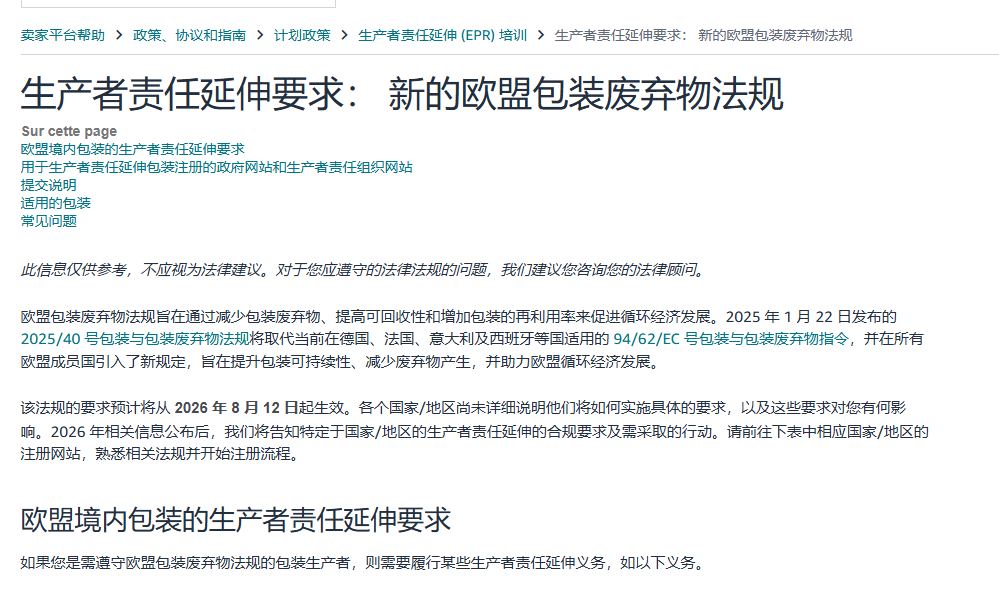
On January 22, 2025, the EU officially issued the Packaging and Packaging Waste Regulation (PPWR) 2025/40, which will completely replace the Directive 94/62/EC that has been in use for many years, and will take effect uniformly in all EU member states on August 12, 2026.
Amazon has issued PPWR compliance reminders through official channels and clearly stated: Sellers who sell packaged goods in nine countries including Germany, France, Italy, Spain, Belgium, the Netherlands, Ireland, Poland, and Sweden must complete Packaging Law (EPR) compliance.
1. What does PPWR mean for cross-border sellers after it takes effect?
For cross-border sellers, the core changes of PPWR lie in three aspects:
1. Broader coverage: all types of packaging, all sales models;
2. Stronger enforcement: platforms cooperate with government inspections;
3. Higher violation costs: directly affecting Listing and account sales permissions.
Therefore, as long as the goods enter the EU market, sellers need to complete registration, declaration, payment, and continuous compliance according to the requirements of the regulations.
2. Which packaging must be compliant?
PPWR covers all types of packaging in the EU market, regardless of use or material restrictions:
1. Primary (sales) packaging: packaging that directly contains goods and is sold with the goods (including disposable/reusable);
2. Secondary (grouping) packaging: removable packaging used to combine multiple goods for easy display or handling;
3. Transportation (tertiary) packaging: packaging that protects the safety of goods during transportation (excluding road/rail/ship/air transport dedicated containers);
4. Service packaging: such as packaging bags, pallets, take-out containers (for bulk or ready-to-eat goods);
5. Composite packaging: an integral packaging made of multiple materials that cannot be manually separated (including inner container + shell).
3. Which sellers are affected?
1. Sellers who sell packaged goods in the EU market
Anyone who puts product packaging (including product packaging, logistics packaging, transportation packaging, etc.) into the EU market may be considered a "producer". This includes brand owners, as well as cross-border e-commerce sellers, online platform sellers, etc.
2. Non-EU sellers
If you register a company outside the EU but sell goods to EU countries through a platform, you are usually considered an "importer" or "placer", and you also need to assume EPR obligations.
4. How should sellers respond?
1. Complete registration in relevant EU countries
In each EU country/region where you sell packaged goods for the first time, you must choose one of the following to complete registration:
① Register directly on the government-designated registration portal of that country;
② Sign a contract with a locally recognized Producer Responsibility Organization (PRO).
2. Regularly submit packaging declaration data
Report the following contents to the local regulatory authorities or cooperating Producer Responsibility Organizations:
① The total quantity of packaging placed on the market;
② Types of materials used for packaging (such as plastics, paper, metals, etc.);
③ Weight of various packaging materials;
④ Packaging attributes (disposable or reusable).
3. Pay environmental protection treatment fees
You need to pay special environmental protection fees to the Producer Responsibility Organization or environmental agency of the sales country for the recycling, treatment, and reuse of packaging waste.
4. Obligations of authorized representatives of non-EU sellers
If your company is not registered in the EU and the target sales country requires designation of an authorized representative, you need to confirm the local rules in advance and complete the authorization, and the authorized representative will fulfill the compliance obligations.
5. How to submit packaging compliance information to Amazon?
The operation path is as follows:
1. Log in to the Amazon seller platform
2. Select the corresponding sales country/region in the upper left corner
3. Enter [Account Status] → [Manage Your Compliance]
4. Click [Submit Compliance Information]
5. Fill in the obtained EPR/packaging registration number
6. Click "Save" to complete the submission
Note: In countries/regions where public registration has been opened, you will receive a notification of the audit results within 7 working days after submission.
6. Consequences of non-compliance
Once it is determined as non-compliant, Amazon may take measures according to local regulations, including but not limited to:
1. Suspend the sales of related Listings;
2. Restrict sales permissions;
3. Upgrade account compliance risks.
Finally:
As long as it involves the sale of packaged goods, compliance is no longer a multiple-choice question, but a required one.
Completing packaging law registration and declaration in advance can not only avoid risks such as Listing removal, sales permission restrictions, and account risk control, but also lay the foundation for long-term layout in the European market.
The above is the content sharing brought to everyone by Yiju Overseas. Feel free to leave a message and discuss in the comments section at any time!