
 Amazon Global Store opening

CBP issued an interim final rule “Importer of Record Enhanced Requirements” on Nov 6, 2026; effective Jan 5, 2027. It applies to entries filed on or after Jan 5, 2027, including cargo still in transit that day. Setting up a new IOR or changing brokers may take weeks—start now.

If you import into the U.S. (for example, shipping to Amazon US), your process depends on whether your IOR is a U.S. IOR or a non-U.S. IOR.

The IOR is the person or company officially responsible for importing your goods. Depending on how you ship, this may be you, your freight forwarder, or your customs broker.

U.S. IOR with documentation: import as usual; the broker must verify U.S. IOR status before filing.
Non-U.S. IOR: must use a CTPAT-validated customs broker. Otherwise cargo may be delayed or blocked.

Step 1: Answer four questions to determine whether you are Scenario A, B, C, or D.
Step 2: Choose your options based on your scenario.

Confirm the questions with your freight forwarder or customs broker. If unsure, treat the answer as “no.” You can also check CBP Form 7501 or your logistics service agreement for IOR information.
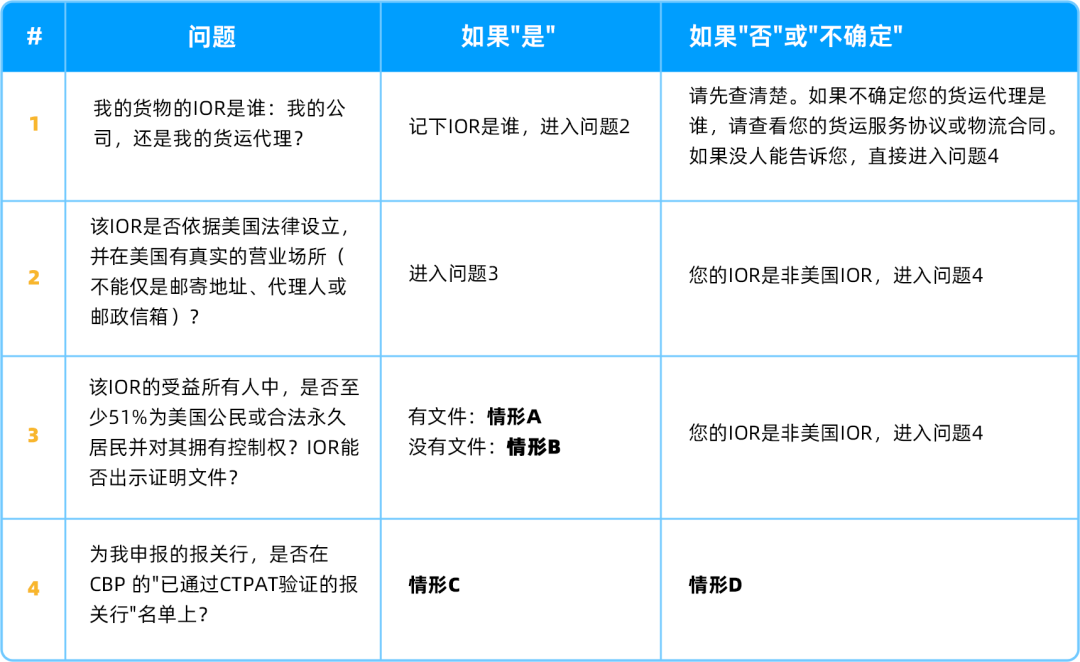

Anyone who owns or controls at least 25% of the IOR, or has substantial control over it, counts. This applies directly or indirectly through every ownership layer.

An IOR can also qualify if it directly holds a substantial amount of unencumbered U.S. real estate. Most sellers fall under the ownership test in Question 3.


Scenario A — U.S. IOR with documentation: import as usual. Keep records such as state business registration, lease or property records, U.S. bank statements, ownership records, and tax returns. The broker must keep verification records for 5 years. Notify your broker if ownership or assets change.

Scenario B — likely U.S. IOR but lacking documents: do not assume compliance. Your broker may refuse to file without proof. Ask your forwarder for Scenario A documents. If you cannot get them, return to Question 4. If your broker is not CTPAT-validated, you are Scenario D—plan now.

Scenario C — non-U.S. IOR with CTPAT-validated broker: continue importing. Confirm your broker is on CBP’s validated list. “Certified” alone is not enough. Get written confirmation of capacity, pricing, and terms after Jan 5.

Scenario D — non-U.S. IOR without a compliant broker: after Jan 5, 2027, entry may be rejected. Choose one of the following:
Option 1: Ask your forwarder to use a CTPAT-validated broker. Get written confirmation.
Option 2: Switch to a forwarder with a qualified U.S. IOR. Request the documents listed in Scenario A. Capacity may be limited, so act early.
Option 3: Become your own IOR. Submit CBP Form 5106 and sign a power of attorney with a CTPAT-validated broker. Use your real business address and allow setup time.
Note: Only Canadian non-U.S. IORs can be CTPAT-validated on their own. For sellers in China under Scenario D, the practical route is to use a CTPAT-validated broker.

Now: Answer the four questions. Goods shipped now may still be in transit on Jan 5.
Next few weeks: Set up IOR, power of attorney, and broker if needed. This may take weeks.
Jan 5, 2027: Rule takes effect. Non-compliant non-U.S. IOR entries cannot be filed.

Before Jan 5, imports continue as usual, but goods shipped now may clear after the rule takes effect. Confirm your scenario now.


A U.S. mailing address is not enough. The IOR must be established under U.S. law and located in the U.S., meet the ownership test, and be verified by your broker. If you cannot get documents, see Scenario B.

Only your company qualifies if it is established under U.S. law, located in the U.S., and at least 51% of beneficial owners are U.S. citizens or lawful permanent residents with control. U.S. registration alone is not enough.

A non-U.S. IOR that is not CTPAT-validated and not using a CTPAT-validated broker cannot import. Shipments may be delayed or stalled.

Whether someone in the U.S. can act as your IOR depends on whether they have a financial interest in the goods, such as being the owner, buyer, or title holder.

Amazon does not endorse specific providers. Refer to CBP’s validated broker list and the four questions.

For Amazon import logistics, visit Amazon Global Logistics. For Amazon official customs clearance, contact act-am-support@amazon.com.

This is an interim final rule. Public comment runs through Jan 5, 2027, so the rule may change. We will share updates.
Action checklist
✅ Confirm who the IOR is: ask your forwarder or broker, or check CBP Form 7501 or your service agreement.
✅ Answer the four questions to determine A–D; if unsure, treat as “no.”
✅ Scenario A: prepare documents and notify your broker of changes.
✅ Scenario B: request documents; if unavailable, return to Question 4.
✅ Foreign IOR: confirm whether you use a continuous or single-entry bond.
✅ Scenario C: verify the broker is CTPAT “validated”; get written confirmation.
✅ Scenario D: choose a plan—CTPAT-validated broker, forwarder with U.S. IOR, or become IOR yourself.
✅ Allow time: IOR setup, power of attorney, and broker changes may take weeks.
✅ Monitor updates, since the rule may still be adjusted before Jan 5, 2027.
The rule takes effect Jan 5, 2027. Setting up IOR and changing brokers takes time, and goods shipped now may clear after that date. Contact your forwarder or broker now, answer the four questions, and if you are Scenario D, choose a plan to avoid delays.
For Amazon questions, use https://wsurl.cc/wg4chn or scan the QR code to contact an official customer development manager: