 Yijia Overseas
Amazon fully launched CDQ in 2026, replacing the original IDQ (Item Data Quality) algorithm, and becoming the core standard for judging Listing quality and allocating natural traffic.
1. What is CDQ?
CDQ stands for Composite Data Quality. It is a comprehensive quality assessment standard provided by Amazon for each ASIN link, aiming to measure the completeness, accuracy and consistency of product detail page information. CDQ score directly affects search ranking and recommendation mechanism, and is the core basis for judging the excellence of Listing.
1. Score range: The score range is 0-100 points. Amazon's old IDQ score was also 0-100 points, and a high score (such as above 90) was required to enter the search algorithm. At present, CDQ has not announced a specific pass line.
2. Data source: CDQ calculates scores based on multi-dimensional information such as structured attributes (brand, model, material, specifications and other core parameters) of the Listing page, text content (title, highlights, descriptions, A+ content), image information, variant relationships, etc.
3. Calculation frequency: It is reported that CDQ is calculated in batches periodically (possibly running daily or weekly) in the background, rather than in real time. Once the Listing information is updated, the new data quality score can be reflected after the above calculation cycle ends.
4. Association with search/Buy Box/Advertising, etc.: CDQ score has become one of the important factors in search ranking; Listings with high scores will be given priority in natural search results and related recommendations. In terms of advertising placement and conversion rate, high CDQ also brings better matching degree and user experience.
Amazon said that improving and enriching product information can increase exposure, promote conversion, and reduce return rate. It is expected that CDQ score will be incorporated into the analysis logic of A9/A10 algorithm and new generation AI models (such as COSMO, Rufus), and become an important signal for buyer search and recommendation.
II. Structural differences between CDQ and IDQ
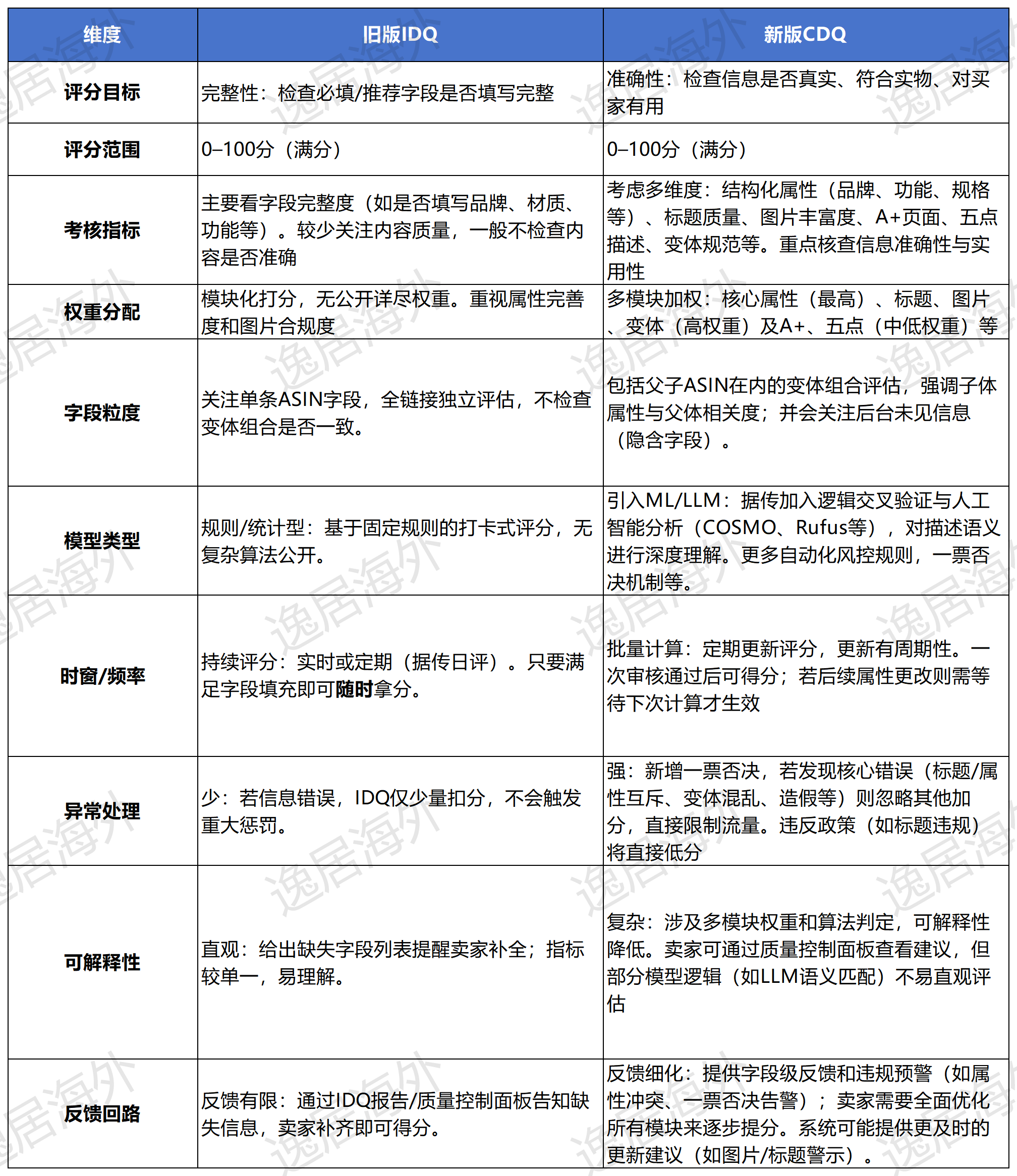
In short, CDQ pays more attention to content authenticity and consistency than IDQ, and encourages sellers to improve Listing quality through more complex algorithms and finer granularity feedback, using "white hat" meticulous operation.
III. Specific upgrade features of CDQ
1. New assessment indicators: On the basis of the original basic attributes, titles and pictures, CDQ takes variant compliance, A+ pages and detailed descriptions into consideration.
2. Algorithm improvement: The early IDQ was mainly a list card scoring method, and CDQ introduced logical cross validation and machine learning mechanism. The system will detect whether the title is inconsistent with the attribute, whether there are false parameters, and if any violation is found, joint punishment will be initiated.
3. Cross domain data fusion: Although there is no official statement, sellers speculate that CDQ may consider "backend" data such as sales speed, inventory status, price competitiveness, customer evaluation, advertising effect, etc., to measure the comprehensive health degree of Listing.
4. Multi language/multi site adaptation: CDQ requires each site (the United States, Europe, Japan, etc.) to evaluate Listing quality in the local language. Sellers need to ensure that multilingual content is accurate and variant settings comply with the rules of each site. CDQ scores of different sites are calculated independently, but they are all scoring standards under the CDQ system.
IV. Listing writing guide under CDQ standard
1. Core attributes (Brand/brand, Title/title, etc.): The title should be concise and logical, using the format of "Brand + core product name + main function + differentiated selling point". For example:
Example: "Mi Home Smart Household Electric Juicer Multifunctional Fruit and Vegetable Mixer 1.2L Large Capacity"The title character is recommended to be controlled between 80-200 characters (the first 80 characters on the mobile phone are important), avoid all uppercase, marketing words and repeated words, and strictly abide by Amazon's title regulations.
2. Five point selling points and descriptions: Each point should take buyer's interest first. Structurally, you can first put forward selling points/advantages, and then supplement specific functions or parameters. For example:
Example: "24 hour insulation - double layer 304 stainless steel vacuum inner liner, long lasting to maintain beverage temperature, so that you can enjoy hot drinks at any time."Concise and intuitive, do not stack keywords, focus on highlighting the core selling points and effects of products.
3. Detailed description: It is recommended to write in natural language and answer "why buyers should buy this product", rather than keyword stacking.
4. Search terms and backend fields: The backend search term field is a place to supplement keywords. According to Amazon's rules, it is recommended to fill in within 250 bytes. Avoid duplication with title/highlights, do not use punctuation and stop words, add common variant spellings, synonyms, long tail words, etc.
5. Product images: Try to provide more than 9 high-definition pictures. The main picture must have a pure white background, and the product main body accounts for ≥85%; other pictures should show details, usage scenarios, size ratio and accessories, etc., to improve the matching degree of pictures and texts. Image quality will affect discoverability and conversion rate; supplement a product demonstration video (such as 15-60 seconds) can further improve traffic and conversion.
6. Product variants: Ensure that the child bodies of the same parent ASIN belong to the same category/purpose. Unify the naming format of variants (such as color/size), and it is strictly forbidden to mix unrelated child bodies under one parent. Keep the title format of parents and children consistent, highlighting different characteristics; any variant with functional differences should be split into a separate parent ASIN.
7. Brand and A+ content: If you have registered a brand, be sure to create a complete brand A+ page (brand story, product details, graphic and text combination, etc.) for all ASINs. Providing high-quality A+ can significantly improve CDQ score and buyer trust.
V. Seller's response strategy and implementation path
Short term (1-3 months): Immediately self check and repair Listing score problems. Including checking the consistency of core attributes and titles, supplementing missing fields, rewriting titles/selling points, unifying variant naming, uploading compliant main and auxiliary pictures, and improving A+ pages.
Medium term (3-6 months): Carry out AB testing and data analysis to monitor the optimization effect. Focus on variant compliance, product evaluation and competitive dynamics. Establish monitoring indicators including CDQ score (if visible backstage), search exposure, click through rate, conversion rate and return rate, etc.
Long term (more than half a year): Regularly obtain Listing health degree, and set up automatic review process after content change. Continuously optimize brand building (such as regularly updating A+ content, maintaining brand official website), and pay attention to possible Amazon algorithm updates. Seller teams should incorporate CDQ compliance into daily operations, such as writing Listings according to CDQ standards when developing new products.
Finally:
Those who do Amazon must understand this change as soon as possible.
The above is the content sharing brought by Yiju Overseas. Welcome to leave a message and discuss in the comment area at any time!