 Yijia Overseas
On July 8, the CPSC and CBP officially launched the PGA eFiling program. According to the CPSC, starting July 8, 2026, regulated consumer goods imported into the U.S. must electronically submit compliance certificate data via the ACE system.
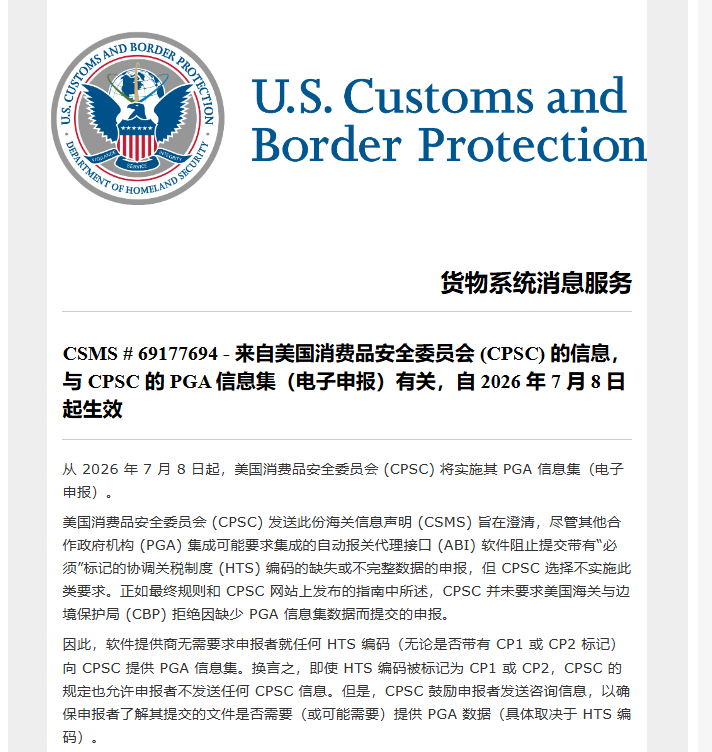
Meanwhile, U.S. Customs and Border Protection (CBP) issued CSMS #69177694 on the morning of July 8 (Eastern Time), providing further clarification on the current phase of CPSC eFiling enforcement.
Today, Yiju Overseas will interpret this latest notice with you.
1. What Signals Does the New Notice Send?
The key change is that even if a product’s HTS code is flagged with CP1 or CP2, not submitting CPSC eFiling data will not cause the ACE system to reject the entry at this stage.
This means that normal import declarations can proceed; the system will not auto-reject for missing CPSC PGA data and will not directly cause clearance rejection.
This means CBP is currently operating under a transitional enforcement model, and the system will not immediately deny release due to missing electronic data.
2. Does This Mean CPSC eFiling Is No Longer Required?
Absolutely not. Many sellers may misunderstand this. The CBP notice emphasizes that the system will not auto-reject entries solely due to missing eFiling data at this time.
This is not a cancellation of CPSC oversight; in fact, all CPSC regulations remain valid.
Including CPC children’s product certificates, GCC general conformity certificates, test reports, labeling requirements, product traceability information, and product safety standards. None of these requirements have been removed.
3. What Are the Risks Without eFiling?
Although entries won’t be automatically rejected now, the risks still deserve sellers’ close attention.
1. Increased Risk of Customs Inspections
Without eFiling data, the system may flag goods as high-risk. Once selected for inspection, sellers must provide: CPC or GCC certificate, test reports, product details, lab information, and manufacturer details. Failure to provide them will affect clearance efficiency.
2. Goods May Be Detained
Products with safety risks, certification anomalies, or suspected violations may still face CPSC-requested CBP inspections. If audit fails, the goods may be held, require additional documents, experience delayed release, be returned, or destroyed. Thus, lacking eFiling does not mean no oversight.
3. Possible Subsequent Penalties
The policy is still in early stage. Once CPSC fully captures e-data, supplementary investigations, administrative penalties, document resubmission, or fines cannot be ruled out. Therefore, proactive compliance costs less than later remediation.
4. Which Products Require the Most Attention?
Any consumer product falling under CPSC jurisdiction is advised to promptly determine if eFiling is required.
Common products include: children's toys, baby/infant products, children's furniture, children's clothing, furniture, mattresses, carpets, household appliances, batteries, lighting, sporting goods, curtains, flammable textiles, etc.
Note that whether eFiling is needed depends not only on the HTS code but also on whether the product itself falls under CPSC regulations.
5. What Should U.S. Sellers Do Now?
Yiju Overseas reminds U.S. sellers to promptly check with logistics, customs brokers, and clearance providers whether their products fall under CPSC jurisdiction, and prepare relevant compliance documents in advance. Sellers are advised to focus on the following:
Step 1: Confirm Whether the Product Is Under CPSC Jurisdiction
Use product category, applicable regulations, and HTS codes to make a comprehensive judgment, not solely relying on whether the HTS carries CP1 or CP2 flags.
Step 2: Prepare Complete Compliance Documents
This includes but is not limited to CPC, GCC, test reports, label information, product traceability info, and factory details.
Step 3: Confirm eFiling Process with Logistics and Customs Brokers
Ensure that logistics providers and customs brokers can complete electronic data transmission via ACE as required.
Step 4: Keep Up with Policy Updates
Currently in a transitional enforcement phase, CBP and CPSC may further tighten requirements based on oversight conditions.
Finally:
This CBP notice only clarifies that the system will temporarily not automatically reject import declarations. It has not reduced any product safety compliance requirements.
Though still in the transitional phase, completing CPC/GCC certificate preparation, product testing, and eFiling process setup in advance will ensure smooth clearance when enforcement tightens, avoiding delays, detention, or penalties due to compliance issues.
That’s the content shared by Yiju Overseas. Feel free to leave comments and discuss!