 Yijia Overseas
Recently, Amazon sent notifications to some Spanish-site sellers, requiring those selling electronic and electrical products to upload a valid Spanish WEEE registration number by September 30, 2026.
Sellers who fail to complete compliance on time will be enrolled in Amazon’s EPR payment-on-behalf service, where the platform will partially fulfill WEEE obligations and charge corresponding service fees.
I. Amazon Requires Upload of Spanish WEEE Registration Number
Amazon is strengthening EPR compliance management in Europe. Sellers of electrical and electronic equipment (EEE) on the Spanish site must upload a valid Spanish WEEE registration number in the seller backend, proving that the products have completed local WEEE registration and assumed take-back responsibilities for waste electronics.
If not uploaded or if the review fails, the platform will take corresponding measures according to its policies, including:
Automatic enrollment in Amazon’s EPR payment-on-behalf service;
The platform partially fulfilling WEEE declaration obligations and charging service fees;
Potential future impacts on product sales and compliance status.
II. Key Spanish EPR Deadlines
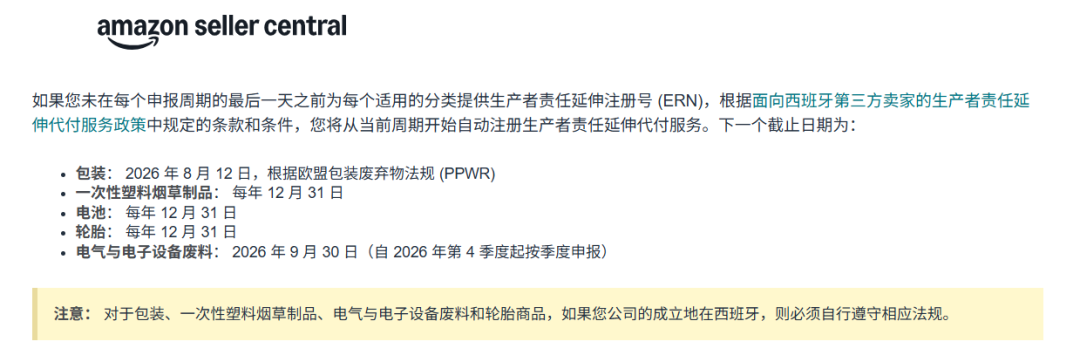
Without providing the relevant Spanish EPR registration numbers by the dates below, sellers will be automatically
1. Packaging submission deadline: August 12, 2026, under the new EU Packaging Waste Regulation (PPWR).
2. Submission deadline for single-use plastic tobacco products, batteries and tires: December 31 each year.
3. Submission deadline for waste electrical and electronic equipment: September 30, 2026.
Sellers are advised to complete the following process as early as possible:
1. Determine whether the product falls within the WEEE scope;
2. Complete Spanish WEEE registration;
3. Obtain the WEEE registration number;
4. Upload it to the Amazon seller backend and wait for review.
Since registration usually takes several weeks, and may involve overseas authorized representatives or supplementary materials, it is advisable not to wait until the deadline.
III. Which Products Must Register for Spanish WEEE?
Any product sold in Spain that requires electricity or electromagnetic fields to function normally generally falls under WEEE regulation. For example: mobile phones, tablets, computers, Bluetooth earphones, speakers, data cables, chargers, power adapters, LED luminaires, lighting products, small household appliances (electric fans, electric kettles, etc.), smart home products, security monitoring equipment, power tools, beauty devices, massagers, and any battery-operated or plug-in electronic products.
A simple rule: if a product needs to be plugged in, charged, or uses a built-in battery to work, it most likely requires WEEE registration.
Specific confirmation should still be based on the product category and local Spanish regulations.
IV. What’s the Difference Between Amazon’s Withholding Service and Self-Registration?
① Self-Registration of WEEE (Recommended)
You own your Spanish WEEE registration number, freely choose a compliance service provider, generally enjoy lower long-term costs, achieve more thorough brand compliance, and find it easier to expand into the European market later on.
② Amazon’s Withholding and Payment-on-Behalf
You do not need to complete part of the declaration process yourself; the platform partially fulfills responsibilities according to its policies, charging corresponding service fees. Over the long term, total costs may be higher.
The payment-on-behalf service fee consists of three parts: an annual fee of €24.99; a 3% environmental levy surcharge calculated based on actual sales volume.
For sellers planning to operate long-term in the Spanish or broader European market, completing WEEE registration independently is generally more conducive to cost control and compliant operations.
Finally:
Before September 30, 2026, Spanish-site sellers dealing with electronic or electrical products should complete WEEE registration and upload their registration numbers as soon as possible, avoiding the platform’s withholding-and-payment-on-behalf model that could affect future operations.
It is recommended that sellers prepare materials in advance and allow sufficient time for review to ensure continued compliant store operations.
That concludes the insights brought to you by Yiju Overseas. Feel free to comment and discuss in the section below!