
 Cross-border information
Amazon US sellers should pay close attention to this news.
In early November, the U.S. District Court for the Western District of Washington approved a class action settlement over Amazon's return policy. Amazon will pay $309.5 million in cash to U.S. buyers who, between September 2017 and February 2026, did not receive refunds after returns or were charged again after refunds.
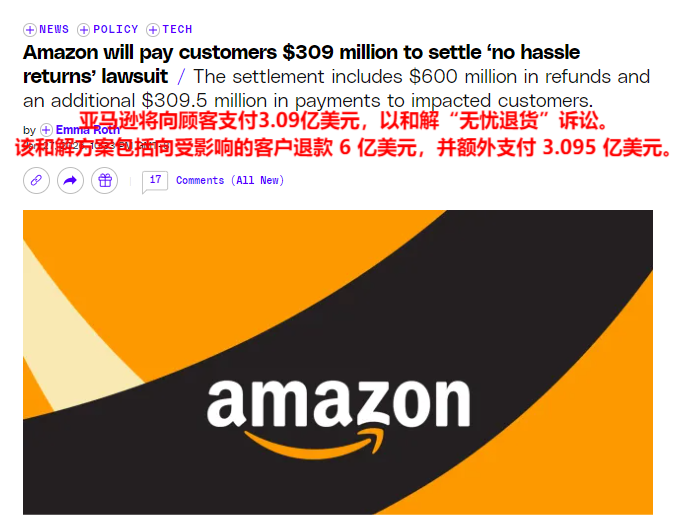
This 2023 class action has settled after three years. Most importantly for sellers, Amazon has committed to completing return/refund process improvements within up to two years.
In other words, Amazon will simplify return approval, improve refund transparency, and shorten processing times. Lower return barriers will push higher return rates and reverse logistics costs onto sellers.
Who will receive the $309.5 million settlement?
The lawsuit covers nearly nine years: September 5, 2017 – February 12, 2026.
U.S. buyers who purchased physical goods during this period, returned them without receiving refunds, or were charged again after refunds are included in the class.
The settlement fund is divided into two groups:
Group A: about 92.7%. No claim form is needed. After the settlement takes effect, these buyers automatically receive principal plus interest; they only need to choose a payment method within 105 days after court approval. About $81 million in orders can be fully refunded.
Group B: A total of $22.6 million will be distributed. Buyers must proactively submit a claim before December 1; otherwise the claim expires.
In addition to the $309.5 million payout, Amazon will spend over $363 million on process changes.
The two core changes are:
1. Monitor return processing time and speed up refunds.
2. Proactively notify buyers whether refunds are approved or denied.
Full refund transparency lowers buyers' return barriers
Why expect higher return rates? The two changes above are the reason.
Previously, returns were hindered by uncertainty: buyers could not track review time, refund timing, or rejection reasons, so many gave up.
Now Amazon will speed up refunds and notify buyers of approval or denial, turning returns into a predictable process and increasing willingness to return.
U.S. rules have already moved this way this year:
On January 26, the FBM seller refund processing window was extended from 2 business days to 4 calendar days;
On February 8, all U.S. FBM sellers were required to use Amazon Prepaid Return Labels (APRL), ending the high-value item exemption;
On February 16, the SAFE-T claim appeal window was cut from 60 days to 30 days.
These changes make returns easier for buyers and leave sellers less room to verify and appeal.
Regulators and consumer groups are focusing on refund timing and return transparency; Walmart, TikTok Shop, and eBay likely face similar requirements.
After the settlement, five cost categories will surface
First, return rates will rise and sunk costs will increase.
Low-price, size-dependent, and appearance-related products will be hit first. Once an FBA order ships, picking and delivery fees are incurred and usually not refunded when buyers return items.
Second, sellers will have less control over returnless resolution.
This feature lets sellers refund without requiring a return when return shipping exceeds item value. Amazon may auto-trigger it to speed refunds, reducing seller control.
Third, SAFE-T claims will have only a 30-day window.
When returned goods are swapped, damaged, or missing parts, sellers must verify and submit materials within 30 days; after that, without evidence, the system rules for the buyer. Open boxes and photograph goods on arrival.
Fourth, FBM mandatory prepaid return labels make reverse shipping a fixed cost.
High-value goods must use Amazon prepaid labels, and shipping fees are deducted from seller accounts. More returns mean higher costs, and returned goods may not be resellable.
Fifth, refund denials will be notified to buyers, increasing disputes.
Previously, buyers might not receive notice of a denied refund. Now buyers receive direct notice, making A-to-Z claims or customer service contacts more likely and increasing after-sales pressure.
Five things sellers can do
First, treat return rate as a core metric.
Do not focus only on sales and ACoS; a one-point return rate increase can eat more profit than advertising. Track returns by SKU.
Second, bring high-return SKUs back to the product level.
For SKUs with return rates above category averages, check listings, size charts, and batch quality issues; the root cause is usually the product and detail page.
Third, set strong SAFE-T reminders.
Set a standard return inspection SOP: open boxes and photograph goods on arrival, and file appeals immediately.
Fourth, recalculate returnless resolution.
For low-value SKUs where return shipping exceeds item value, decide whether resale or refund-and-let-keep is more cost-effective, then configure rules in advance.
Fifth, track multiple platforms.
Sellers on Walmart and TikTok Shop U.S. should not watch only Amazon; monitor new return rules across platforms together.
The $309.5 million may be paid by Amazon, but costs will be passed to sellers. Smoother return experiences mean more reverse logistics costs and after-sales disputes. Peak-season traffic is precious; sort out product descriptions, quality standards, return verification, and after-sales rules in advance to protect profits after the promotion.
Source: Dabao External Promotion