
 Seller's Home
Sales on Amazon can sometimes feel like a mystery. Recently, a seller noticed a competitor’s sales surged 8x on September 12 and fully exploded on September 13, after normal levels on September 11.
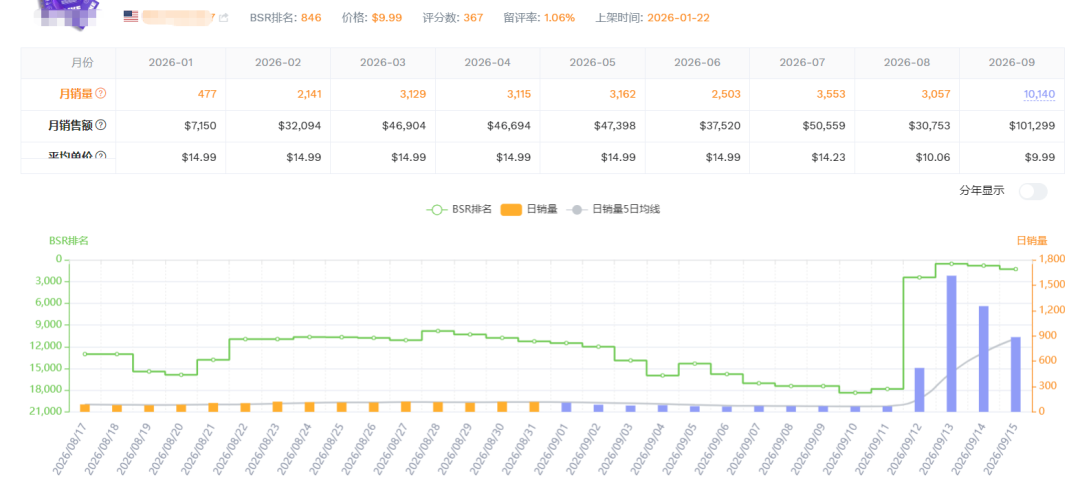
Image source: Zhiwubuyan
According to the seller's research, this product had no Amazon ads, and traffic relied on organic ranking and TikTok videos. But TikTok sales stayed flat during those days, so TikTok-driven traffic can be ruled out.
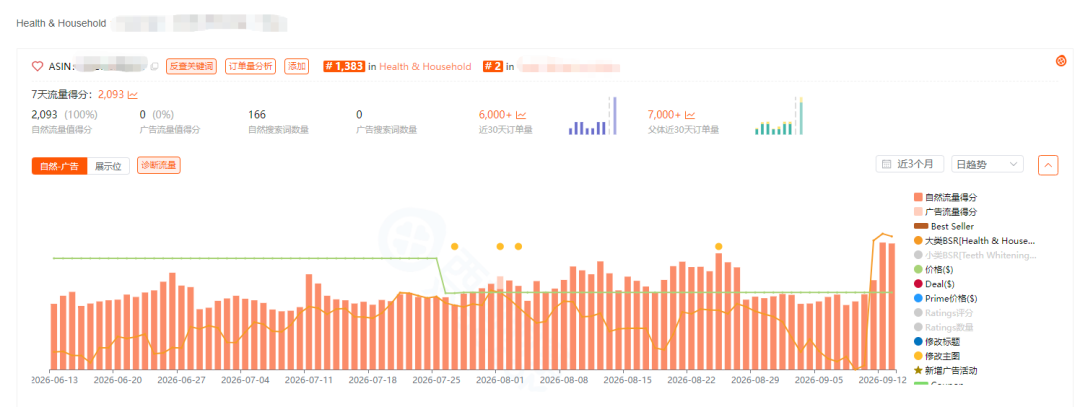
Image source: Zhiwubuyan
The only change was a price cut from $14.99 to $9.99 in late July, then mostly unchanged. Off-site checks found no obvious movement. This creates a contradiction: the price cut was already a month and a half old, no surge during that period, and organic traffic did not grow as sharply as orders. So where did the 8x surge come from?
This question sparked much discussion among sellers.
01
Where did the 8x order surge come from?
At first, sellers saw the price cut as the simplest explanation. But it happened more than a month earlier, and traffic did not rise enough during that time. As one seller noted, a delayed surge from a late-July cut is unlikely. The lower price may have improved conversion and set conditions for later, but another trigger was likely present.
Given no Amazon ads and no clear change in TikTok store sales, regular ads and TikTok shop traffic are unlikely main causes. Organic search, recommendations, Deals, Coupons, affiliates, and other off-site channels may all be candidates.
One seller suggested watching keyword ranking changes between September 11 and 12. If search impressions, clicks, and orders rose together, Amazon organic traffic may have been amplified. If orders changed first and BSR then fell quickly, followed by organic traffic, it looks more like an external trigger amplified by organic ranking.
Not every sudden surge should be blamed on off-site traffic. Recommendation shifts, top competitor stockouts or price rises, slower delivery, or short-term category supply gaps may give a product extra exposure. Sellers can check where the ASIN appeared in competitor placements and whether the top 20 category products showed stockouts, price increases, or rating anomalies around September 11-12. If several competitors slipped at once, the surge may come from category traffic redistribution rather than a mysterious external promotion.
Off-site traffic is not limited to Facebook and TikTok. Public social posts, Deal sites, Coupon sites, review articles, YouTube, Pinterest, and email affiliates can all drive orders. Private groups and Deal subscription emails often are not fully indexed, so sellers may not find evidence through simple searches.
For investigation, search combinations such as ASIN+Deal, brand+Coupon, or product title+Amazon Deal. Check reviews for phrases like 'found the deal through a platform.' If no clear source is found, that does not mean no off-site traffic exists; it may just have limited visibility.
A mature judgment is not to rush for a single answer, but to split the timeline: when traffic rose, when orders rose, when ranking improved, when competitors showed anomalies, and when price, Coupon, Promotion, or Featured Offer changed. Only by aligning these points can you tell whether the surge was organic growth, recommendation traffic, a category gap, or a short-term external push.
Today's Amazon surges are rarely explained by one factor. Ads, price cuts, off-site traffic, recommendations, keyword rankings, competitor stockouts, and even a viral social video can all be triggers.
02
EU digital tax paused
Beyond competitor traffic, sellers should also watch the operating environment. According to the Financial Times, the EU will not rush to introduce a unified digital services tax on Amazon, Google, Meta, and other large tech companies.
The starting point was France's proposal for an EU-wide digital services tax to increase future EU budget revenue, estimated at about €5 billion annually. France, Italy, Spain, and Austria already have national digital services taxes, so France wants to extend the approach to the EU level.
But the proposal soon met two practical problems. On one hand, the US opposes unilateral European taxes on large tech firms and has launched investigations into some national digital taxes. If the EU pushes ahead, it may worsen transatlantic trade friction and risk retaliatory tariffs. On the other hand, EU members worry that separate national taxes cause double taxation, inconsistent rules, and enforcement difficulties. EU Commissioner Wopke Hoekstra said that as long as a global solution is not fully ruled out, the EU should prioritize the OECD multilateral tax framework rather than act unilaterally.
In other words, Brussels is not rejecting the digital tax outright, but delaying a decision to see whether a global solution can progress. Current arrangements may become clearer by year-end.
For Amazon sellers, the direct impact is limited for now, but the long-term signal matters. If an EU-wide digital tax moves forward, platforms may face higher compliance costs and tax pressure, affecting commissions, ad costs, logistics fees, or pricing strategy.
Rather than guessing the final tax rate, it is more practical to leave margin in product profit, monitor policy progress before year-end, and recalculate true profit across EU marketplaces.