
 Xiao Huangyin said across borders
In Amazon's pricing system, the relationship among List Price (MSRP), Typical Price/Was Price, and Reference Price can be summarized as follows: List Price and Typical Price together form the two core sources of the Reference Price. Both appear as strikethrough prices to show buyers the discount depth and savings amount, and serve as benchmark prices for promotions.
The specific definitions, differences, and relationships are as follows:
1. Reference Price
The Reference Price is the strikethrough baseline price shown on Amazon product detail pages and search results. Its main purpose is to create a "sense of discount" so buyers can intuitively perceive savings, thereby improving click-through and conversion rates. It is not an independently set price; instead, it is dynamically displayed by the system after validation based on the List Price or Typical Price.
2. List Price (MSRP / Manufacturer's Suggested Retail Price)
· Definition: The suggested retail price provided by the manufacturer, supplier, or seller. Sellers can manually enter it in Seller Central.
· Validation rules (new rules effective April 23, 2026): On Amazon US and UK, the List Price must meet at least one of the following conditions to pass validation and appear as a strikethrough price:
o The product has recently been offered at that price by other retailers;
o Buyers have purchased the product at that price on Amazon as the Featured Offer (Buy Box).
· Validation lookback period: 90 days (180 days for seasonal products). New products need at least 9 days of Featured Offer data to qualify for validation.
· Key change: The old tactic of entering arbitrarily inflated prices to create "fake discounts" has largely stopped working. List Prices that cannot pass validation will not display as strikethrough prices on the front end.
3. Typical Price / Was Price
· Definition: Calculated automatically by Amazon and cannot be set by sellers. It is the median price buyers actually paid for a product on Amazon over the past 90 days.
· Calculation rules (new rules effective May 18, 2026):
o If, in a product's 90-day price history, the selling price is below the non-promotional median price for more than half the time, the system will include all sales prices (including promotional prices) in the Typical Price calculation.
o Sales types not included in the Typical Price: Buy X Get X, Subscribe & Save promotions, tailored coupons, and promotions during peak shopping events (such as Prime Day and Black Friday/Cyber Monday).
· Key impact: Frequent or long-term low-price promotions will lower the Typical Price, compressing future promotional discount space and potentially failing to meet minimum discount requirements for major deals.
Core relationships among the three and operational impact
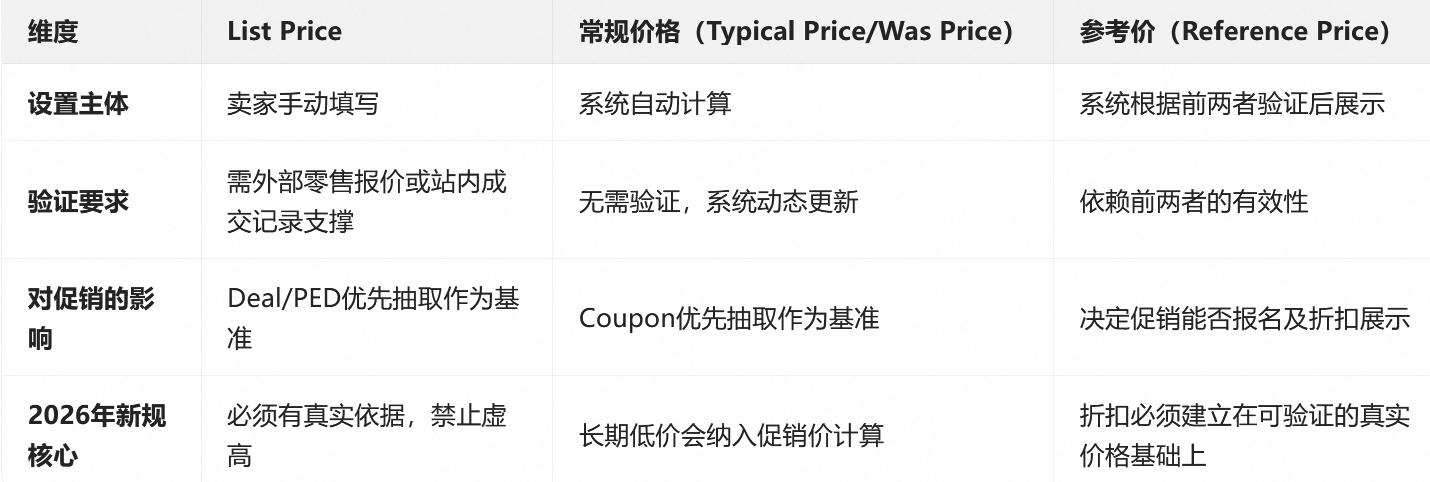
Operational key points:
· Do not enter List Price arbitrarily: Inflated prices cannot pass validation. If no strikethrough price appears on the front end, it will directly affect conversion and eligibility for promotion submission.
· Maintain Typical Price over the long term: After the May 18, 2026 rule change, unplanned frequent promotions will lower Was Price. Today's actions fully fade only after 90 days, so think carefully before adjusting prices.
· Different promotion tools use different baselines: Coupons prioritize Typical Price, while Deals/PED prioritize List Price. Plan price history in advance according to the target promotion type.
· Price history is now public and transparent: Amazon has launched the Price History feature on the front end, allowing buyers to view 30/90/365-day price fluctuation curves. Tactics such as "raise the price first and then discount" will be directly exposed.
In short, the core logic of Amazon's 2026 pricing policy is: discounts must be based on verifiable real prices. Sellers no longer manage only discount percentages, but the entire price history of an ASIN.