 Cross-border E-commerce Excellent Craftsman School
Recently, at the Amazon Global Summit, an Amazon spokesperson announced that the seller AI assistant Amelia will be launched for Chinese sellers. What does this mean for sellers, and what impact will it have? Will operational work be replaced?
Since the beginning of this year, we can feel Amazon's comprehensive embrace of AI. From improving the COSMO algorithm and generative AI navigation Rufus on the user side, to various AI tools on the seller side, such as backend keyword generation for copywriting, images, A+, videos, and now the new seller assistant Amelia, this series of AI updates have brought varying degrees of pressure to operators. As operational personnel, how should we adapt to this AI wave? Today we will delve into these issues.
What is "Amelia"?
Amazon defines "Amelia" as a powerful new generative AI sales assistant, aimed at providing sellers with efficient and personalized services through deep learning and natural language processing technology, codenamed "Project Amelia". According to Amazon, it mainly has the following three functions:
1. Knowledge Q&A: Sellers can ask specific questions, such as "What preparations do I need to make for the peak season?" Amelia provides personalized information and suggestions based on each seller's product situation, which are based on relevant information summarized from the seller center.
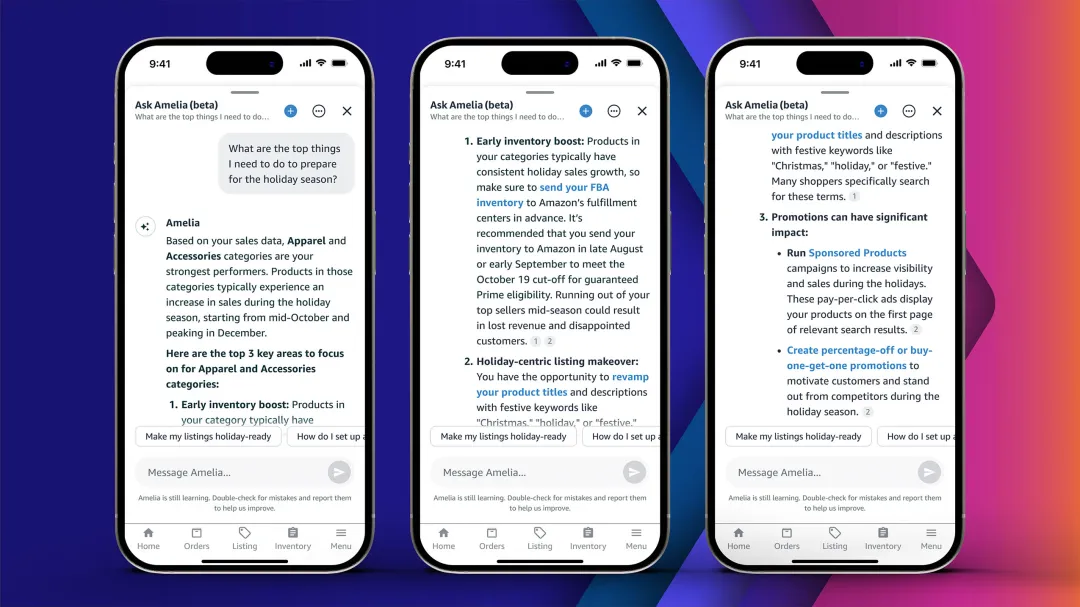
Image source: Amazon
2. Store performance updates and metric analysis: Sellers can quickly obtain sales data of their stores, such as asking "How is my business performance?" to learn about recent sales, sales volume, website traffic summaries, and compare with last year's data. It can also track the seller's inventory data, predict future restocking needs, and reduce the risk of stockouts or excess inventory.
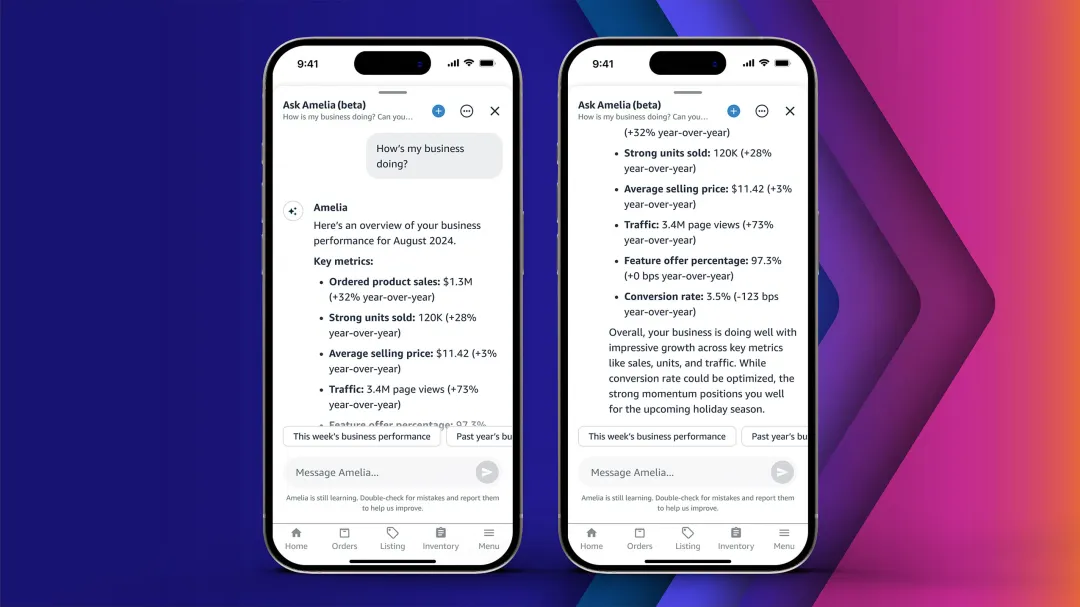
Image source: Amazon
3. Real-time support for operational issues: It can help sellers diagnose problems and even help open cases to solve some specific problems. For example, asking "I have 300 items in transit, but it's not showing in the report. Can you help me check?" Amelia will provide specific guidance, and if necessary, human intervention will be involved, or contact the case to ensure the problem is resolved as soon as possible.
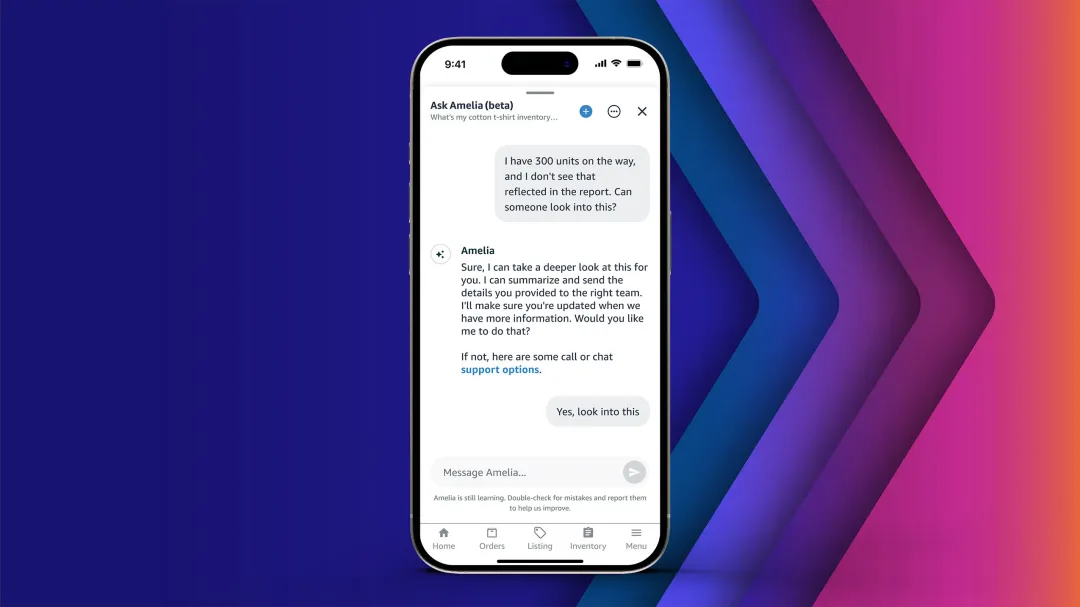
Image source: Amazon
From the content of the three major functions, it covers multiple links in the seller's daily operations. It can be predicted that the seller assistant Amelia may significantly improve the operational efficiency of sellers in the future and solve their daily operational problems. It may become a powerful assistant for sellers' daily work.
This speculation about the AI assistant has also made many operators worried about whether their jobs will be replaced. In fact, AI can indeed handle many basic tasks, such as listing copywriting, image design, time-based ad adjustments, customer service, etc., and the quality of completion may even exceed that of basic operations. For those operators who only focus on stocking, the possibility of being replaced is even higher.
However, we currently believe that the key point of AI's ability to solve problems lies in efficiency, and the quality is still far from enough. For example, the quality of generated listing copywriting is still quite different from the copywriting written by sellers after doing a lot of keyword research, and it is difficult to achieve high and accurate inclusion in system indexing. Moreover, in terms of advanced operational work, AI is still difficult to replace at present. For example, sellers with the following three capabilities still have strong competitiveness:
1. Advertising optimization capability. Operators with strong advertising capabilities are still very competitive and in demand because AI cannot perform deep optimization and decision-making like humans.
2. Process-oriented and systematic hot-selling replication capability. Operators who can turn their operational experience into systems and processes, design complete operational processes, and continuously create and replicate hot-selling products, this systematic thinking will not be replaced.
3. Team management capability. At present, the role of AI is to improve efficiency, but management still requires collaboration between people. Operational talents with management capabilities are indispensable, whether at the team or company level.
How can operational personnel improve their core competitiveness?
Those who do Amazon operations know that the same operational methods produce different results for each person. This is because everyone's understanding of each method is different, and this difference often determines the level of operational ability. For example, in Amazon operations, everyone may know how to negate words, but the specific words negated in the advertising report are different for each person. Over time, the performance of the same advertisement will differ.
So, what aspects do operators need to improve? We have 3 suggestions:
1. Strengthen bottom-line logical thinking. Bottom-line logic refers to the thinking method of finding solutions to problems from the bottom and essence of things. The stronger the bottom-line logic, the stronger the ability to solve problems. This is why we always emphasize that every operator needs to understand the bottom-line logic of Amazon. Only by mastering the understanding of bottom-line logic can we make correct decisions, find effective methods to solve problems, and develop replicable operational methods to bring the maximum benefit to the company.
2. Strengthen data thinking. In fact, whether it is Amazon operations or other e-commerce platform operations, in the final analysis, it is all about "data". Amazon's operations, whether pre-sale product selection or post-sale shipping, advertising, inventory, competitor analysis, sales evaluation, are all based on data analysis. For example, in keyword analysis, how to combine keyword tools, brand analysis, front-end search rankings, and other data to determine which keywords are good, and then dig out more effective long-tail keywords; how to grab high positions through precise matching, and how to increase the coverage of long-tail traffic through broad matching layout; and then advertising budget, advertising layout, sales forecast, inventory planning, market trends, all need data analysis to support decision-making. Therefore, a powerful Amazon operator must have the ability to collect, organize, filter, and analyze data, and let data analysis become a subconscious part of the operational process.
3. Improve process-oriented capabilities. In this regard, ordinary operators often make mistakes, such as unclear operational purposes, unquantified goals, no stage-by-stage goal decomposition, no stage-by-stage goal management and evaluation optimization, no specific review and summary, the entire operation lacks rhythm, and the operation is particularly passive, mainly manifested as:
- Operation is unorganized, dealing with various things at the same time, work goals are unclear
- Hot-selling products cannot be replicated, and the success rate of hot-selling products is low
- No review, no summary, the same problems will occur again in the next product
Excellent operators will make things go in the direction they expect, rather than passively adapting to the development of events. Therefore, in the operational process, it is necessary to clarify every link of the project, grasp the key nodes of the project, maintain the rhythm of the operation, and make every link of the operational project basically follow the path designed at the beginning during the execution process.
Take advertising as an example, a truly rhythmic operation should be:
1. Clarify the advertising background: Why do this advertisement, this is the basis for clarifying the purpose of the advertisement;
2. Clarify the purpose of the advertisement: For example, is the purpose of this advertisement to increase the exposure of the product or to improve the conversion of the product;
3. Set advertising budget: Predict the advertising budget based on the profit situation of the advertising campaign, which can effectively prevent Amazon PPC advertising overspending, and avoid wasting a lot of expenses due to incorrect keyword bidding;
4. Stage-by-stage goal evaluation and optimization: It is necessary to record and analyze the daily advertising data, compare it with the set quantitative goals, analyze the reasons, stage-by-stage evaluate the effects of different advertising channels, and focus on the effective advertising groups;
5. Review and summary.
In conclusion, the launch of Amelia is an important step for Amazon to fully embrace AI. It is both a challenge and an opportunity. As operational personnel, instead of fearing being replaced, it is better to actively embrace change, continuously learn and improve core competitiveness. In the future, the real operational operators will be those who can seamlessly collaborate with AI, not those who stand still.