
 Cross-border E-commerce Excellent Craftsman School
Recently, Amazon announced two favorable policies, focusing on image ownership management and FBA storage models. Although they address different concerns, both aim to enhance sellers' operational efficiency and protect their rights.
Policy One: New [Image Manager] Tool Launched
In recent years, Amazon has increasingly emphasized the visual presentation of products, especially in natural search and advertising recommendations, where image quality directly affects traffic and conversion.
With the introduction of the COSMO image recognition algorithm, this algorithm evaluates the consistency of Listing content and visuals through a "trinity" identification mechanism—text description × image verification × comment corroboration—to determine the exposure priority of products in search results and recommendation positions. In other words, high-quality images that closely match the copy description are more likely to be recommended to potential buyers by the algorithm, while low-quality or stolen images may affect exposure and link weight.
However, in actual operations, many sellers have encountered issues: original images shot at high costs being stolen, and even facing malicious complaints and counter-accusations of infringement. This not only wastes time and resources but can also directly drag down the link.
To address this, Amazon has introduced a new tool, [Image Manager], providing a solution to this pain point. It helps sellers monitor image sources and status in real-time, protects the rights of original images, and improves the exposure and conversion effects of Listings under the COSMO algorithm.
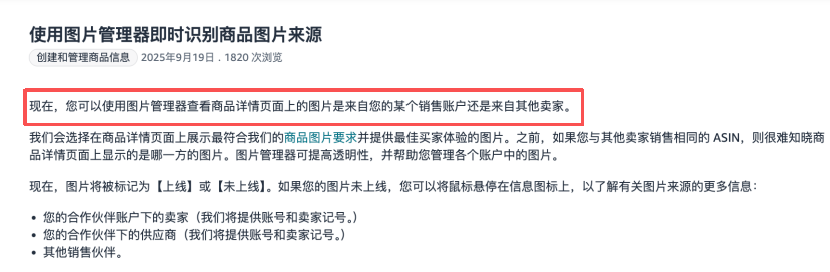
Image source: Amazon
Key features of the [Image Manager] tool:
1. Instantly identify image sources: Clearly see whether the product detail page images come from a specific sales account or other sellers.
2. Directly distinguish status: Images are now labeled as [Online] or [Offline]. If a seller's image is marked as offline, sellers only need to hover over the information icon to view the source and provide their account and seller mark. For example: sellers under partner accounts, suppliers, and other sales partners.
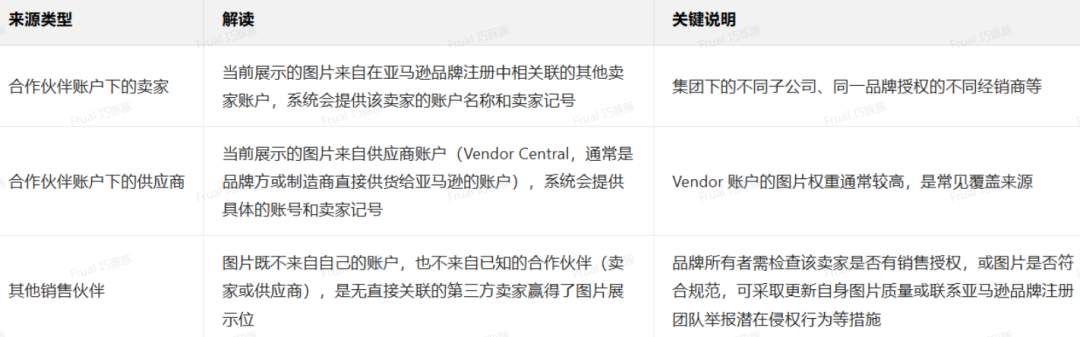
Image source: Amazon
3. Track modifiers: If images are maliciously tampered with, Amazon can track the responsible person and feedback to the original seller.
Sellers can use the Image Manager to understand whether their uploaded images are displayed, optimize offline images in time, and improve the presentation effect on the detail page, thereby increasing the conversion rate. At the same time, sellers operating multiple accounts can more efficiently manage image resources for each account.
More importantly, the Image Manager can serve as evidence for rights protection: when facing theft or malicious complaints, sellers can appeal to Amazon based on the information, reducing the risk of infringement and protecting link security.
Policy Two: Termination of FBA Product Mixed Storage Mode, Reducing Operating Costs
Unlike the Image Manager, which focuses on "detail page display and rights protection," another policy directly relates to warehousing and logistics costs—Amazon announced that the FBA product mixed storage mode will be discontinued by the end of the year.
Previously, multiple sellers' identical products were mixed and stored, and randomly selected for shipment. While this model improved Amazon's warehouse distribution efficiency, it also caused many problems for sellers: sellers needed to label thousands of products every day, incurring high labor and time costs, and if some sellers' product quality issues arose, it could lead to complaints and bad reviews from buyers, even account risks.
The new policy allows products with manufacturer barcodes to be sent directly to FBA warehouses without additional labeling. Amazon officially estimates that this adjustment can save sellers about $600 million annually.
For sellers, this eliminates the tedious process of labeling thousands of products daily, allowing them to invest the saved labeling costs in marketing and promotion. Sellers can also reduce warehouse operation errors and improve shipping accuracy.
However, sellers with large inventories and slow turnover should note that independent storage may increase warehousing costs, and sellers must ensure that factory products have compliant manufacturer barcodes, otherwise, storage may be delayed.
At the same time, Amazon US also announced a new return policy:
1. Directly send replacement parts to buyers without full returns
2. Provide partial refund options for minor product issues
3. Reduce returns due to communication misunderstandings through real-time customer service intervention
This means that sellers do not have to passively accept "full returns" when facing returns, which is expected to reduce return rates and losses.
Overall, Amazon's recent continuous launch of the Image Manager, termination of FBA mixed storage mode, and new return policy, although different in approach, all directly address pain points in seller operations. Whether it's protecting original image rights, reducing warehousing and labeling costs, or reducing return losses, these measures convey a clear message: Amazon is continuously optimizing platform rules to improve sellers' operational efficiency.
Hope today's sharing can inspire sellers.