 Yamasen Cross-border
Recently, Amazon sent a compliance alert email to a large number of cross-border sellers regarding Executive Order 14411. This latest move targeting U.S. import customs enforcement has once again pushed the "Importer of Record (IOR)" into the spotlight. For the vast majority of Chinese cross-border sellers who are accustomed to using offshore companies (such as Hong Kong companies or mainland China companies) as the foreign IOR for customs clearance, or who rely on logistics freight forwarders' "Delivered Duty Paid (DDP)/dual-clearance" services, this upcoming regulatory rule not only affects customs clearance efficiency but will also directly reshape supply chain costs and compliance landscape.
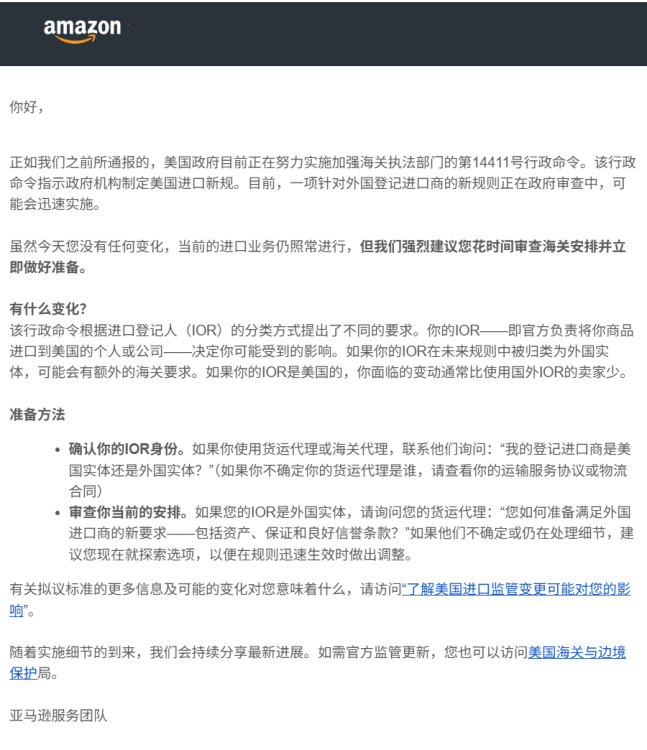
According to the details of Executive Order 14411, the U.S. government plans to classify Importers of Record (IOR) into two categories: U.S. domestic entities and foreign entities outside the U.S., and implement significantly differentiated regulatory measures: U.S. domestic IOR: Regulatory impact is relatively mild, focusing on routine compliance verification, bond and solvency matching the declared value. Foreign IOR (the mainstream model for Chinese sellers): Becomes the target of key customs oversight and restrictions. Proposed constraints include three major "killer measures": 1. Ban on informal entry channels Previously, some low-value or small-volume goods could be cleared quickly through informal entry. Once the new rule takes effect, foreign IORs will be strictly limited to formal entry channels. This not only means a comprehensive increase in hard requirements such as qualification review, proof of assets, and bonds, but also entails a look-through beneficial owner declaration requirement. 2. Customs bond (Bond) rules tightened comprehensively The "Continuous Bond" widely used by sellers or freight forwarders may no longer apply to foreign IORs. Instead, a per-transaction Single Transaction Bond may be required, potentially with higher cash collateral. This will significantly increase capital occupation and per-shipment logistics costs. 3. Customs broker qualification threshold raised: Must have CTPAT certification This is the most easily overlooked but most fatal hidden clause for most sellers. The new rule plans to require that all foreign IOR declarations must be handled by a U.S.-licensed customs broker that holds CTPAT (Customs-Trade Partnership Against Terrorism) certification. Industry warning: Many small customs brokers and freight forwarder services on the market that rely on low-price "shared IORs" or borrowed, non-compliant customs entry qualifications will quickly lose their customs clearance eligibility under this rule.
Many sellers may wonder: "I've been working with my freight forwarder for years and everything has been smooth. Why is there suddenly risk?" The answer lies in the confusion of responsible parties and affiliation risks: Shared IOR risk: Many sellers use tax-inclusive channels that rely on a "shared IOR" provided by the logistics company. Once one seller's goods under that IOR have infringement, underreporting, or prohibited items, all goods under that IOR may be detained or inspected by customs. Customs brokers lacking CTPAT certification: Many low-cost customs brokers cooperating with low-price freight forwarders have not obtained CTPAT validation. After the new rule takes effect, these brokers will no longer be able to submit declarations for foreign IORs. CBP Form 5106 look-through review: Customs is strictly verifying the authenticity of foreign IOR registered addresses, contacts, and tax ID numbers. IORs using false or bulk-affiliated addresses face the risk of being directly frozen by customs. In response to Amazon's official warning, sellers should immediately launch a supply chain compliance review, recommended as "three steps": Step 1: Ask your freight forwarder two key questions Don't wait until goods arrive at a U.S. port to discover they cannot be cleared. Confirm with your freight forwarder now: Confirm the customs clearance entity: "For our goods currently shipped to the U.S., is the IOR a U.S. domestic entity or a foreign entity?" Confirm broker qualification: "Does the customs broker you work with in the U.S. have CTPAT certification (CTPAT-Validated Broker)?" Step 2: Evaluate the feasibility of establishing a "U.S. Entity" Because foreign IORs face significant restrictions in clearance procedures, bond costs, and review strictness, for sellers with stable monthly shipment volumes and larger scale, setting up a U.S. domestic subsidiary (U.S. Corporation/LLC) as the local IOR is the most thorough solution for risk avoidance and cost reduction: 1. Enjoy the same Continuous Bond policy as domestic companies. 2. Lower customs examination rate (Exam Rate). 3. Improve supply chain controllability and completely eliminate reliance on a "shared IOR." Step 3: Plan costs and funds properly If you still need to use the foreign IOR model in the short term: Calculate in advance the increased handling costs from single bonds and formal clearance. Allow more buffer time for compliant customs clearance and logistics timelines to avoid FBA stockouts due to extended customs document review.