 Yamasen Cross-border
As cross-border e-commerce compliance policies (such as EPR environmental recycling and VAT) become increasingly strict, sellers operating French sites on platforms such as Amazon, Fnac, and Cdiscount are hearing more and more about a concept—the Private Copying Levy (Redevance pour la Copie Privée). This system has been in operation in France for many years and aims to protect the legitimate rights and interests of intellectual property owners.
The Private Copying Levy (usually administered and collected by the French authority Copie France) is not a traditional national fiscal tax, but rather a copyright compensation payment. Under French law, it is legal for consumers to copy copyrighted works for personal purposes (such as downloading music to a phone or saving videos to an external hard drive). However, this practice objectively reduces the income of copyright owners (authors, performers, record and film producers). Therefore, the French government requires a copyright compensation payment on all devices and media with storage and copying functions. This fee is ultimately borne by the buyer, but it must be withheld, remitted and declared by manufacturers, importers, or those who introduce the goods into the French market.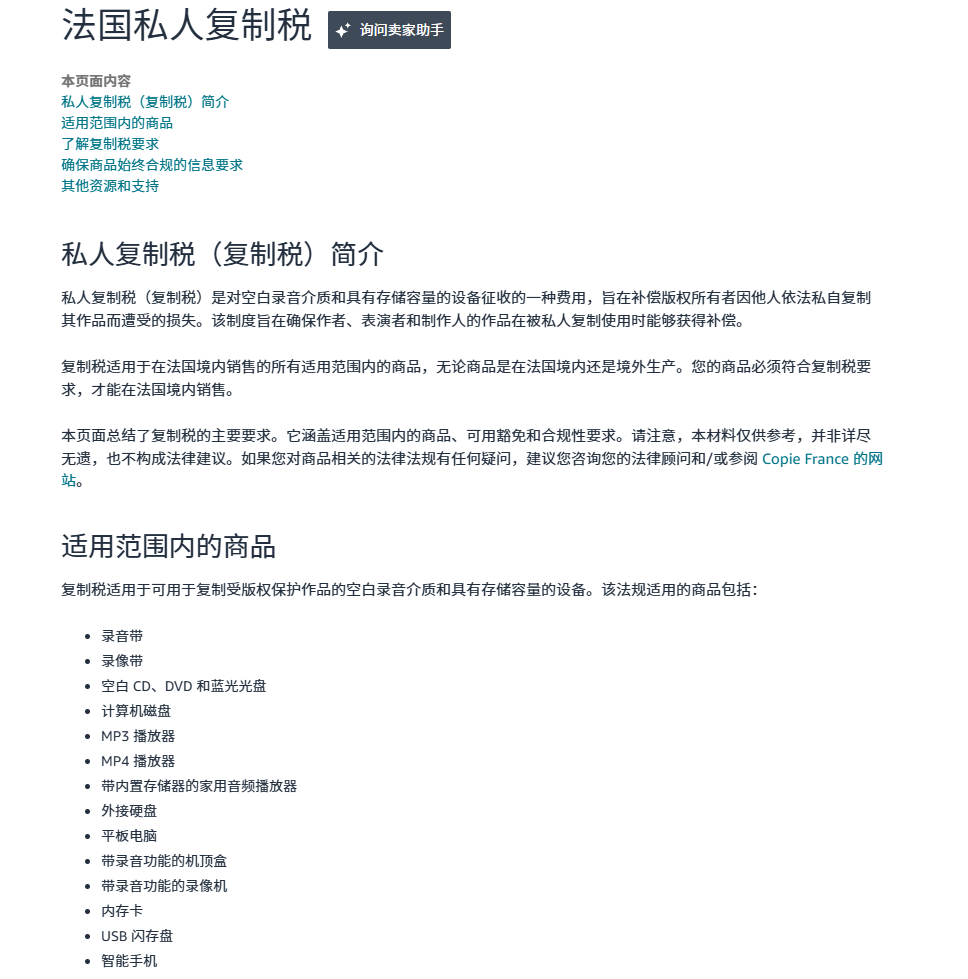
The Private Copying Levy covers a very wide range of products. As long as a product has the function of storing data, playing or recording audio/video, it is generally within the scope of the levy. It mainly covers the following hardware categories: Mobile smart devices:smartphones, tablet computers. Storage media:USB flash drives, memory cards (SD/MicroSD cards), blank CD/DVD/Blu-ray discs. Standalone storage hardware:external portable hard drives (HDD/SSD), computer disks. Audio/video playback and recording devices:MP3/MP4 players, home audio devices with built-in storage, set-top boxes and video recorders with recording functions. Note: Regardless of whether the goods are manufactured in France, transferred from other EU countries (such as using FBA cross-border EU fulfillment), or shipped directly into France from outside the EU (such as China), as long as they are ultimately delivered to French consumers, this rule must be followed. Who is the taxpayer? As a seller, if you fall into any of the following situations, you are deemed to be the responsible entity: 1. Directly import applicable goods into France from outside the EU (such as China); 2. Introduce and sell applicable goods into France from other EU countries (such as warehouses in Germany or Poland); 3. Manufacture and sell these goods in France. How are the rates calculated? The Private Copying Levy is not calculated proportionally based on the sales amount (such as 5% or 10%), but is charged at a fixed amount according to the type of device and storage capacity (GB/TB). The larger the storage capacity, the higher the fee per unit. For example: a 128GB smartphone and a 128GB SD card have different unit rates, and the tax standards are periodically reviewed and updated by an independent administrative committee. To ensure that products can be sold smoothly in the French market (on Amazon and other platforms), sellers need to complete compliance through the following three steps: Register a Copie France account ──> Submit sales data on time every month ──> Pay the corresponding tax Register the entity: Before placing products on the market, go to the Copie France official website to register an account or consult Yamaxun for registration, register company information and apply to become a compliant taxpayer. Monthly declaration: truthfully submit the quantity of applicable products sold in the French market, device types, and specific storage capacity specifications every month. Pay the tax: pay the corresponding tax according to the invoice generated by the system after declaration. Not all sales of applicable products require payment of the levy. If the products are sold to enterprises, government agencies or institutions for professional use (rather than personal private copying), the buyer or seller may apply for a tax exemption in advance or apply for a tax refund later. However, for ordinary B2C cross-border e-commerce retail, the vast majority of transactions must be declared and paid normally.