 Yijia Overseas
Recently, many cross-border sellers have been discussing the topics of "Order No. 837" and ODI (Overseas Direct Investment) filing.
So, what exactly is Order No. 837? Which situations require ODI filing? What are the risks if not filed? What does it mean for cross-border sellers? Let's clarify all at once today.
1. What is Order No. 837?
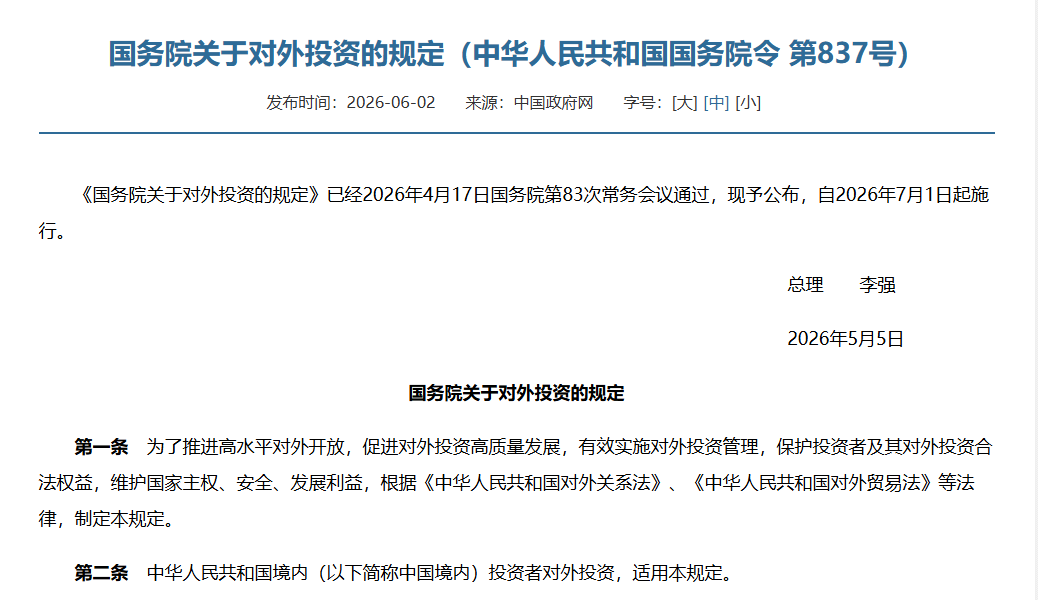
Order No. 837 refers to the "Regulations of the State Council on Foreign Investment," promulgated by the State Council in May 2026 and officially implemented from July 1, 2026.
This is China's first administrative regulation specifically regulating overseas investment activities, marking the upgrade of overseas investment (ODI) supervision from departmental rules to the level of State Council regulations. Its core purposes are:
① To standardize corporate overseas investment behavior;
② To prevent illegal capital outflows;
③ To strengthen the supervision of cross-border capital flows;
④ To enhance the authenticity review of overseas investments.
Therefore, regulatory requirements for overseas investment, establishment of overseas companies, mergers and acquisitions of overseas enterprises, and allocation of overseas assets are continuously being refined. And ODI filing is one of the most important links.
2. What is ODI Filing?
ODI (Overseas Direct Investment) refers to the filing of overseas direct investments. Simply put, when a domestic company invests funds overseas, establishes a company, acquires equity, or obtains actual control rights, it needs to file or apply with the relevant authorities.
This mainly involves the National Development and Reform Commission (NDRC), the commerce authorities (Ministry of Commerce), and the State Administration of Foreign Exchange (SAFE). Only after completing the filing can a company legally and compliantly transfer funds overseas for investment activities.
3. Which Situations Require ODI Filing?
Many sellers mistakenly believe that only large enterprises need ODI when going overseas. In fact, the following scenarios may involve ODI filing.
Situation One: Domestic Company Investing in a Hong Kong Company
For example, if domestic company A invests in and establishes Hong Kong company B, and Hong Kong company B engages in cross-border e-commerce business, this is a typical overseas investment behavior.
Situation Two: Domestic Company Injecting Funds into Overseas Companies
Registering companies in the United States, the United Kingdom, Germany, or BVI, which are established or increased capital by domestic enterprises.
Situation Three: Acquiring Equity in Overseas Companies
Acquiring overseas brands, factories, e-commerce companies, or intellectual property companies, involving equity investment or acquisition of control rights.
Situation Four: Constructing Overseas Warehouses and Factories
Building overseas warehouses or establishing overseas production bases. If it involves corporate investment in overseas projects, ODI filing is required.
Situation Five: Domestic Company Transferring Funds to Overseas Entities
If a domestic company directly transfers funds to a Hong Kong company, including registered capital, shareholder loans, or project investment funds, banks usually require ODI-related documents. Otherwise, the transfer may not be processed.
4. Which Situations Usually Do Not Require ODI Filing?
1. Cross-border Platform Sales Revenue
Sales revenue from Amazon, Walmart, eBay, Mercado Libre, etc., is not considered overseas investment.
2. Service Trade Payments
Advertising fees, software fees, SaaS tool fees, and logistics costs are considered current account items and usually do not require ODI filing.
3. Individual Investment Behavior
If an individual uses personal funds to purchase overseas securities or other investment products, it is not within the scope of corporate ODI management. However, it must comply with foreign exchange regulations.
5. What Are the Consequences of Not Filing for ODI?
This is the issue of greatest concern to sellers. Currently, regulatory focus has shifted from whether there is investment to whether the funds are legally transferred abroad. If filing is required but not done, the following issues may be faced.
1. Funds Cannot Be Transferred Out
The most common situation is when a company prepares to increase capital in a Hong Kong company. Banks require ODI filing certificates, commerce filing documents, and NDRC filing documents. Without these, the transfer may be refused.
2. Bank Account Review Obstructed
In recent years, banks have strengthened anti-money laundering reviews. If there are large-scale cross-border transfers or frequent remittances to related overseas companies but the legality of the investment cannot be proven, it may trigger risk control reviews.
3. Difficulty in Returning Overseas Profits
In the future, if a Hong Kong company makes a profit and distributes dividends back to the domestic company for tax declaration, if the initial investment path was not compliant, it may affect subsequent profit repatriation.
4. Risk of Regulatory Penalties
Overseas investment projects that should be filed but are not may be required to rectify; in serious cases, administrative penalties may be imposed.
6. What Impact Does It Have on Cross-border Sellers?
For cross-border sellers, the biggest impact of Order No. 837 is not on the sales link but on corporate structure and capital compliance.
Sellers in Category One: Minimal Impact
Domestic entities operate stores; platforms receive payments directly; there is no overseas company structure. Generally, ODI issues are not involved.
Sellers in Category Two: Need Close Attention
If a Hong Kong company holds the store, receives payments, and the domestic company injects funds into the Hong Kong company, it is necessary to assess whether ODI filing is required.
Sellers in Category Three: High Attention Group
Overseas brand acquisitions, overseas factory layouts, and overseas supply chain investments. In the future, aspects such as capital flow, profit repatriation, and financing for listing may all involve ODI compliance requirements.
Finally:
Order No. 837 is not about restricting companies from going overseas but emphasizing compliant overseas expansion.
If your business involves overseas companies, local stores, overseas warehouse layouts, or investments by overseas entities, it is recommended to sort out the capital path and equity structure as soon as possible, assess whether ODI filing is needed, and avoid affecting business development due to compliance issues later on.
This is the content sharing brought to you by Yiju Overseas. Feel free to leave comments and discuss anytime!