 Yijia Overseas
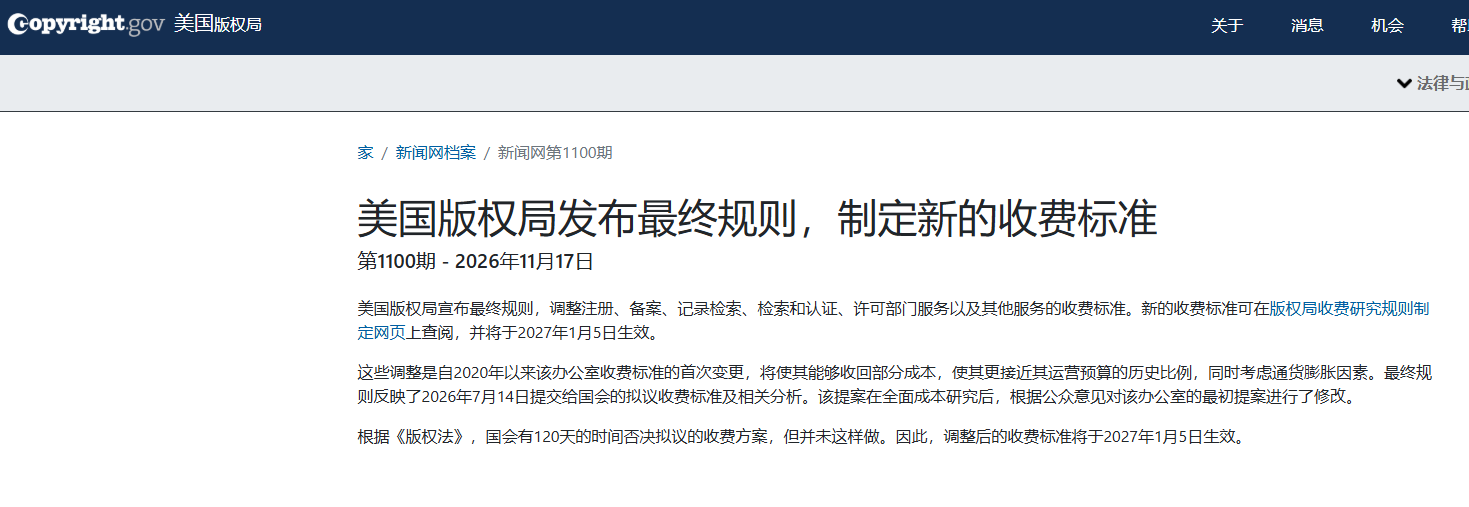
The U.S. Copyright Office issued a notice on November 17, 2026, announcing adjustments to fees for copyright registration, document filing, record searches, retrieval and certification, and other services.
This is the first fee adjustment by the U.S. Copyright Office since 2020. The new fees will take effect on January 5, 2027.
Cross-border sellers operating on Amazon, Etsy, and Shopify in the U.S. market should pay attention in advance if they have copyright registration needs for product images, original designs, brand visual assets, and similar materials.
Which items will increase? What are the differences between the old and new fees? How should cross-border sellers plan ahead? Read on for details.
1. The U.S. Copyright Office Officially Announces Fee Adjustments
According to the final rule issued by the U.S. Copyright Office, the adjustments mainly involve:
1. Copyright registration fees;
2. Paper and electronic application fees;
3. Collective work registration fees;
4. Copyright document filing fees;
5. Copyright record search and certification fees;
6. Other related administrative service fees.
The U.S. Copyright Office stated that the adjustments are mainly to address inflation and rising operating costs, improve cost recovery, and maintain normal copyright registration services.
Note that not all items are increasing uniformly; some service fees will decrease, but overall most fee items will rise.
2. Key Focus for Cross-Border Sellers: Copyright Registration Fee Changes
For cross-border sellers, the most important change is the U.S. copyright registration fee.
According to the officially published old and new fee schedule, several commonly used services will change as follows:
1. Standard Application (electronic)
Old fee: $65
New fee: $85
Increase: about 30.8%
This is the most common electronic copyright application method for eligible original work registration.
2. Paper Filing
Old fee: $125
New fee: $185
Increase: 48%
The paper filing fee increase is larger. The U.S. Copyright Office is also using the fee difference to encourage applicants to use the electronic application system.
3. Single Application
Old fee: $45
New fee: $55
Increase: about 22.2%
This application applies to specific cases with one author, one work, and the author is also the only copyright claimant.
4. Other Registration Services
In addition to common application methods, some special copyright registration services will also see notable changes:
① Preregistration of unpublished works: increases from $200 to $320.
② Copyright renewal application: increases from $125 to $165.
③ Restoration of copyright registration: increases from $100 to $165.
④ Special expedited handling fee: increases from $800 to $1,100.
Not all items are increasing. For example, the electronic supplementary registration fee will decrease from $100 to $85.
The above fees are subject to the final fee rule published by the U.S. Copyright Office.
3. How Will the Fee Increases Affect Cross-Border E-Commerce Sellers?
For cross-border sellers operating in the U.S. market, copyright protection is an important part of product intellectual property planning.
The following types of sellers, in particular, should pay close attention.
1. Sellers with many product images and original designs
If product main images, detail page images, packaging designs, illustrations, and other content are originally created by the company, consider copyright registration based on the actual situation.
Copyright registration helps establish a record of ownership and provides evidence for rights enforcement in disputes such as image theft or design copying.
2. Sellers with original brand visual assets
Brand logos, original promotional images, video assets, product manuals, and similar materials may involve different types of intellectual property protection.
Sellers should choose the appropriate protection method based on the nature of the work, rather than simply placing all materials under copyright registration.
3. New sellers planning to enter the U.S. market
If a company plans to enter Amazon, Etsy, Shopify, or other U.S. market channels, it is advisable to sort out the intellectual property ownership of product designs, image assets, and brand content in advance.
Especially when there is outsourced design, commissioned photography, or third-party creation, confirm in advance whether copyright ownership and relevant authorization documents are complete.
4. What Should Cross-Border Sellers Do Now?
There is still time before the new fee schedule takes effect. Sellers can prepare in advance by doing the following:
First, inventory existing original works.
Organize product images, original designs, brand promotional assets, and other commercially valuable works, and identify which need copyright protection.
Second, check work ownership and authorization documents.
If works are created by designers, photographers, or third-party agencies, confirm contracts, copyright transfer agreements, and authorization documents to avoid future ownership disputes.
Third, plan copyright application timing properly.
If you already have clear copyright registration needs, learn about application requirements, material requirements, and review procedures in advance, and arrange the application according to your actual situation.
However, do not ignore work eligibility, material authenticity, and ownership issues just to file before the fee increase.
Final note:
The U.S. Copyright Office's fee adjustment means that from 2027, the cost of U.S. copyright registration and related services will change for businesses.
For cross-border sellers, intellectual property protection should not focus only on trademarks and patents. Product images, original designs, brand visual assets, and other copyright issues also deserve attention.
Sellers are advised to review their intellectual property layout in advance and make copyright protection arrangements based on product types, sales markets, and brand development plans.
The above is the content shared by Yiju Overseas. Feel free to leave comments and discuss!