
 AGI Sea Log
On November 3, QuestMobile released the "China Mobile Internet Autumn Report". Overall growth has slowed significantly. As of September 2026, mobile internet monthly active users reached 1.281 billion, up only 0.9% year-on-year; but user time spent still grew, with average monthly usage per person reaching 189.8 hours in September, up 6.5% year-on-year.
User growth has peaked, so where does the extra time come from? Short dramas and short videos.
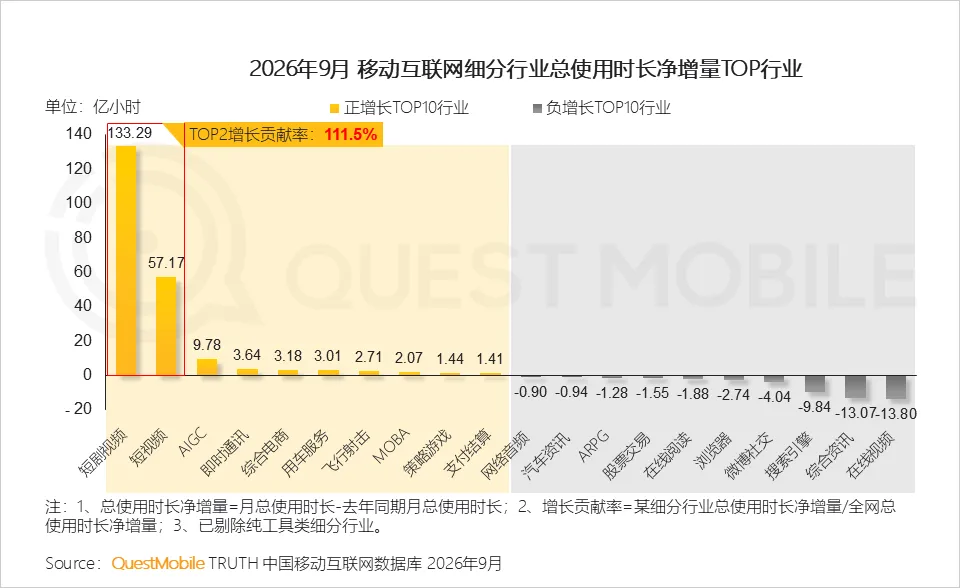
One set of data in the report is very telling: the contribution rate of time growth from short dramas and short videos reached 111.5%, eating up a large amount of user time previously spent on online video and general news. In September, total usage time of short drama videos increased by a net 13.329 billion hours, and short videos by a net 5.717 billion hours, far ahead of the third-ranked AIGC track. Over the same period, online video time did not rise but fell, dropping by 1.38 billion hours.
Amid this shift in attention, the product landscape within major companies is also being rewritten. The second-place product at Douyin Group has changed hands.
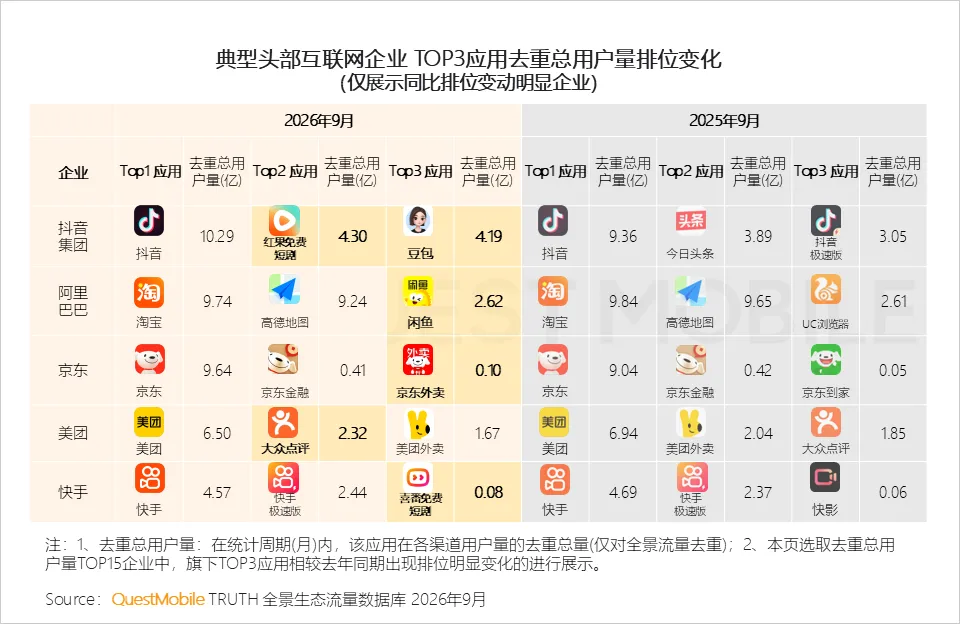
In September 2026, the deduplicated total users of Douyin, Hongguo Free Short Drama, and Doubao were 1.029 billion, 430 million, and 419 million respectively. Hongguo ranked second in the group with an advantage of about 11 million users. In the same period last year, this position alternated between Toutiao and Douyin Lite. In one year, free short dramas scaled up rapidly, surpassing Doubao, which had high expectations.
Hongguo's breakthrough took a path completely different from the early short drama industry. When it launched in August 2023, the mainstream short drama model was still paid unlocking, while Hongguo chose free viewing and advertising monetization, combined with coin tasks to retain users. Checking in, watching dramas, and completing tasks could all be exchanged for cash, keeping the entry barrier very low.
With Douyin's traffic entry, Fanqie Novel's IP reserves, and ByteDance's recommendation algorithm, its growth climbed steadily. From Q1 2025 to July-August 2026, Hongguo's monthly active users surged from 168 million to 403 million, and daily active users rose from 52 million to 177 million.
Its most outstanding advantage is stickiness. In Q3 2026, Hongguo's average daily usage time per person was 151 minutes, ranking first among apps with over 100 million MAU, higher than Douyin's 133.5 minutes, WeChat's 98.3 minutes, and Xiaohongshu's 95.7 minutes. With episodes lasting only a few minutes and dense plot twists, users easily sit for two or three hours, exactly the traffic pattern that the advertising model favors.
The report also shows that in September, Doubao's per-user usage frequency and usage time fell by 6.1% and 7.8% month-on-month respectively, while DeepSeek continued to grow. For Doubao, user scale is no longer the challenge; finding a sustainable and scalable monetization path is now the core issue.
Notably, Hongguo, which has already closed its business loop, is also deliberately slowing down. In the first half of 2026, Hongguo's core revenue was about 20 billion yuan, with advertising accounting for 97%. In late October, Hongguo announced it would remove the coin feature by the end of the year and add rest and sleep reminders. When a product occupies two and a half hours of users' time each day, a model that relies on coin incentives and algorithms to endlessly extend time spent is seeing diminishing marginal returns, while regulatory and public pressure follow. Growth driven purely by stacking time has hit a ceiling.
In a saturated internet, the essence is a battle for attention. In a market where the total number of users is basically fixed, whoever can capture users' time shift at a lower cost will move up the rankings.