 Seller's Home
Amazon is undergoing a strategic shift from "sales first" to "quality first."
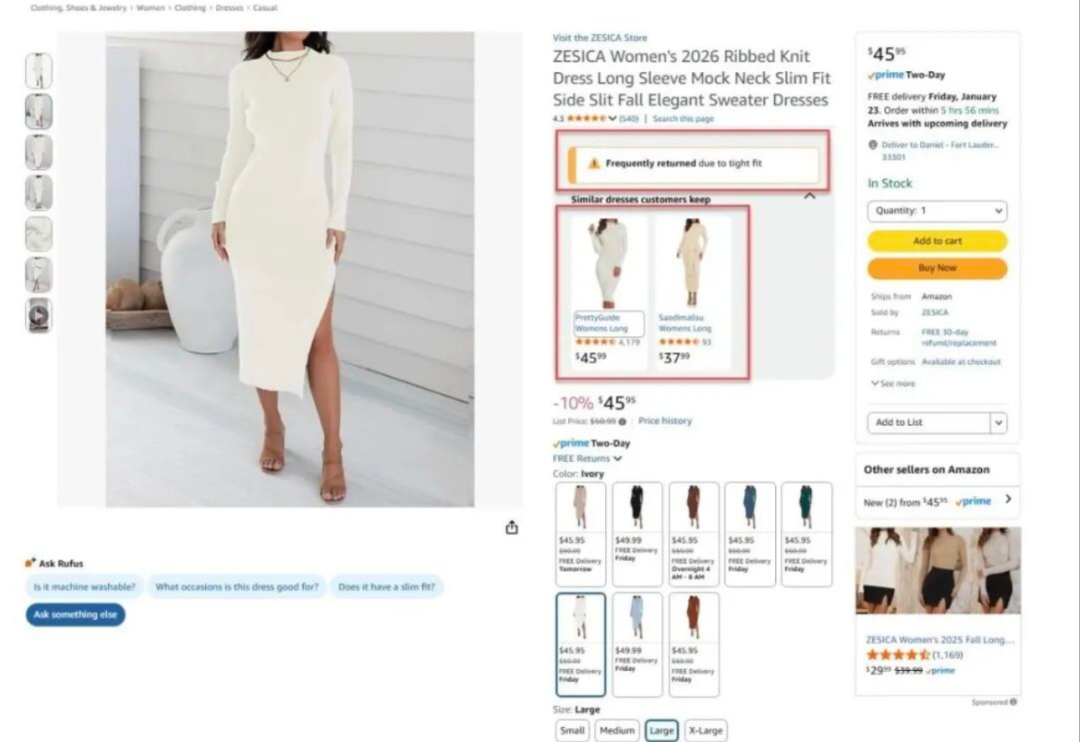
Many sellers have noticed that Amazon's "Frequently Returned" high return rate label has been upgraded. The most significant change is the label's position directly below the most prominent product link title.Next to the yellow exclamation mark, the words "Frequently Returned" are clearly visible, directly informing consumers that the product has a high return rate issue.
01
Amazon Updates High Return Rate Label
What's more surprising is that the label also includes a brief explanation of the return reasons, such as "size too large," "does not match description," or "quality issues." This information comes from the analysis of return data.
As shown in the image above, the return reason for the women's clothing link is "tight fit" (size too small). Combined with Rufus's question in the lower left corner of the main image, buyers can intuitively understand the evaluations of other customers for a product. Moreover, below the label, "similar products ordered by other buyers" are recommended for buyers' reference.
Such an upgrade of the high return rate label has caused a stir among sellers.One seller said, "It's one thing to show a high return rate label, and it's another to move it below the price. Now they even put competitor links there. Are they trying to kill me off faster?"
Subsequently, many sellers also found that with the upgrade of the return label, their sales volume dropped. One seller said, "My sales dropped by three-quarters, and it turned into these competitor products."
Regarding this upgrade, sellers have mixed opinions.
Some sellers believe that, on the positive side, it serves as a warning and provides valuable decision-making information for consumers. It also clearly indicates the reasons for high return rates, reducing buyers' speculation. For example, if clothing is marked as "size too small," buyers will buy a larger size when purchasing, which can effectively reduce the return rate.
However, more sellers believe that as soon as buyers see "high return rate" and specific reasons, their willingness to place orders will drop sharply, resulting in a cliff-like drop in conversion rates. It is currently uncertain whether the reasons extracted by AI are accurate. Moreover, the recommendations below the label directly divert traffic to competitors and reinforce buyers' concerns with the help of AI assistant Rufus.
02
The Essence of Business is Product
Currently, many sellers are thinking about how to mitigate the impact of the "high return rate" label.
Some sellers openly say that the only way is to return to the essence of business, which is to focus on the product.The seller said, "Increase sales and reduce return rates, and naturally, it will disappear. There is no other way."
In fact, Amazon has made several changes to the high return rate label.
As early as two years ago, at the beginning of 2023, some products on Amazon's US site were labeled with "Frequently Returned Item." Products with this label had an orange box below the listing, with the words "Frequently Returned Item" in bold, followed by two lines of small text:
Check the product details and customer reviews to learn more about this item
Translated into Chinese, it means: Please check the product details and customer reviews to learn more about this item.
By March 2025, Amazon had "upgraded" this label: it became more prominent and noticeable, making the issue of plummeting conversion rates for high return rate sellers even more apparent.
Currently, there has been a new upgrade. Amazon's adjustment seems to also aim to improve platform credibility by eliminating low-quality products and force sellers to optimize their supply chain and service quality.
Industry insiders suggest:
One is to merge existing ASINs into a new ASIN and then promote it again. However, this operation may lead to the need to reaccumulate natural weight or reset the return rate data to 0 by refurbishing to a new ASIN.
Second, ensure that the title, five-point description, and image information are true, accurate, and unambiguous. Explain common reasons for returns in advance in the listing to manage buyer expectations.
Third, appropriately control advertising budgets to avoid ineffective spending. At the same time, stabilize order volume by optimizing listings and improving service quality, and dilute the return rate with new orders.
Fourth, use return reports, buyer messages, and negative reviews to summarize common reasons for returns (such as size, material, function, etc.) to provide direction for optimization.
Fifth, if the product itself has irreparable defects, consider developing an upgraded or new version, and gradually phase out problematic links through variants or new ASINs to receive traffic.
As return rates and reasons become more transparent, the actual quality of products and the accuracy of descriptions will become more important.
The information in this article is for reference only and should not be used as the basis for investment decisions