 Cross-border e-commerce Hugo.com
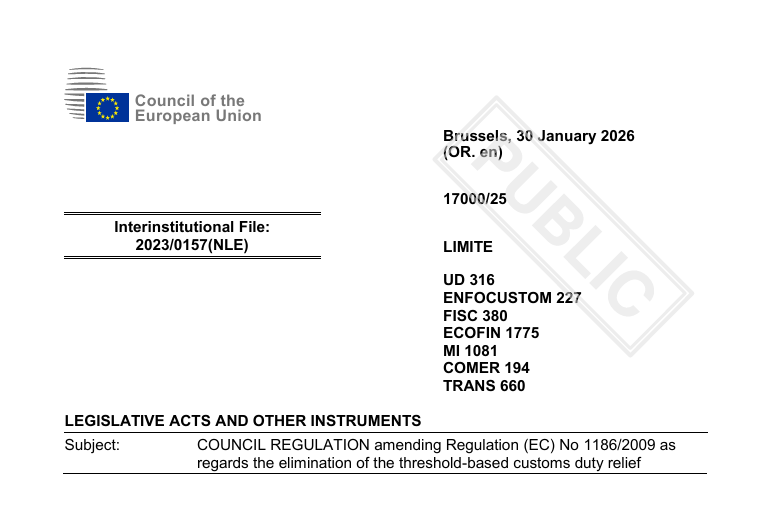
The EU has officially abolished the duty exemption for packages valued below €150.
Recently, the EU's latest cross-border e-commerce import regulatory reform plan has officially taken effect. According to the official content, this reform will abolish the long-standing duty exemption policy for small parcels valued below €150, while also clarifying transitional tax measures and long-term goals.
The EU is one of the world's largest cross-border e-commerce consumer markets. This new policy will have a profound and direct impact on global cross-border e-commerce platforms and sellers layout in the EU market, especially on those with low average order value, thin margins, and reliance on direct mail models.
As a policy buffer, the EU has set a two-year transition period, from July 1, 2026, to June 30, 2028. During this period, small parcels valued ≤€150 and directly sent to EU consumers will be uniformly subject to a fixed duty of €3 according to the commodity category (Customs Tariff Subheading). Different categories of goods in a single parcel need to be taxed separately. For example, a parcel containing a silk blouse and a woolen blouse, because they belong to two different categories of goods, will need to pay €6 in duties.
It should be noted that during this transition period, the collection of the fixed duty of €3 has no exemptions. Even goods that fall under the following special tax collection scenarios must still be paid according to regulations:
1. Goods applicable to Article 143(1)(ca) of Directive 2006/112/EC, which exempts value-added tax;
2. Remote import sales goods collected and paid by cross-border e-commerce platforms on behalf of the EU IOSS (Import One-Stop Service) mechanism;
3. Postal parcels defined in Article 1(24) of Regulation (EU) No 2015/2446, namely traditional international mail sent through the Universal Postal Union system.
After the transition period ends on July 1, 2028, the fixed duty policy of €3 will be officially abolished, and all non-EU imported goods will be subject to duties according to the actual Most-Favored-Nation Rate/Agreement Rate corresponding to the customs tariff number, while value-added tax will continue to be collected according to the current rules of EU member states.
To achieve precise tax collection after the transition period, the EU will also complete the construction of the customs data center and put it into formal operation simultaneously. This center will connect the customs data systems of all EU member states, realizing the full-process digital supervision of cross-border e-commerce parcels' value verification, tariff classification, tax rate calculation, and tax collection, greatly improving the efficiency and accuracy of tariff collection.
The European Commission has made it clear that it will assess the trade flow transfer situation every month starting from October 2026 and evaluate the progress of customs information infrastructure construction before December 2027. If necessary, the transition period measures will be extended.
According to official disclosures from the EU, this policy adjustment stems from multiple considerations. On the one hand, the tax exemption policy for small parcels causes the EU to lose about €10 billion in tariff revenue each year, and there is a regulatory loophole where a large number of non-compliant goods flow into the market through tax-exempt channels; on the other hand, with the rapid development of global e-commerce, the tax exemption policy has caused unfair competition between EU domestic retailers and cross-border e-commerce, impacting the development of local industries. Makis Keravnos, the Finance Minister of the Republic of Cyprus, stated that abolishing the outdated small parcel tariff exemption can not only plug the speculative loopholes of bad sellers but also support the development of EU domestic enterprises, which is a key measure to enhance the competitiveness and security of the EU.
With the rapid rise of global cross-border e-commerce, the EU, as an important trading economy, has closely related the tightening and regulation of its small parcel tariff policy to the cross-border trade environment and internal EU demands at each stage.
For sellers who rely on low prices and high volume, this new policy is almost a devastating blow, directly breaking the industry's original low-price competition logic. Many cross-border e-commerce platforms have also reminded sellers to adjust their business strategies in a timely manner.
After the policy is implemented, it will have a profound impact on the global cross-border e-commerce industry. According to statistics, in 2024, the number of cross-border parcels valued below €150 within the EU reached 4.6 billion, and by July 2025, the monthly import volume was still 36% higher than the same period in 2024. Currently, nearly 180 direct mail parcels enter the EU every second, of which 97% are small items. Among them, platforms like Temu and Shein contribute over 70% of the order volume, and over 95% of the goods on these platforms are priced below €150. The new policy will directly lead to an average cost increase of 15-20% for them.
For sellers, the surge in costs is the primary impact, directly squeezing profit margins. Sellers of low-priced small items, multiple SKUs, and low gross margin goods are particularly affected, with some goods potentially incurring losses, further squeezing the living space of small and medium-sized sellers. And when the cost pressure is transmitted to the end pricing, sellers' "low-price advantage" is weakened, and competitiveness declines. Sellers are in a dilemma: if they bear the costs themselves, their profits will shrink; if they raise prices, they will lose price-sensitive consumers and see orders decline. Sellers with weak strength and lack of core competitiveness may be eliminated, and large Chinese cross-border e-commerce platforms that mainly rely on small parcel orders will also be directly impacted.
Some cross-border e-commerce sellers told Hugo Cross-border that for sellers of 3C accessories, daily necessities, and other categories with low average order value and thin margins, the fixed duty of €3 will significantly compress profits, and some low-margin goods may even incur losses; small and medium-sized sellers without overseas warehouse layout and relying on direct mail will face a double blow of logistics and tariff costs, completely losing their price advantage; even sellers with medium and high average order values who were not originally applicable to the tax exemption policy will also be indirectly squeezed in profits due to the overall increase in industry costs and market pricing adjustments.
Industry experts suggest that cross-border e-commerce practitioners should seize the transition period window, carry out cost calculations as soon as possible, optimize pricing strategies and product portfolios, dilute tariff costs by consolidating shipments and increasing average order values; at the same time, accelerate the upgrade of compliance capabilities, improve customs declaration processes, and actively deploy EU overseas warehouses or explore supply chain localization to reduce policy impact. In addition, enterprises can also focus on high-value-added goods, strengthen brand building and local operations, and break away from reliance on price advantages.
Leading cross-border platforms have taken the lead in transformation. Temu plans to increase the coverage of European warehouses to 80% by the end of 2026, avoid duties through local shipping, and subsidize the cost of overseas warehouse entry; Shein will shift 60% of its European orders to local warehouse shipments, eliminate SKUs with an average order value below €15, and focus on promoting high-value-added set products. Industry insiders analyze that this new policy will accelerate the reshuffling of the cross-border e-commerce industry. Sellers with low quality and price and lack of core competitiveness may be eliminated, while enterprises with scale effect, supply chain advantages, and brand strength, as well as those with overseas warehouse layout and localized operations, will have more competitive advantages.
The tightening of the EU's small parcel tariff is an irreversible trend. Short-term pressure is inevitable, but in the long run, policy regulation forces the industry to develop towards compliance and high quality. Non-compliant enterprises are eliminated, optimizing the market competition environment and providing a fair competition platform for sellers who focus on brand, quality, and innovation; the EU's emphasis on green compliance also brings premium space for related sellers, promoting the industry's transition from "price competition" to "value competition".
&