 Cross-border e-commerce Hugo.com
By 2026, cross-border e-commerce will no longer be simply about "low price and high volume". With the tightening of regulatory policies and the increase of trade barriers in various countries, compliance has become the lifeline of enterprises going overseas. Recently, the US Customs and Border Protection (CBP) announced that it had officially seized a batch of Chinese-made e-Bikes; at the same time, domestic ports such as Yantian and Nansha have also launched intensive inspections on the 9810/9710 customs declaration mode recently. These internal and external news all point to the same signal: cross-border e-commerce is accelerating into the "era of strong regulation".
Against the backdrop of the rapid growth in demand for electric bicycles (e-Bikes), the US market is welcoming a round of stricter compliance regulations.
Recently, the US Customs and Border Protection (CBP) seized a batch of electric bicycles from China at the Norfolk port in Virginia, which attracted attention within the cross-border circle.
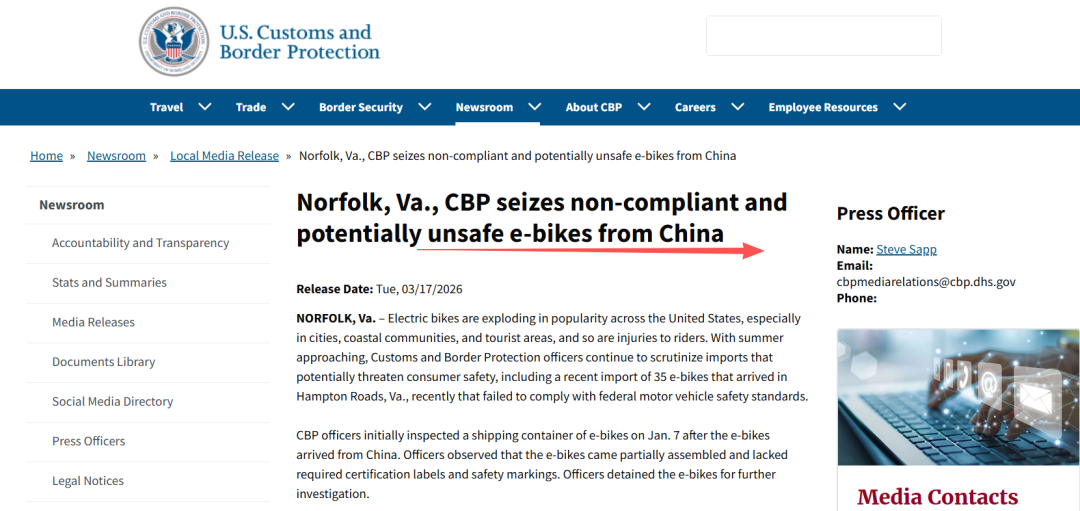
Image source: CBP
According to information released by CBP, this batch of goods entered the US port in the form of "not fully assembled" at the time of declaration, and some key components were in a disassembled state. However, in the actual inspection process, the US Customs and Border Protection (CBP) found that this "semi-finished" form did not effectively evade supervision, but triggered a stricter review process.
Further checks showed that this batch of electric bicycles had obvious problems with missing labels, including incomplete necessary product identification information and safety signs.
Subsequently, relevant agencies intervened and determined that this batch of products failed to meet the requirements of the US motor vehicle safety-related standards system, and after the customs proposed a "return treatment" suggestion, the importer did not cooperate in implementation, which directly led to the entire batch of goods being detained in the United States, and the loss was almost a foregone conclusion.
It is worth noting that this incident releases an important signal - the path of "split shipment + overseas assembly" is being closely monitored by US regulators.
In the past two years, driven by the trend of green travel, the demand for electric bicycles in the European and American markets has grown rapidly, becoming an important incremental track for Chinese sellers to go overseas. Many sellers have achieved sales outbreaks on platforms such as Amazon relying on supply chain advantages. But at the same time, this category has gradually come under regulatory scrutiny.
Some cross-border sellers choose to export electric bicycles in multiple parts to reduce transportation costs, evade vehicle certification or tariff pressure, and then complete assembly overseas. This model was once regarded as a "gray optimization path" and is not uncommon in the industry. But now, as regulation tightens, this operation is rapidly becoming ineffective.
Now a clear trend is that the past model of rapid going overseas relying on price advantage and supply chain efficiency is being reshaped by a stricter compliance system. Especially in high-value markets such as the United States, factors such as product safety and supply chain transparency are becoming new competitive barriers.
It can be foreseen that similar inspections and seizures will still occur frequently in the coming period of time. This batch of seized electric bicycles (e-Bikes) will also become a microcosm of the overall tightening trade and regulatory environment in the United States. As regulation continues to tighten, high-growth categories such as electric bicycles will enter the "era of strong compliance".
While the US Customs continues to increase compliance inspections, domestic export chain supervision is also further advancing. In recent days, news about "Nansha and Yantian Ports strictly inspecting 9710/9810 customs declarations" has been fermenting in the cross-border e-commerce circle.
Many sellers and freight forwarders reported that the core export ports in South China - Yantian and Nansha have synchronized strengthening the supervision of cross-border e-commerce B2B exports (9710) and overseas warehouse exports (9810) modes, focusing on "trade authenticity verification", including penetration checks on the entire link data such as orders, funds, logistics, and entity information.
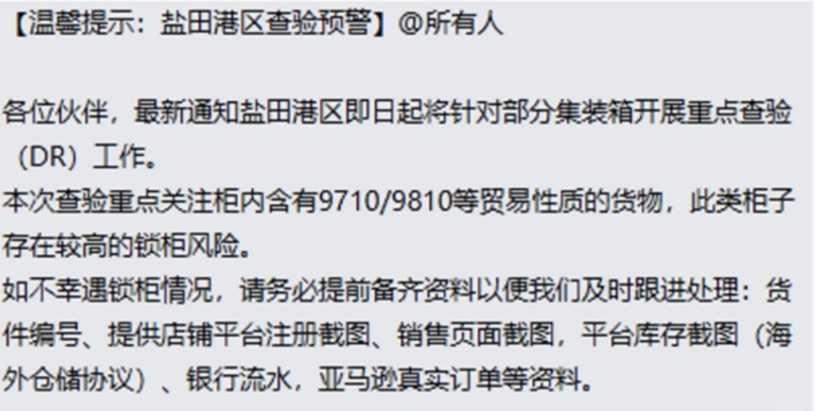
Image source: Community screenshot
9710 and 9810 are important institutional innovations for the rapid development of cross-border e-commerce. The former is for B2B direct exports, and the latter serves the overseas warehouse storage model. Both simplify the mechanism through "list + customs declaration form", which greatly improves the efficiency of customs clearance and also reduces the threshold for small and medium sellers to go overseas.
However, as the industry scale expands, some gray operations have gradually emerged, such as completing customs declarations through fictitious orders, deliberately underreporting or misreporting commodity values, using "no real import subject" dual-clearance tax-inclusive mode, or even evading some regulatory requirements through overseas warehouse links.
The supervision upgrade of Yantian and Nansha is a concentrated response to these issues. From the current feedback in the industry, the supervision method has shifted from previous sampling inspections to more systematic verification, not only focusing on the declaration of individual shipments, but also emphasizing the authenticity and consistency of the entire link data. Once inspected, enterprises often need to supplement materials such as store backend order screenshots, transaction records, payment vouchers, commodity pricing basis, and logistics information to prove the authenticity of the transaction.
What's more noteworthy is that this kind of supervision is not limited to the customs clearance at the moment, but gradually extends to subsequent verification.
Some customs brokers have already reminded their clients that even if the goods are released smoothly, they may still face retrospective inspections subsequently. If an enterprise cannot provide complete link data, it may not only be required to pay additional taxes, but also risks being listed on the abnormal list.
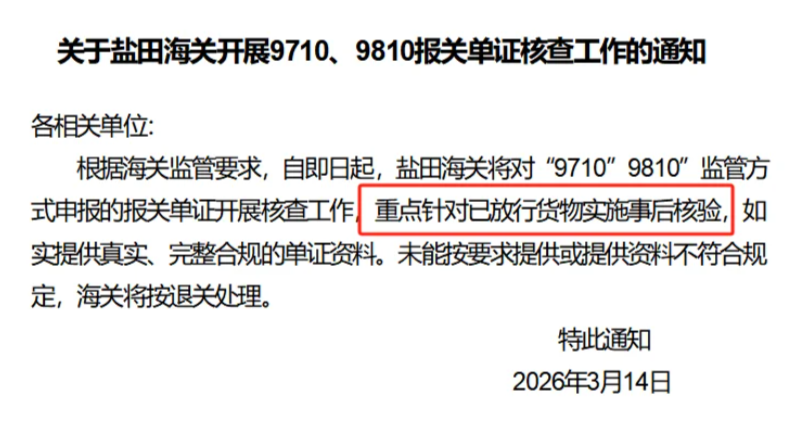
Image source: Community screenshot
Obviously, the domestic regulatory authorities are promoting the standardization of cross-border e-commerce exports from multiple dimensions. If you look further, you will find that this round of domestic tightening actually echoes the regulatory changes in overseas markets.
Since 2026, the regulation of cross-border e-commerce in the United States and Europe has obviously tightened. The US Customs has strengthened the audit of importer identities, and large-scale inspections and returns occur frequently; the European Union is promoting platforms to assume more "importer responsibilities", trying to clarify the responsibility attribution from the source. Against this background, if there are still a large number of unreal declarations or gray links on the Chinese export side, it will undoubtedly amplify the risks of overseas customs clearance and compliance, and even affect the overall trade credit.
Therefore, for sellers, the cost of compliance declaration, data preparation, tax treatment and other links will undoubtedly rise in the short term, but from a longer-term perspective, this change will help reduce the risks of return and detention, and make the supply chain more stable.
For logistics and freight forwarding service providers, this is also a clear watershed. Those service providers that have long relied on "gray customs clearance" and "tax-inclusive mode" will find it increasingly difficult to survive, while enterprises with formal customs declaration capabilities, data integration capabilities, and overseas customs clearance resources will have the opportunity to stand out. The competition in the future will no longer be just about price, but about compliance capabilities and service stability.