 Seller's Home
On the evening of July 10, SHEIN's Hong Kong IPO reached a key milestone.
According to China Securities Journal, the International Cooperation Department of the China Securities Regulatory Commission disclosed the "Notice on the Overseas Listing Filing of SHEIN Global Holdings Limited." The filing shows that SHEIN plans to issue up to 341.6 million ordinary shares for overseas listing on the Hong Kong Stock Exchange.
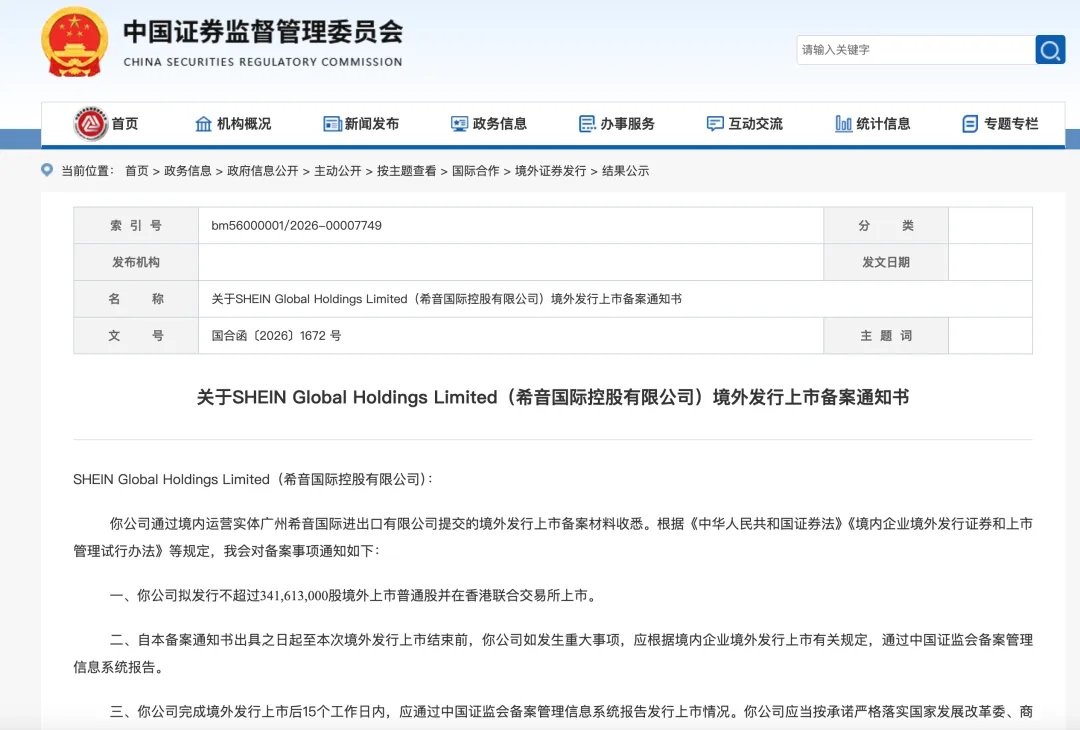
Figure: SHEIN Overseas Listing Filing Notice
Obtaining the CSRC's overseas listing filing is a major step forward for SHEIN's HK IPO, though it does not mean the listing is complete. Upcoming steps include HKEX review and pricing. The exact timing, fundraising size, and final valuation will be disclosed in the formal prospectus.
In any case, for a company that has explored listings in New York, London, and Hong Kong, this filing brings SHEIN closer to becoming a public company.
SHEIN's IPO draws attention not only as a potentially significant consumer listing in Hong Kong but also because of its distinctly cross-border nature: its business serves global consumers, its headquarters is in Singapore, while its supply chain and operations are deeply rooted in China.
From this perspective, the IPO is not just a corporate capital event; it is a window to observe how Chinese cross-border enterprises move from "selling goods globally" toward global operations and global capital markets.
01
From New York, London to Hong Kong
SHEIN's listing plan has lasted several years.
In November 2023, reports emerged that SHEIN confidentially filed for a US IPO. According to The Paper, it could have gone public as early as 2024, making it one of the largest consumer IPOs in recent years.
As global market and regulatory conditions shifted, SHEIN turned to the UK. In June 2024, Cailian Press reported that it submitted a London listing application. By 2025, Yicai quoted sources saying SHEIN had received FCA approval, with a latest reported valuation of around $50 billion.
London did not become the final destination. In 2025, SHEIN pivoted to Hong Kong, advancing its application confidentially. The CSRC filing now marks substantive progress for its HK IPO.
On the surface, this is a route from New York to London to Hong Kong. Underneath, it reflects a cross-border enterprise continuously seeking balance among different market rules, regulatory requirements, and capital environments.
The US offers mature tech and consumer investors and high visibility; London wanted to attract large international companies; Hong Kong has close ties with mainland industries while hosting a broad international investor base.
SHEIN's exploration of three capital markets should not be simplified as success or failure of any single attempt. For a company with operations, supply chain, and structure across multiple countries, choosing the listing venue is itself part of global governance.
The ultimate choice of Hong Kong reaffirms SHEIN's industrial foundation and development environment.
According to China Securities Journal, selecting Hong Kong underscores the company's determination to deeply root in and develop with China, and to boost confidence in the cross-border e-commerce sector.
This statement is noteworthy because even though SHEIN has grown to serve global consumers, the core capabilities underpinning its efficiency and business model remain tightly linked to China's supply chain.
SHEIN's listing plan has lasted several years.
In November 2023, reports emerged that SHEIN confidentially filed for a US IPO. According to The Paper, it could have gone public as early as 2024, making it one of the largest consumer IPOs in recent years.
As global market and regulatory conditions shifted, SHEIN turned to the UK. In June 2024, Cailian Press reported that it submitted a London listing application. By 2025, Yicai quoted sources saying SHEIN had received FCA approval, with a latest reported valuation of around $50 billion.
London did not become the final destination. In 2025, SHEIN pivoted to Hong Kong, advancing its application confidentially. The CSRC filing now marks substantive progress for its HK IPO.
On the surface, this is a route from New York to London to Hong Kong. Underneath, it reflects a cross-border enterprise continuously seeking balance among different market rules, regulatory requirements, and capital environments.
The US offers mature tech and consumer investors and high visibility; London wanted to attract large international companies; Hong Kong has close ties with mainland industries while hosting a broad international investor base.
SHEIN's exploration of three capital markets should not be simplified as success or failure of any single attempt. For a company with operations, supply chain, and structure across multiple countries, choosing the listing venue is itself part of global governance.
The ultimate choice of Hong Kong reaffirms SHEIN's industrial foundation and development environment.
According to China Securities Journal, selecting Hong Kong underscores the company's determination to deeply root in and develop with China, and to boost confidence in the cross-border e-commerce sector.
This statement is noteworthy because even though SHEIN has grown to serve global consumers, the core capabilities underpinning its efficiency and business model remain tightly linked to China's supply chain.
02
SHEIN's Globalization
Cannot Be Separated from China's Supply Chain
Cannot Be Separated from China's Supply Chain
The most talked-about term for SHEIN is "small batch, rapid response".
Traditional apparel firms forecast demand and produce large batches, risking inventory pile-up if predictions miss. SHEIN splits orders into small batches, tests with low quantities, and quickly reorders based on feedback, better matching supply with demand.
But "small batch, rapid response" goes beyond reducing initial volumes. It entails consumer insight analysis, product development, digital coordination, supplier response, quality control, warehousing, and cross-border logistics.
A report by Outlook Oriental Weekly, affiliated with Xinhua, shows that Panyu, Guangzhou has over decades built a complete garment supply chain. It hosts numerous manufacturers, fabric markets, wholesale centers, storage bases, and an international air hub. This density and responsiveness underpin the rapid model.
Thus, SHEIN's growth is not merely the platform unilaterally "transforming" the supply chain. It stems from the company's capabilities in demand analysis, digital coordination, and global operations, while also resting on the Pearl River Delta's long-accumulated manufacturing expertise and industrial ecosystem.
In other words, SHEIN's platform abilities and China's manufacturing foundation jointly form this model.
SHEIN continues strengthening ties with domestic industrial clusters. Xinhua reported in 2024 that SHEIN's supply chain headquarters settled in Zengcheng, Guangzhou. Phase one covers 738 mu (about 49.2 hectares) with a total floor area of no less than 800,000 sqm and a total investment of 3.69 billion yuan. It will house an intelligent warehousing and logistics park integrating storage, preparation, sorting, dispatching, and settlement.
According to the latest China Securities Journal report, SHEIN directly serves consumers in about 160 countries and regions. It has designated Guangdong as a "demonstration province for industrial clusters going global," helping 21 cities' industrial belts participate in digital transformation through cross-border e-commerce.
Regarding supplier support, SHEIN disclosed that in Q1 2026 it delivered 1,200 pieces of self-developed tools and equipment to suppliers, conducted nearly 100 training sessions, and saw nearly 8,000 supplier participations. Its business model evolved from its early own-brand apparel to a "self-operated + marketplace" dual engine, bringing in more third-party merchants and industrial cluster enterprises.
These developments show SHEIN's relationship with China's supply chain has moved beyond procurement. It is trying to open its accumulated overseas market capabilities, digital tools, and supply chain experience to industrial cluster merchants.
For the domestic cross-border industry, this may be more noteworthy than just discussing SHEIN's sales scale.
Historically, Chinese manufacturers often stayed in production and supply roles. SHEIN represents a different path: building on China's supply chain to directly connect with global consumers and gradually engage in brand, channel, and market rule-making.
03
After Listing
How Will the Market Reevaluate SHEIN
For SHEIN, an IPO typically means more than just fundraising.
Becoming a public company improves share liquidity but also requires facing investors, regulators, and the market in a more open and stable manner. The specific use of IPO proceeds awaits the prospectus.
Valuation will be a focal point.
Yicai reported that SHEIN's valuation once exceeded $100 billion in a 2022 funding round; in 2023 it was about $60 billion. In 2025, sources cited by Yicai put the latest valuation at roughly $50 billion.
It must be noted that private funding valuations, media reports of potential IPO valuations, and final offering valuations are distinct concepts and cannot be simply compared. SHEIN's HK offering price, fundraising size, and listed valuation have not been officially disclosed.
However, valuation shifts indicate that the market's lens for SHEIN is changing.
In its early growth, the market focused on sales scale, user growth, and overseas expansion speed. As it grows larger and enters public markets, investors will also scrutinize profit quality, brand strength, governance, and adaptability across different trade and regulatory environments.
Today, global trade rules, platform regulations, and supply chain transparency requirements keep evolving. For SHEIN, sustaining supply chain efficiency and market responsiveness while continuously strengthening global governance will be a long-term observation point for public markets.
These are not unique demands for SHEIN; they are questions all major consumer and platform companies entering global capital markets must answer.
From another angle, these demands can become opportunities to build long-term competitiveness. Supply chain management, environmental governance, product compliance, and information transparency, while requiring investment, can enhance long-term trust among global consumers, partners, and capital markets.
Previously, SHEIN was known for small-batch rapid response, online traffic, and China's supply chain efficiency. After listing, it will need to demonstrate how to convert those capabilities into more stable brand value, operational quality, and global governance capacity.
This is not a negation of its original model, but a natural evolution in evaluation criteria as the enterprise reaches a new stage.
03
After Listing
How Will the Market Reevaluate SHEIN
For SHEIN, an IPO typically means more than just fundraising.
Becoming a public company improves share liquidity but also requires facing investors, regulators, and the market in a more open and stable manner. The specific use of IPO proceeds awaits the prospectus.
Valuation will be a focal point.
Yicai reported that SHEIN's valuation once exceeded $100 billion in a 2022 funding round; in 2023 it was about $60 billion. In 2025, sources cited by Yicai put the latest valuation at roughly $50 billion.
It must be noted that private funding valuations, media reports of potential IPO valuations, and final offering valuations are distinct concepts and cannot be simply compared. SHEIN's HK offering price, fundraising size, and listed valuation have not been officially disclosed.
However, valuation shifts indicate that the market's lens for SHEIN is changing.
In its early growth, the market focused on sales scale, user growth, and overseas expansion speed. As it grows larger and enters public markets, investors will also scrutinize profit quality, brand strength, governance, and adaptability across different trade and regulatory environments.
Today, global trade rules, platform regulations, and supply chain transparency requirements keep evolving. For SHEIN, sustaining supply chain efficiency and market responsiveness while continuously strengthening global governance will be a long-term observation point for public markets.
These are not unique demands for SHEIN; they are questions all major consumer and platform companies entering global capital markets must answer.
From another angle, these demands can become opportunities to build long-term competitiveness. Supply chain management, environmental governance, product compliance, and information transparency, while requiring investment, can enhance long-term trust among global consumers, partners, and capital markets.
Previously, SHEIN was known for small-batch rapid response, online traffic, and China's supply chain efficiency. After listing, it will need to demonstrate how to convert those capabilities into more stable brand value, operational quality, and global governance capacity.
This is not a negation of its original model, but a natural evolution in evaluation criteria as the enterprise reaches a new stage.
04
04
Chinese Cross-Border Enterprises
Enter a New Globalization Phase
Chinese Cross-Border Enterprises
Enter a New Globalization Phase
SHEIN's listing journey offers an observation sample for China's cross-border industry.
Over the past decade, the rapid growth of Chinese cross-border e-commerce largely benefited from manufacturing strength, cost-effectiveness, platform traffic, and logistics systems. Many enterprises leveraged these to sell Chinese goods worldwide.
That was the first phase of globalization for Chinese cross-border firms: opening overseas markets through supply chain and channel efficiency.
But as scale expands and brand influence grows, challenges evolve. Companies must understand not only consumers but also legal, regulatory, and public environments across markets; they must maintain growth while establishing robust governance and disclosure mechanisms; they need to sell goods while building global brand credibility, partner trust, and social recognition.
This can be seen as Chinese cross-border enterprises entering "Globalization 2.0".
In this phase, product, price, traffic, and supply chain efficiency remain vital, but are no longer everything. Brand building, global governance, regulatory adaptation, organizational capability, and long-term trust are becoming new competitive standards.
SHEIN is among the early Chinese cross-border firms to reach this stage.
Its significance is not as a simple copy template. SHEIN's fast-fashion industry, supply chain foundation, and timing are unique. Yet its path—starting from China's supply chain, directly serving global consumers, and then entering global capital markets—shows the industry what new questions arise when a cross-border enterprise grows large.
The July 10 overseas listing filing is an important milestone in SHEIN's IPO journey, but not the finish line.
If it successfully completes the Hong Kong listing, SHEIN will transform from a relatively low-profile private firm into a global consumer company subject to ongoing public market scrutiny. In the past, people focused on how it quickly responds to consumer demands and organizes China's supply chain; in the future, the market will also watch how it improves governance, builds long-term brand value, and stays competitive amid a changing international landscape.
From New York to London to Hong Kong, SHEIN has been searching for the right listing gateway while continuously redefining its relationships with China's supply chain, global markets, and capital rules.
In this sense, what makes SHEIN's IPO noteworthy is not just its ultimate valuation, but the real-time sample it provides for Chinese cross-border enterprises advancing toward the next stage of globalization.
SHEIN's listing journey offers an observation sample for China's cross-border industry.
Over the past decade, the rapid growth of Chinese cross-border e-commerce largely benefited from manufacturing strength, cost-effectiveness, platform traffic, and logistics systems. Many enterprises leveraged these to sell Chinese goods worldwide.
That was the first phase of globalization for Chinese cross-border firms: opening overseas markets through supply chain and channel efficiency.
But as scale expands and brand influence grows, challenges evolve. Companies must understand not only consumers but also legal, regulatory, and public environments across markets; they must maintain growth while establishing robust governance and disclosure mechanisms; they need to sell goods while building global brand credibility, partner trust, and social recognition.
This can be seen as Chinese cross-border enterprises entering "Globalization 2.0".
In this phase, product, price, traffic, and supply chain efficiency remain vital, but are no longer everything. Brand building, global governance, regulatory adaptation, organizational capability, and long-term trust are becoming new competitive standards.
SHEIN is among the early Chinese cross-border firms to reach this stage.
Its significance is not as a simple copy template. SHEIN's fast-fashion industry, supply chain foundation, and timing are unique. Yet its path—starting from China's supply chain, directly serving global consumers, and then entering global capital markets—shows the industry what new questions arise when a cross-border enterprise grows large.
The July 10 overseas listing filing is an important milestone in SHEIN's IPO journey, but not the finish line.
If it successfully completes the Hong Kong listing, SHEIN will transform from a relatively low-profile private firm into a global consumer company subject to ongoing public market scrutiny. In the past, people focused on how it quickly responds to consumer demands and organizes China's supply chain; in the future, the market will also watch how it improves governance, builds long-term brand value, and stays competitive amid a changing international landscape.
From New York to London to Hong Kong, SHEIN has been searching for the right listing gateway while continuously redefining its relationships with China's supply chain, global markets, and capital rules.
In this sense, what makes SHEIN's IPO noteworthy is not just its ultimate valuation, but the real-time sample it provides for Chinese cross-border enterprises advancing toward the next stage of globalization.
This analysis is for informational purposes only and does not constitute investment advice.