 Seller's Home
For cross-border sellers already managing inventory and operations in the U.S. market, Mexico is a new opportunity that isn’t far away—but still requires careful evaluation of entry costs.
Under the traditional approach to expanding into Mexico, sellers typically need to prepare new product assortments and reassess warehousing, logistics, teams, and local operations. Rather than making heavy upfront investments, many sellers would prefer to test local demand using existing U.S. inventory and then decide on next steps based on actual performance.
In April this year, TikTok Shop formally launched the “US-to-MX” cross-border fulfillment model, and many sellers who have already gained traction in the U.S. are using this model to test the Mexican market. In July, the US-to-MX model announced a comprehensive upgrade: it officially integrated FBT (Fulfilled by TikTok) logistics, making the “U.S. warehouse direct to Mexican orders” chain more complete.
01
US-to-MX: A supplementary operations model for “one inventory serving two countries”
What is US-to-MX? Put simply, it is a supplementary operations model for TikTok Shop in Mexico. The core logic is to let U.S. inventory directly fulfill Mexican orders, enabling sellers with China or U.S.-based entities to sync their U.S. warehouse stock directly to their Mexican storefront. When a consumer places an order, goods are shipped from the U.S. to Mexico.
Before, sellers looking to enter the Mexican market had to stock goods separately and bear the risks independently. This wasn’t just a matter of capital tied up in inventory—it was also a psychological gamble: who would dare to invest heavily to test a market that hadn’t been validated yet?
The US-to-MX model precisely addresses this pain point by transforming “separate inventory for two locations” into “one inventory sold in two countries.” Stock in a U.S. warehouse becomes directly equal to sellable inventory in Mexico. Sellers don’t need to create a separate assortment for Mexico, significantly reducing capital occupancy and sharply lowering the barrier to market testing.
Recently, the US-to-MX model gained a critical upgrade with full integration into FBT official logistics. If US-to-MX unlocked the flow of goods so that products can reach Mexican consumers, then integrating FBT brings certainty to logistics fulfillment as well.
02
Integrating FBT
Further refining the US-to-MX operational chain
Starting from July this year, U.S. FBT began supporting the US-to-MX project. After sellers link their US-to-MX store with their FBT account and enable inventory sharing, U.S. FBT inventory can serve both the U.S. and Mexican markets simultaneously, with the system dynamically allocating and deducting stock. When a Mexican consumer places an order, the order is picked, packed, and shipped from an eligible U.S. FBT warehouse.
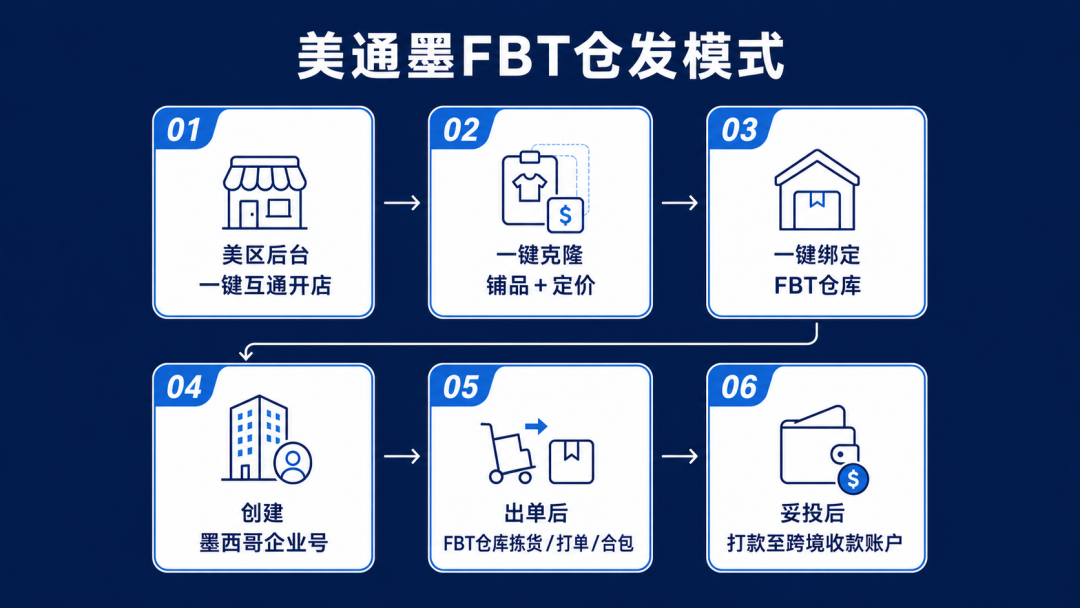
From a seller’s operational perspective, the FBT fulfillment model brings three main changes.
First, the approach to inventory use shifts. U.S. FBT stock can serve both the U.S. and Mexican markets, helping to reduce redundant inventory and the costs of managing stock across multiple locations.
Second, fulfillment is further consolidated. Sellers no longer need to handle separate order fulfillment processes for the U.S. and Mexico, allowing them to devote more energy to product selection, content, creator partnerships, and advertising.
Third, market validation becomes more flexible. Since FBT does not require a minimum shipment commitment, sellers can test Mexican demand with a selection of products first and then adjust subsequent investment and restocking plans based on actual sales performance.
Platform data shows that under the existing U.S. domestic FBT service, most orders can be delivered within three working days, and over 98% of orders are shipped within one calendar day. On the traffic side, many newly FBT-inducted products see average daily page views increase by over 40%, with average conversion rates rising by over 15%.
For sellers, the value of the FBT fulfillment model goes beyond simplifying fulfillment. Eligible products can also receive fulfillment labels such as “3-Day Delivery,” which will be displayed on product detail pages, checkout pages, short videos, live streams, the marketplace, and in search. These products gain corresponding recommendation and visibility support, while clear fulfillment information helps ease consumer concerns about delivery timeframes.
US-to-MX’s integration with FBT, in some respects, reshapes the cost structure of cross-market operations. Previously, serving both the U.S. and Mexico meant allocating separate resources across supply chain, logistics, after-sales service, and other areas—each link left little room for error. Now, the FBT US-to-MX model consolidates these scattered functions into a unified fulfillment foundation: goods shipped from U.S. FBT warehouses and received by Mexican consumers, with all intermediate fulfillment steps managed by the platform.
The operational chain is thus greatly simplified, and behind this simplification lies the potential to significantly reduce costs and free up profit margins.
Currently, the US-to-MX FBT fulfillment model only supports US-to-MX stores (US-MX). Sellers who have already opened direct-ship stores from China to Mexico will need to open a new store if they wish to use this model.
Thus, based on the current model design, the US-to-MX FBT fulfillment model is best suited for sellers who already hold inventory in the U.S., have some experience operating in the U.S. market, and want to validate Mexican demand on a small scale first.
03
Dual engine of content and marketplace
How long will Mexico’s window of opportunity remain open?
Mexico’s appeal lies in its “blue ocean” nature.
According to World Bank data, in 2023 the share of household final consumption in GDP varied notably among major global economies: Mexico around 70%, the U.S. around 68%, Indonesia around 54%, Europe around 52%, and China around 40%. From a cross-comparison perspective, Mexico significantly exceeds the global average. This means Mexico’s robust domestic demand and vibrant consumption atmosphere suggest that for cross-border sellers, products are more easily accepted by the market, and new categories can more readily follow a growth path from trial sales to scaling.
Looking at recent operational performance, the content e-commerce ecosystem in the Mexican market is accelerating its maturity. TikTok ranks among the top social media platforms in the country by user base, with extremely high penetration. Short videos and live streams excel at product demonstration, interest stimulation, and creator-driven seeding, while the marketplace, search, and product cards capture consumers’ more defined purchase needs. The content field and the marketplace field are gradually forming synergies, providing sellers with richer channels to reach local consumers.
For sellers, entering the Mexican market isn’t just about moving goods and inventory there. Content formats such as original short videos, stores’ own live streams, creator short videos, and creator live streams need to be combined based on team capabilities; when necessary, service providers and agencies can be leveraged to complete the initial cold start.
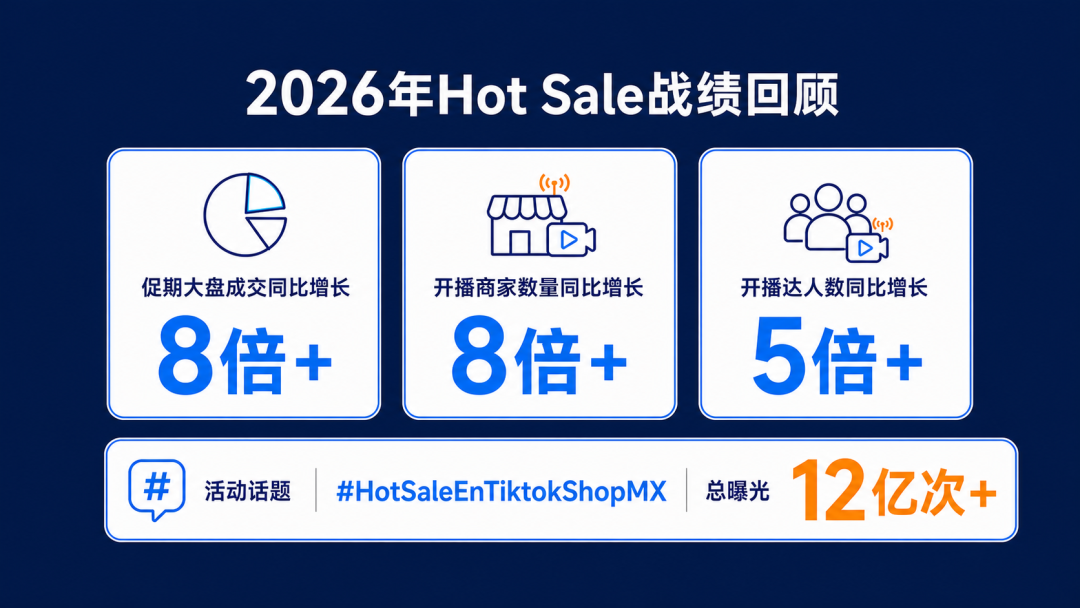
During Hot Sale, an important e-commerce promotion event in Mexico held in the first half of the year, TikTok Shop’s Mexico market recorded an over 8x year-on-year increase in GMV during the promotional period, with the number of live-streaming sellers growing more than 8x, the number of participating creators rising over 5x, and related topic exposure exceeding 1.2 billion.
From US-to-MX linking U.S. inventory with Mexican orders, to FBT further strengthening fulfillment, to the platform’s continuing investment in creators, content, advertising, and operational resources—the pathways for sellers to enter the Mexican market are becoming increasingly diverse.
Mexico won’t be a story of overnight riches, but as the market ecosystem continues to develop and operational supplements like US-to-MX keep improving, it is becoming an incremental market worth serious evaluation for more cross-border sellers.