 Yijia Overseas
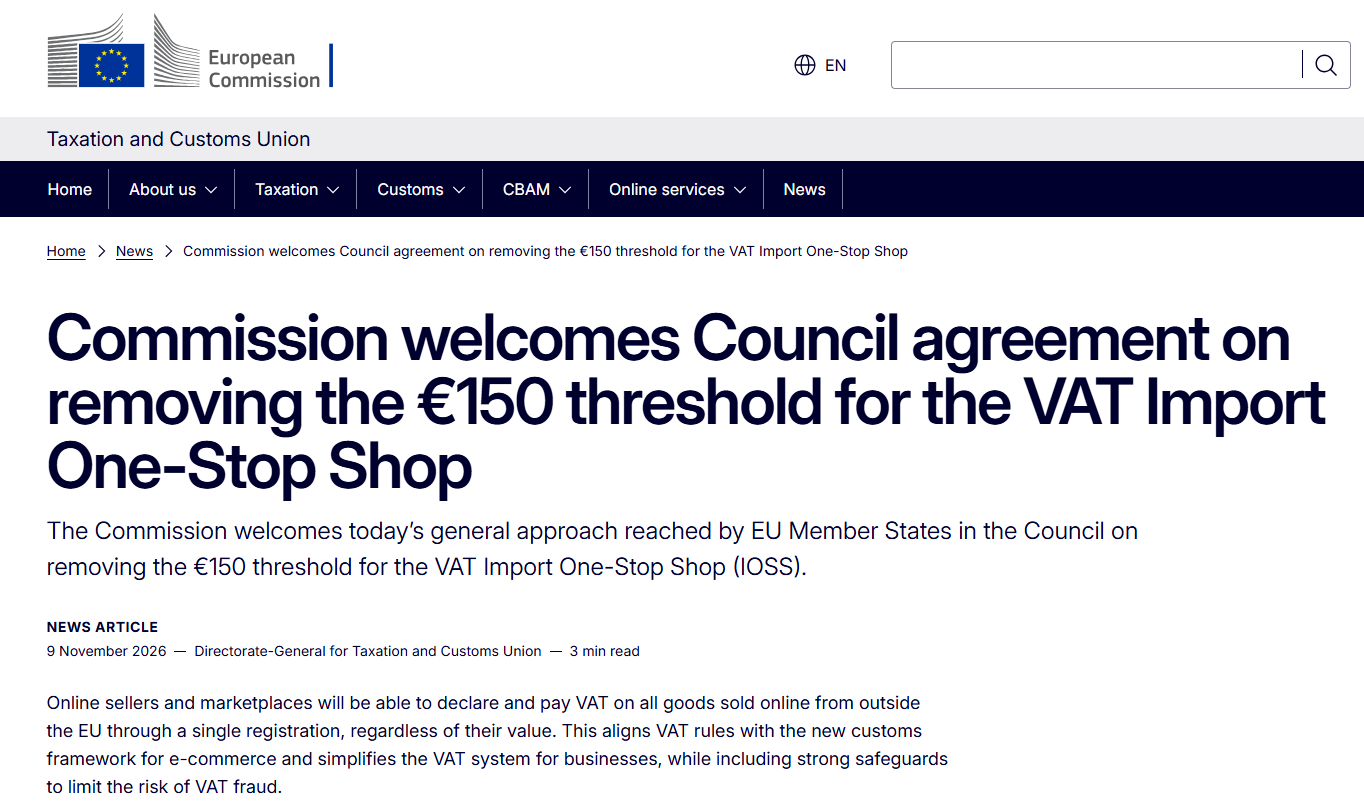
Recently, the European Commission announced that EU member states have reached a general approach on removing the €150 threshold for the Import One-Stop Shop (IOSS).
Under the new proposal, the IOSS will no longer be limited to imported goods valued at €150 or below; goods above that amount are also expected to be included in the unified declaration mechanism.
At the same time, e-commerce platforms’ VAT obligations will be further expanded, and cross-border e-commerce tax compliance requirements in Europe may see a new round of adjustments.
1. What is the IOSS and why is the EU removing the €150 threshold?
The Import One-Stop Shop (IOSS) is an EU mechanism designed to simplify VAT declaration and payment for imported goods in cross-border e-commerce.
Since 1 July 2021, the EU has abolished the low-value VAT exemption for imported goods, meaning all imported goods are in principle subject to VAT. To simplify tax handling for low-value cross-border e-commerce goods, the EU introduced the IOSS.
Previously, eligible sellers could use the IOSS to collect VAT from consumers at the point of sale and declare and pay it through a single EU member state, rather than registering for VAT separately in each consumer’s country merely because of relevant cross-border distance sales.
However, the IOSS previously applied mainly to imported goods with an intrinsic value not exceeding €150 per consignment. Goods above €150 had to be handled under other import VAT declaration and payment rules.
The removal of the €150 IOSS threshold is mainly intended to align VAT collection rules with the new EU customs reform and reduce the complexity of applying different declaration mechanisms to goods of different values.
2. What will change after the €150 IOSS threshold is removed?
1. The scope of the IOSS will be further expanded
Previously, the IOSS mainly applied to imported goods not exceeding €150.
After the new rules take effect, the IOSS will cover imported goods of different values and will no longer be restricted by the €150 threshold. Goods above €150 may also be handled under the IOSS for VAT declaration and payment in the future.
Note that goods subject to excise duty remain excluded from the scope of these rules.
2. E-commerce platforms’ VAT obligations will be further expanded
The reform also concerns the deemed supplier rules for platforms.
Previously, platforms meeting certain conditions had to assume VAT liability for some sales of imported goods they facilitated. After the new rules take effect, this responsibility will extend to sales of imported goods of different values.
In other words, platforms will need to cover not only goods at or below €150, but also relevant sales of goods above €150.
For sellers operating in Europe through platforms such as Amazon, Temu and SHEIN, the platforms’ tax handling mechanisms may be further adjusted.
3. Customs supervision will be further extended
The reform will also extend the IOSS to sales of goods from customs warehouses established for distance sales under the new Union Customs Code. In the future, even goods sold through such customs warehousing arrangements will be included in the new VAT supervision framework.
At the same time, the EU will further harmonise the eligibility criteria for intermediaries appointed by non-EU businesses to fulfil IOSS obligations and strengthen supervision of the VAT declaration and payment process.
3. Effective from 1 July 2028: what key dates should sellers watch?
According to the European Commission, the policy is expected to be rolled out in phases:
① 9 November 2026: EU member states reached a general approach in the Council on removing the €150 IOSS threshold.
② Subsequent legislative steps: The European Parliament will be consulted again on the text, after which the EU Council will formally adopt the relevant directive.
③ 1 July 2028: The new rules are planned to apply after the EU Customs Data Hub becomes operational.
④ 1 December 2030: The European Commission plans to review the operation of the IOSS mechanism, including the effectiveness of VAT collection.
Note that what has been published so far is the Council’s general approach, and the legislative process still needs to be completed. Sellers should therefore continue to follow the formal directive and implementing rules.
4. What preparations should cross-border sellers make now?
Although the new rules are planned for 2028, it is essential for cross-border sellers operating in the EU market to review their tax compliance in advance.
1. Check European VAT registration and filing status
Review the sales countries involved, VAT registrations and filing records to ensure consistency among goods sales, imports and tax declarations.
2. Understand the difference between the IOSS and regular import VAT
The IOSS is not a VAT registration method that all imported goods must use. Sellers should determine the applicable declaration mechanism based on product value, sales model, import route and platform tax arrangements.
3. Monitor platform VAT withholding policies
As platform deemed supplier responsibilities expand, sellers should monitor whether platforms adjust VAT collection, order tax information and related filing requirements, to avoid tax errors caused by misunderstanding the policies.
4. Plan European tax affairs in advance
Sellers operating in multiple European countries, using overseas warehouses or adopting different import models should review VAT registration, filing and import compliance requirements in advance to avoid future policy adjustments affecting normal operations.
Final note:
From the abolition of the low-value import VAT exemption in 2021, to the removal of the €150 customs duty exemption threshold in 2026, and now the planned removal of the €150 IOSS threshold, the EU is gradually improving its tax and customs supervision system for cross-border e-commerce imports.
Tax compliance requirements in the European market are becoming more detailed. Understanding VAT policies in advance, standardising tax filings, and reviewing import and sales chains will help businesses better respond to upcoming regulatory changes.
That is all from Yiju Overseas. Feel free to leave comments and discuss below!