 Seller's Home
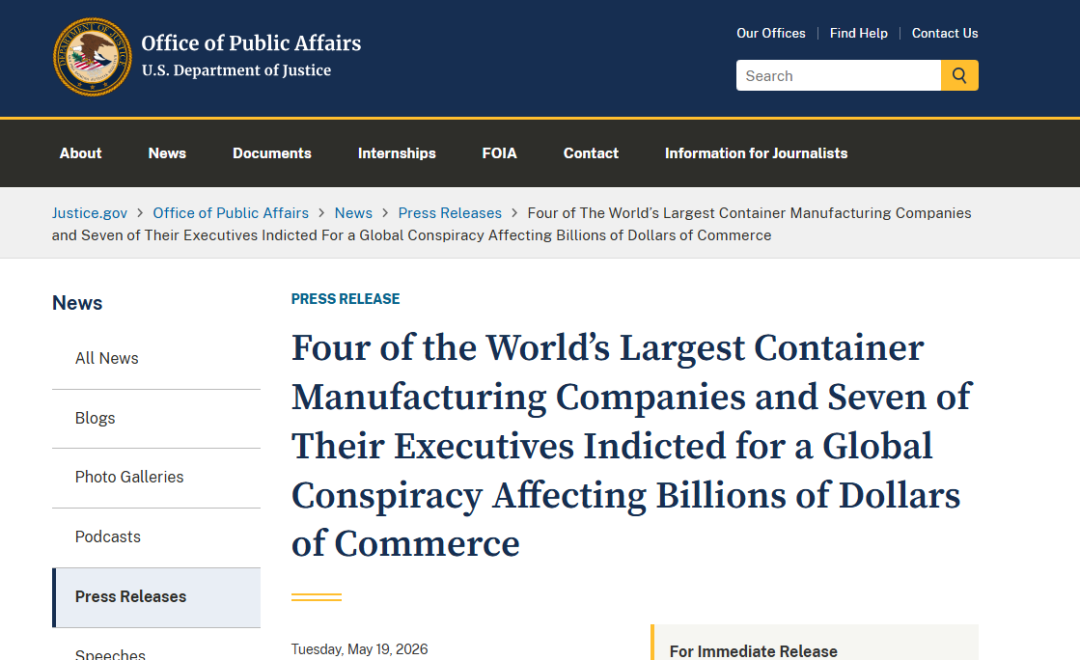
Recently, a piece of news has caused a sensation in the cross-border circle: the U.S. Department of Justice officially sued four Chinese container manufacturing giants on May 19, accusing them of conspiring to limit production to manipulate global container prices during the COVID-19 pandemic.
It is reported that these four companies control up to 95% of the global production of standard dry cargo containers.As soon as the news came out, some sellers said directly: "It seems that I know why I faced the situation of difficulty in getting a container and skyrocketing freight rates back then."
01
A "Container Monopoly Case" That Lasted for Years
According to the indictment statement issued by the U.S. Department of Justice, Zhong* Group, Sheng* Container, Shanghai** Logistics Equipment Co., Ltd. and Xinhua* Group Co., Ltd. conspired to cut container production from November 2019 to early 2024, thereby pushing up prices.
The department said: "This conspiracy that lasted for many years doubled the price of standard containers from 2019 to 2021, and during the COVID-19 pandemic and the global supply chain crisis, the profits of container manufacturers increased by about 100 times."
These four companies have not yet responded immediately to CNBC's request for comment.
The indictment cited internal company dialogues and emails, and also sued seven company leaders.
The U.S. Department of Justice said that several "conspirators" reached an agreement to limit production shifts, install surveillance cameras to monitor compliance, prohibit the construction of new factories, and impose fines on member companies that exceed the agreed production ceiling. According to the Justice Department, these companies produce a total of 95% of the world's standard non-refrigerated transport containers.
The indictment was filed in the Northern District of California federal district court in January this year and was unsealed by the U.S. government on Tuesday.
According to the U.S. Sherman Antitrust Act, the companies involved may face fines of up to 100 million U.S. dollars, and individuals may be sentenced to up to 10 years in prison and a fine of 1 million U.S. dollars. If the amount of criminal proceeds or victim losses is higher, the fine may even double.
02
Where Did the Extra Shipping Costs Paid by Sellers Go?
As soon as this news came out, the entire cross-border circle boiled, and sellers discussed it one after another:
"No wonder a container was speculated to nearly 20,000 U.S. dollars in 2021. We lost money on every order!"
"At that time, the freight forwarder said every day that there was a shortage of containers. I thought it was really the global supply chain collapse."
"The profits of those two years were all eaten by the freight. I dare not take orders, and if I take them, I can't send them out."
"Seeing the profits of container manufacturers double 100 times really broke me."
For Amazon sellers who have experienced maritime logistics during the pandemic, "sky-high freight rates" and "difficulty in getting a container" are unforgettable memories. On the trans-Pacific route, before the pandemic, the sea freight price of a 40-foot container from Ningbo Port in China to Los Angeles in the United States was only 1,000 to 2,000 U.S. dollars, but during the pandemic, this price once soared to 14,000 U.S. dollars, about 7 to 14 times that of normal years.
At that time, the industry generally explained that the surge in freight rates was generally attributed to multiple factors such as supply chain chaos, port congestion, and surge in demand caused by the pandemic. These are indeed important reasons. However, this indictment reveals that in a market environment where demand has already skyrocketed, upstream manufacturers are still limiting production and controlling quantity, further amplifying the price increase.
If monopoly manufacturers deliberately reduce container production, then the already fragile balance of shipping capacity in the global supply chain under the impact of the pandemic will be further broken. The shortage of containers directly leads to the soar of sea freight rates, and the high freight rates are ultimately transmitted to the logistics costs of every Amazon seller.
Although this suspected price manipulation behavior has ended in early 2024, its profound impact on the global maritime market has not disappeared. For Amazon sellers in 2026, logistics costs are still one of the core pressures of operation.
Data shows that in the past, logistics costs accounted for about 25% - 30% of the total cost of sellers, and now this figure has climbed to 35% - 40%. If the unit price of the product itself is low and the volume is large, the proportion of freight will directly exceed 50%, squeezing the already thin profit margin to almost nothing.
Although this news makes many sellers uncomfortable, in the long run, this lawsuit may not necessarily be a bad thing.If the case promotes judicial or regulatory rectification, the container pricing mechanism may become more transparent and predictable. For sellers, freight costs are more likely to tend to be stable and reasonable in the long run.
At the same time, sellers cannot only focus on Listing optimization and advertising in future operations, but also put more energy into supply chain management. They should not only look for cheaper or more stable freight forwarders, but also start to consider whether they need to build overseas warehouses, or even understand the pricing logic of the container industry, etc.
This case is still in the prosecution stage at present, and Sellers Home will continue to pay attention to the follow-up progress.
The relevant information in this article is for reference only and is not used as the basis for investment decisions