
 Cross-border information
As April begins, tax regulation in the cross-border e-commerce industry continues to intensify! Shenzhen has taken the lead in initiating the "first shot" of tax compliance rectification for freight forwarding.
In recent days, the Shenzhen Tax Bureau has issued tax inspection notices to multiple international freight forwarding companies within its jurisdiction. The content of the notice is as follows:
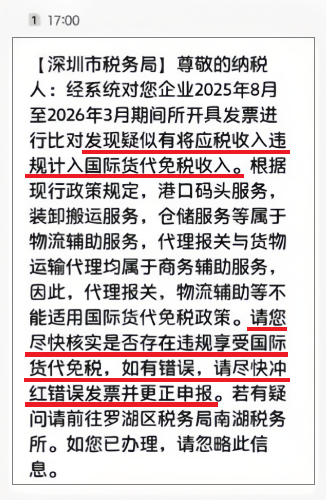
(Screenshot of the SMS sent by Shenzhen Tax Bureau)
According to the content of the SMS notice, Shenzhen Tax Bureau requires freight forwarders who receive the information to conduct a comprehensive self-inspection of their billing and declaration data from August 2025 to March 2026, and to pay full taxes on income that incorrectly enjoyed tax exemption.
As we all know, international freight forwarding services are exempt from value-added tax (VAT), which is a tax preference provided by the state for cross-border taxable activities.
However, the application of this preferential policy has strict boundaries. It only covers income directly from providing international freight forwarding services that can enjoy tax exemption, while supporting services such as customs declaration, warehousing, loading and unloading, and domestic transportation must be accounted for separately and taxed at a 6% rate.
This tax inspection in Shenzhen is precisely aimed at the long-standing issues of blurred policy boundaries and illegal tax exemption within the industry, with three core characteristics:
1. Long retrospective period and wide coverage
The inspection spans nearly 8 months, thoroughly plugging the loopholes through which freight forwarding companies have previously mixed taxable income into tax-exempt ranges via "bundled billing" and "mixed accounting." Past illegal operations will face systematic retrospective accountability.
2. Tightened accounting standards, business must be separated
The tax authorities explicitly require freight forwarding companies to strictly separate tax-exempt and taxable businesses, account for them separately, and issue invoices separately. If not clearly separated, all income will be treated as taxable, directly overturning the industry's traditional extensive "one-ticket" model.
3. Dual verification of funds + bills
Tax-exempt income must be settled through the corporate account of financial institutions, and companies must fully retain a complete set of documents including business contracts, transportation documents, payment vouchers, and customs declarations. Mismatches or missing information in the flow of funds, bills, and business will directly result in the loss of tax-exempt status.
Shenzhen Tax Bureau's inspection of freight forwarders is not an isolated incident.
Since last year, the national tax audit against the entire cross-border e-commerce industry has been continuously intensified. In addition to the logistics end, compliance risks at the seller and customs declaration ends have also erupted, with multiple typical cases serving as warnings to the industry.
On the cross-border seller side, concealing income and receiving payments through private accounts have become hotspots for audits.
At the beginning of 2026, Shenzhen, Xiamen, Yiwu, and other places successively investigated multiple cross-border e-commerce tax evasion cases. Many companies concealed cross-border sales revenue through private accounts, did not file tax returns, and were ultimately pursued for huge amounts of taxes, late fees, and fines. The legal representatives of the involved companies also faced legal accountability.
In the supporting links of cross-border logistics, illegal models such as "buying customs declarations" have been specifically targeted.
Some non-compliant freight forwarders evade taxes by underreporting cargo value, using others' tax numbers for customs clearance, and buying export declarations. Such behaviors are not only tax violations but also suspected of smuggling. Once discovered, the related shipments will face customs clearance delays, seizures, and penalties, affecting upstream and downstream enterprises.
For us cross-border sellers, the tax compliance of freight forwarders is directly related to our own operational stability and the safety of Amazon shipments, and it is by no means a trivial matter.
Because once the freight forwarder you cooperate with is investigated for tax violations, sellers are highly likely to be implicated and face multiple risks.
On the one hand, non-compliant invoices affect tax deductions and export tax rebates.
Non-compliant freight forwarders cannot provide compliant VAT invoices, which will prevent sellers from processing input tax deductions and export tax rebates normally, increasing operating costs. If your freight forwarder is found to have issued false invoices, the seller as the recipient will also be investigated and required to transfer input tax amounts and pay back taxes.
On the other hand, freight forwarder dishonesty triggers Amazon shipment risks.
Freight forwarders listed as high-risk by the tax authorities will have their goods monitored closely by customs and tax authorities. Shipments sent by sellers to Amazon are prone to customs clearance delays, detentions, or even seizures. If the freight forwarder breaks the capital chain or runs away due to tax issues, sellers are more likely to face the situation of losing both money and goods.
Therefore, under the trend of industry compliance, when choosing logistics partners, we sellers must not only look at prices but also prioritize tax compliance to avoid joint risks:
1. Carefully verify the qualifications and tax credit of freight forwarders.
Preferably choose companies with regular business licenses,general taxpayer status, no tax arrears or dishonest records. You can check their compliance through tax and credit public platforms, and give priority to considering AEO certification and customs advanced certified freight forwarders.
2. Clarify service separation, refuse vague billing.
Clearly distinguish international freight forwarding, customs declaration, warehousing, and other service contents and charges when signing contracts, and require freight forwarders to issue compliant invoices for tax-exempt and taxable businesses separately, eliminating "one-ticket coverage."
3. Pay attention to retaining complete business documents.
Retain the entire process of entrustment contracts, invoices, customs declarations, logistics trajectories, and other materials, regularly check three-stream consistency, and immediately terminate cooperation if you find illegal behaviors such as freight forwarders receiving payments through private accounts or incomplete documents.
This tax inspection of Shenzhen freight forwarders marks the cross-border e-commerce industry's complete departure from extensive growth and entry into an era of full-chain compliance.
Sellers can only ensure the stable transportation of Amazon shipments and operate steadily in a strict regulatory environment by choosing compliant freight forwarders and building a solid compliance defense line at the logistics end, avoiding significant losses due to minor issues.
End of Article!
-------------
Source: Cross-border Sellers' Concentration Camp