
 Amazon Global Store opening
In 2019, amid increasingly fierce domestic e-commerce competition and shrinking profit margins, Lanmen Trading Company turned its attention to overseas markets. After comprehensive consideration of volume, user base, and long-term development potential, this small and medium-sized trading company located in Luohe, Henan, chose to join Amazon and officially started its cross-border e-commerce business.
In the early stages of entrepreneurship, Lanmen Trading entered the market with a product-stocking model, mainly focusing on children's toys and household office supplies, accumulating experience and data through rapid product launches. However, as the business progressed, the team gradually realized the limitations of the stocking model in terms of energy consumption, profit structure, and account risks, and began to actively adjust their direction.
In recent years, Lanmen Trading has gradually shifted to boutique operations and introduced Amazon's paid seller services for both the US and European sites in 2025, hoping to support the company's steady growth in a multi-site, multi-market environment with more systematic and professional guidance.
In Luohe, Henan, there is no shortage of people doing business. There are factories, trading companies, and a group of small and medium-sized sellers who keep trying and adjusting their direction in the wave of cross-border e-commerce. Lanmen Trading is hidden on such an inconspicuous street.
The team is not large, the office is not new, but Amazon's page is always open on the computer screens. Compared to those star sellers with annual sales of tens of millions, it is more like the most common and real type in the cross-border industry: starting late, with a winding path, slowly reaching today through repeated choices.
A few years ago, their Amazon backend showed a typical early state of Chinese sellers: a considerable number of links, scattered categories, intense pace, and operations staff being occupied with new launches, maintenance, and order following every day. This is not uncommon; instead, it is the starting point most familiar to small and medium-sized sellers. However, Lanmen Trading's subsequent choices made this seemingly ordinary path possible to turn.

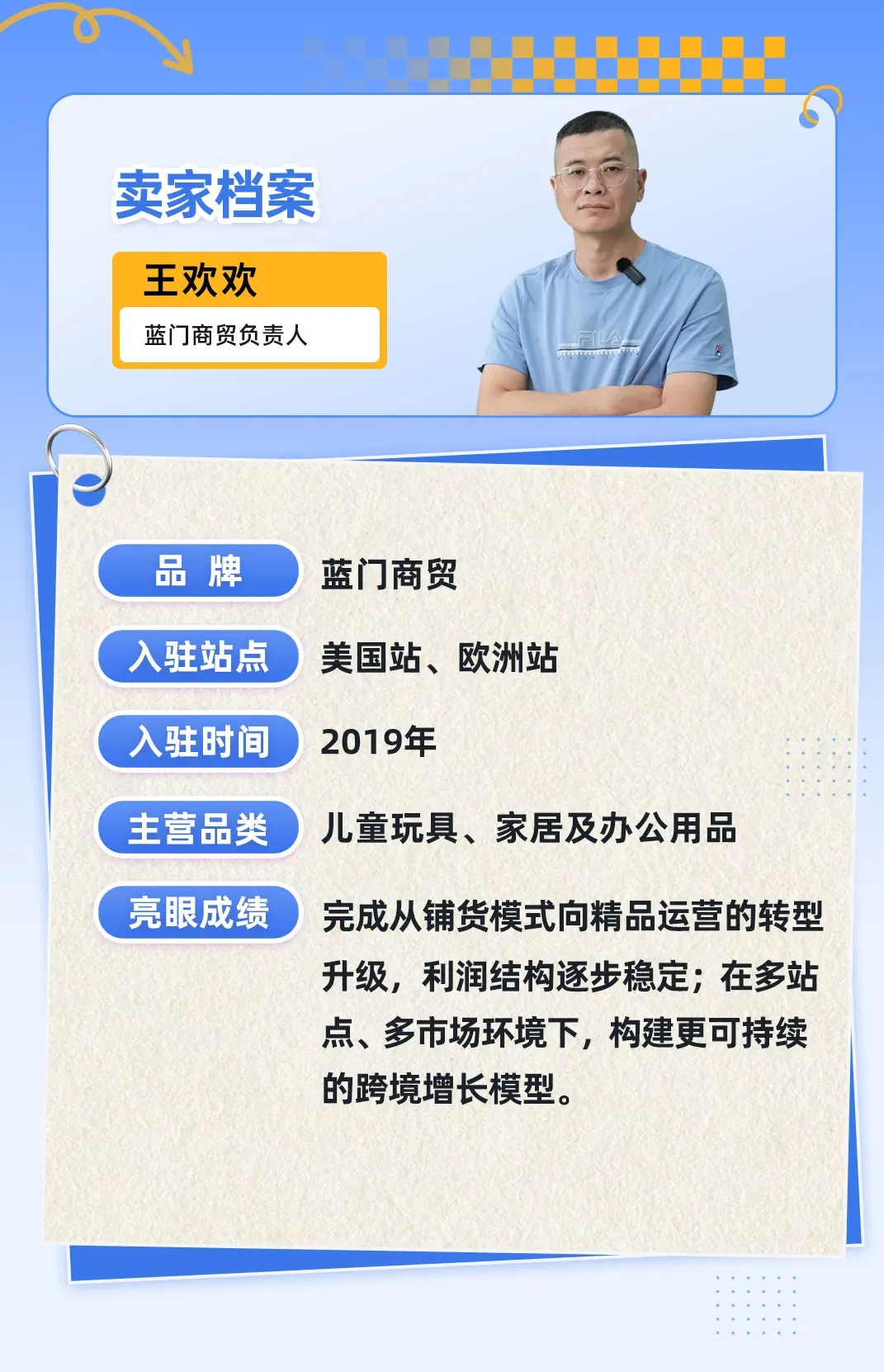
Lanmen Trading's entry into Amazon was not early. Wang Huanhuan, the person in charge, recalled that in 2019, when the company decided to try cross-border e-commerce, domestic market competition was already fierce, with price wars, channel involution, and continuously compressed profits being the real issues faced by the team. For him, going overseas was not a radical strategic leap but more like a choice pushed forward by reality.
 Wang Huanhuan, Person in Charge of Lanmen Trading
After comprehensive comparison, he finally chose Amazon. On the one hand, there was the certainty brought by the user scale, and on the other hand, the maturity and transparency of the rules provided this inexperienced team with a relatively stable testing ground. The initial product selection was also conservative, with children's toys, household items, and office supplies being categories with mature supply chains and clear demand.
At that stage, Lanmen Trading adopted a typical stocking model. With a large number of SKUs and rapid updates, the focus was on "constantly launching new products" and "maintaining survival." This model could indeed bring a certain order scale in the early stage, but as the volume grew, problems gradually emerged. Product maintenance costs remained high, team energy was fragmented, and the brand assets and profit margins that truly settled were limited.
In a review, the team began to systematically sort out inputs and outputs, re-evaluating the efficiency issues under the stocking model. The conclusion was not complicated but clear: Continuously piling up SKUs could not bring sustainable growth but instead amplified management and operational costs.
Subsequent adjustments were made, and Lanmen Trading decided to shrink its front, reduce ineffective links, and invest more time and resources in product quality, link maintenance, and brand perception. This meant shifting from "many and fast" to "few and refined," as well as a complete reconstruction of the operational logic.
Changes were not immediate. In the first few months, data fluctuations were significant, and order volume even declined at one point. But after about half a year, changes began to show, profit structure stabilized, user feedback became more concentrated, and the team's understanding of products and markets gradually deepened. More importantly, the boutique model made operations no longer just "firefighting" but had planning and rhythm.

What truly stabilized this transformation was another decision made by Lanmen Trading in 2025—joining Amazon's seller growth services for the US site. For a small and medium-sized seller who had already run through the basic model, this was not a necessary option, and even in the industry, it was often accompanied by hesitation and observation.
Lanmen Trading's motivation was not complicated. As the degree of boutique increased, issues such as account security, compliance risks, advertising structure, and product selection judgment became more specialized, and internal experience alone could hardly cover all details. What they needed was more systematic and rule-compliant guidance, not just fragmented information acquisition.

After joining the service, changes were first reflected in communication efficiency. Whether it was account issues or operational questions, they could directly connect with specific official exclusive consultants. A communication involving multiple issues impressed Wang Huanhuan: "The other party did not give a general reply but broke down the problems one by one, giving targeted suggestions combined with backend data and rules." This feeling of "being seen" is particularly important for small and medium-sized teams.
At the specific execution level, the support provided by Amazon's seller growth services official exclusive consultants was not limited to one module but covered multiple key links of boutique operations. Listing optimization was no longer just simple image updates but systematically sorted out around A+ content, keyword layout, and attribute filling, making the link itself have a stronger conversion foundation.
Adjustments to the advertising structure were equally important. Through negative word settings and search term optimization, Lanmen Trading gradually compressed ineffective traffic, concentrating the budget on keywords and scenarios with more conversion potential. Advertising was no longer just "spending money for exposure" but became an efficiency tool that could be continuously optimized.
The introduction of AI tools gave the team more room for imagination for the future. From image generation to advertising analysis, to trying new features like Rufus, these tools became aids to improve efficiency and judgment. For small teams with limited manpower, this leverage effect is particularly evident.
If the boutique of the US site was an active transformation, then the promotion of the European site was more like a test pushed forward by complexity. Compared to the US market, the European site has a larger volume but more countries and more fragmented policies. Different countries' compliance requirements, tax rules, and policy update frequencies pose higher requirements for account security.

Wang Huanhuan did not describe this experience as some kind of "success secret." Instead, he preferred to see it as a phased choice verification. In his view, the seller growth service cannot replace the seller's own judgment and execution, but at key nodes, it can indeed reduce the cost of trial and error, allowing the team to focus their energy on more important things.
There are no exaggerated data or dramatic turns. Wang Huanhuan's experience is more like a true microcosm of many domestic small and medium-sized sellers: finding direction in changes and adjusting rhythms through repeated trials. They are not eager to go faster but hope that each step is more certain.
As cross-border e-commerce moves from a dividend period to a refined competition stage, what really widens the gap is often not the amount of resources but whether there is a willingness to pay patience and costs for long-term capacity building. Perhaps this is exactly where Lanmen Trading's story is most worth recording. It has no grand narrative but is real enough; it has no standard answer but provides a reference sample for later comers. Being able to walk steadily on the road overseas is itself a rare ability.
If you have any questions about Amazon, you can use the link ( https://wsurl.cc/wg4chn) or scan the code to contact the official customer development manager: