 Cross-border e-commerce Hugo.com
Recently, the cross-border logistics industry and some social media have been discussing an issue regarding the U.S. Customs and Border Protection (CBP) initiating a special document review operation codenamed "5H". Thousands of containers have been detained due to declaration document issues, and some will face the risk of forced return.
According to discussions among some sellers, this operation is led by the newly established Fast Doc Review department of U.S. Customs, codenamed "5H" (also referred to as H5 by sellers). Unlike traditional container inspections, 5H inspections are more about "document review first, physical inspection later". Once selected, the goods will have their processes completely suspended at the port.
Specifically, according to industry insiders, this department mainly uses a combination of system screening and manual review to conduct in-depth reviews of import declaration materials, focusing on verifying whether the declared value is reasonable, the product description is accurate, the HS code matches, and whether the importer's qualifications are compliant — including but not limited to requiring importer representatives/legal entities to complete identity verification, non-U.S. citizens to present legal status and work authorization in the U.S., and verifying identity documents beyond passport information and other key elements.
Once it is determined that the "right to enter" is not met, the container will be directly refused release and required to be returned within 30 days, emphasizing that the return must be conducted under CBP supervision, and the costs of inspection fees, storage fees, etc., must be borne. This "zero tolerance" attitude has caught many Chinese sellers and freight forwarders off guard.
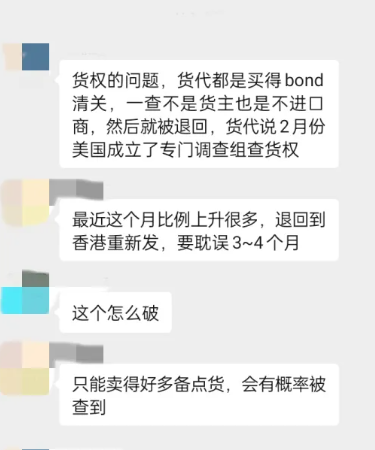
According to some freight forwarders and sellers, once the container arrives at the port, it is marked as "Entry Processing Hold", the system status is frozen, and it cannot be picked up or transshipped. At this point, costs such as port storage fees, demurrage fees, and detention fees begin to accumulate continuously. Some small and medium-sized sellers admit that just a few days of detention fees can reach thousands or even tens of thousands of dollars, and if ultimately forced to return, they will also have to bear high return shipping costs and related processing fees. For cross-border e-commerce companies with already thin profit margins, this is undoubtedly a heavy blow.
From the current feedback, the core reasons for triggering 5H inspections are concentrated in several aspects.
First is the issue of declared value. Some companies adopt a low-declaration strategy when customs declaration to reduce tariff costs, but in the current highly digitalized regulatory environment, the customs system can compare historical transaction data, market prices of similar products, and past declaration records of importers. Once a significant deviation is found, it may be judged as a risk anomaly.
Secondly, mismatch between product name and code. Some companies use more general product descriptions to simplify processes or due to operational habits, leading to inaccurate HS code classification. Such "vague declarations" become high-risk factors. In addition, issues such as insufficient importer guarantee limits and incomplete qualification information will also directly affect the customs clearance results.
Sellers suggest that if the shipment has been marked for H5 inspection, confirm the feasibility of customs clearance with the freight forwarder as soon as possible; if it is determined that it cannot pass, do not delay and immediately initiate the return process to avoid daily accumulation of port fees and storage fees, the longer the delay, the greater the loss.
If not shipped, complete the pre-shipment document review with the freight forwarder before shipping to ensure that the declaration data, invoices, packing lists, and qualification information are true, complete, and consistent; resolutely refuse the freight forwarder's suggestion of extremely low declared value to avoid triggering inspections for small gains.
02
Just as U.S. customs are conducting strict inspections of export documents, a recent report by foreign media seems to clearly echo the "5H" inspection operation initiated by U.S. customs.
Recently, according to a report by foreign media "Bloomberg", there is a gap of up to 112 billion dollars between China's export data to the United States and the actual records of U.S. customs. This means that as much as a quarter of the goods shipped from China to the United States last year may have bypassed the U.S. tariff regulatory system in some way.
Foreign media also pointed out that there are various "fancy tax avoidance" methods behind this tariff loophole, among which the most representative is the so-called "dual clearance and tax-inclusive" scheme. Some Chinese cross-border logistics companies openly promise to shippers that the all-inclusive cost from China to the United States can be as low as $0.70 per kilogram and is "tax-inclusive". However, Ryan Petersen, CEO of the American logistics giant Flexport, stated outright that import duties are usually calculated based on the value of the goods, not weight, and this kind of "tax-inclusive" billing model based on weight is itself a typical signal of tariff fraud.
What's more, some logistics service providers directly promise customers to "share tariff risks", claiming to help customers save 40% to 50% of costs, which is often accompanied by under-declaration of value, incorrect classification of goods, and even the use of shell companies as nominal importers and other illegal operations.
Therefore, the current strict 5H inspection is essentially a "net mending operation" targeting these 112 billion dollars of lost tax revenue, attempting to completely clear out those supply chains that rely on "under-declaration" for survival by blocking containers with inaccurate documents and flawed qualifications.
For sellers, the past reliance on under-declaration of value, vague declarations, or "tax-inclusive transportation" gray operations is being gradually eliminated. In the future, if sellers want to remain competitive on the U.S. line, they must improve the transparency of declarations and the standardization of documents to ensure that compliance certifications are complete. Otherwise, they may not only face the direct loss of container return but may also face more severe penalties for suspected tariff fraud.